


Bun is the complete toolkit for building and testing full-stack JavaScript and TypeScript applications. If you're new to Bun, you can learn more from the Bun 1.0 blog post.
curl
curl -fsSL https://bun.sh/install | bashpowershell
powershell -c "irm bun.sh/install.ps1 | iex"npm
npm install -g bunbrew
brew install oven-sh/bun/bundocker
docker pull oven/bunBun 1.4 adds +1,517 tests from the Node.js test suite - our biggest jump in Node.js compatibility since Bun 1.0. Bun v1.4 also fixes over 2,900 issues. It reduces idle CPU usage by 5x, reduces memory usage by up to 35%, and starts 50% faster on Linux. It adds Bun.Image, Bun.WebView, Bun.markdown, Bun.cron(), Bun.Terminal, bun run --parallel, bun test --parallel, bun audit fix, bun dedupe, and bun prune. And it rewrites Bun from Zig to Rust.
This post covers everything we've shipped since Bun 1.3.0 (with new to Bun v1.4 tagged).
To upgrade:
bun upgradeNode.js compatibility#
Bun is designed to be a drop-in replacement for Node.js. We've added +1,517 tests from the Node.js test suite to run on every commit of Bun.
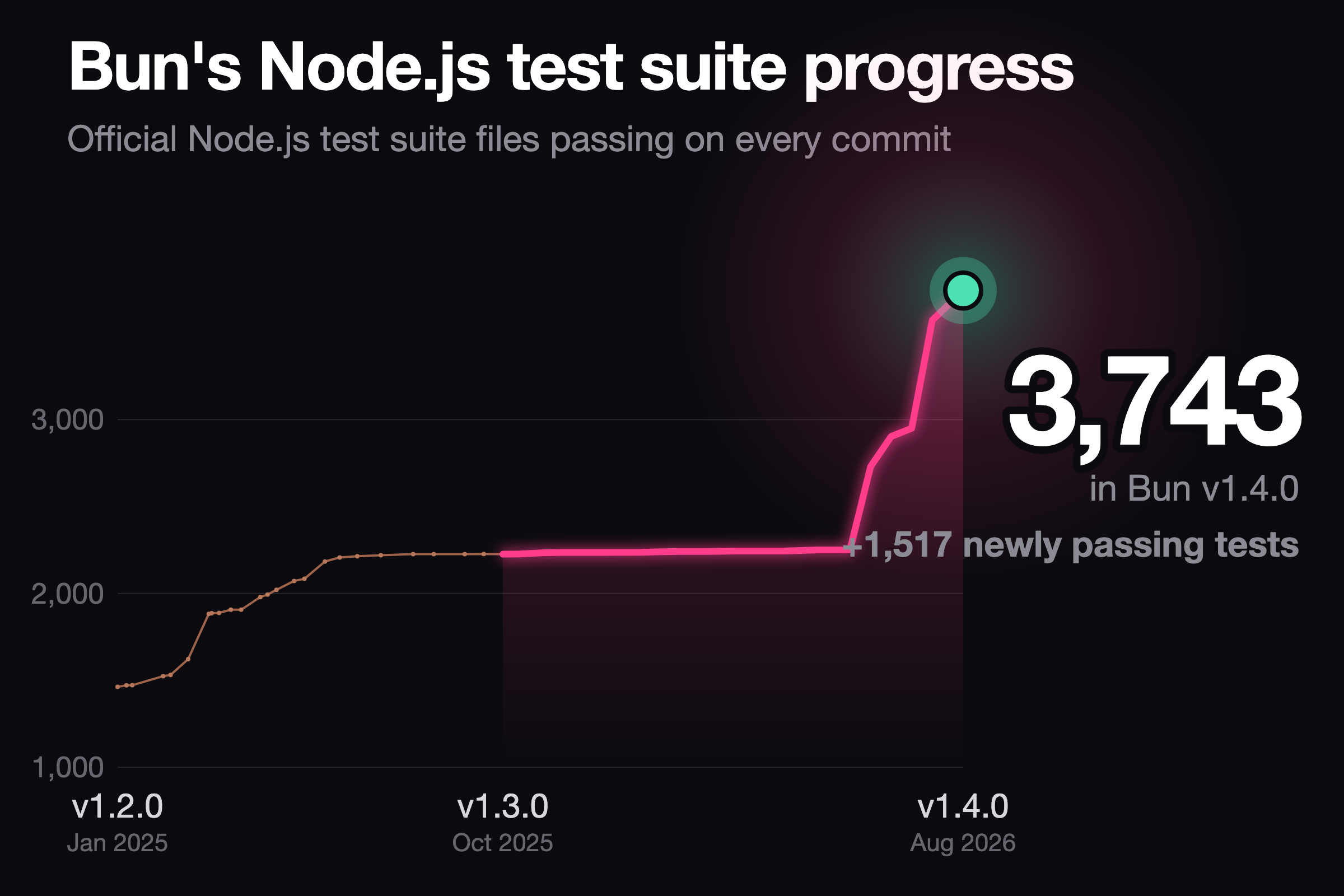
node:http, node:fs, node:cluster, node:timers, node:zlib, node:vm, and node:stream pass 97% of Node's own tests; node:quic 99%; node:events, node:trace_events, and node:sqlite 100%.
test/parallel suite, Bun 1.3 → 1.4. The tick marks the 1.3 baseline.Bun is not 100% compatible with Node.js yet. In practice, much of the existing JavaScript ecosystem just works. You can more closely track Bun's Node.js test suite progress here.
Playwright v1.4.0#
Playwright now runs on Bun: drive a browser with connectOverCDP(), run your suite with playwright test and a playwright.config.ts, open --ui, and launch Chromium on Windows.
Next.js 16 v1.3.2#
bun --bun next build works on Next.js 16.3 with Turbopack and the React Compiler.
vitest v1.4.0#
vitest runs under Bun, including --coverage, with the threads and forks pools.
OpenTelemetry v1.4.0#
OpenTelemetry's http and fs instrumentation export spans, and shimmer and require-in-the-middle patch bundled code.
dd-trace v1.4.0#
dd-trace traces and @datadog/pprof profiles continuously; the V8 C++ APIs they link against are implemented.
Additional Node.js compatibility improvements#
Every day, Bun gets closer to 100% Node.js compatibility. More packages now work in Bun without changes:
- Nuxt:
nuxt devconnects HMR and the Nuxt DevTools. - testcontainers and dockerode:
container.exec()works. - https-proxy-agent and socks-proxy-agent:
http.request()tunnels through them. - crawlee: crawls through
proxy-chain. - @grpc/grpc-js and ConnectRPC: servers behind Envoy and clients behind AWS ALB work.
- amqplib: connects to RabbitMQ.
- @aws-sdk/client-s3: streaming uploads work.
- TypeORM: starts with the decorator settings in your
tsconfig.json. - nock: intercepts
httpandhttpsrequests. - Fastify
inject()and light-my-request: work. - happy-dom: no longer breaks
console.log. - piscina: runs.
New Node.js APIs in Bun:
worker_threads:resourceLimits,stdout,stderr, andevaloptions.- ws:
'upgrade'and'unexpected-response'events. socket.upgradeTLS({ isServer: true }): server-side STARTTLS.node:cluster: shares listening sockets between workers.node:repl,node:trace_events,node:domain: implemented.
Production#
Bun v1.4 uses less memory, less CPU, and starts faster.
Until Bun v1.4, Bun used two memory allocators - JavaScriptCore's libpas allocator and mimalloc. JavaScriptCore in Bun now uses mimalloc (improving memory reclamation), and we've extended mimalloc with features like partial page clearing, a scavenger thread that frees memory while JavaScript idles, and improved lazy zeroing.
CPU usage#
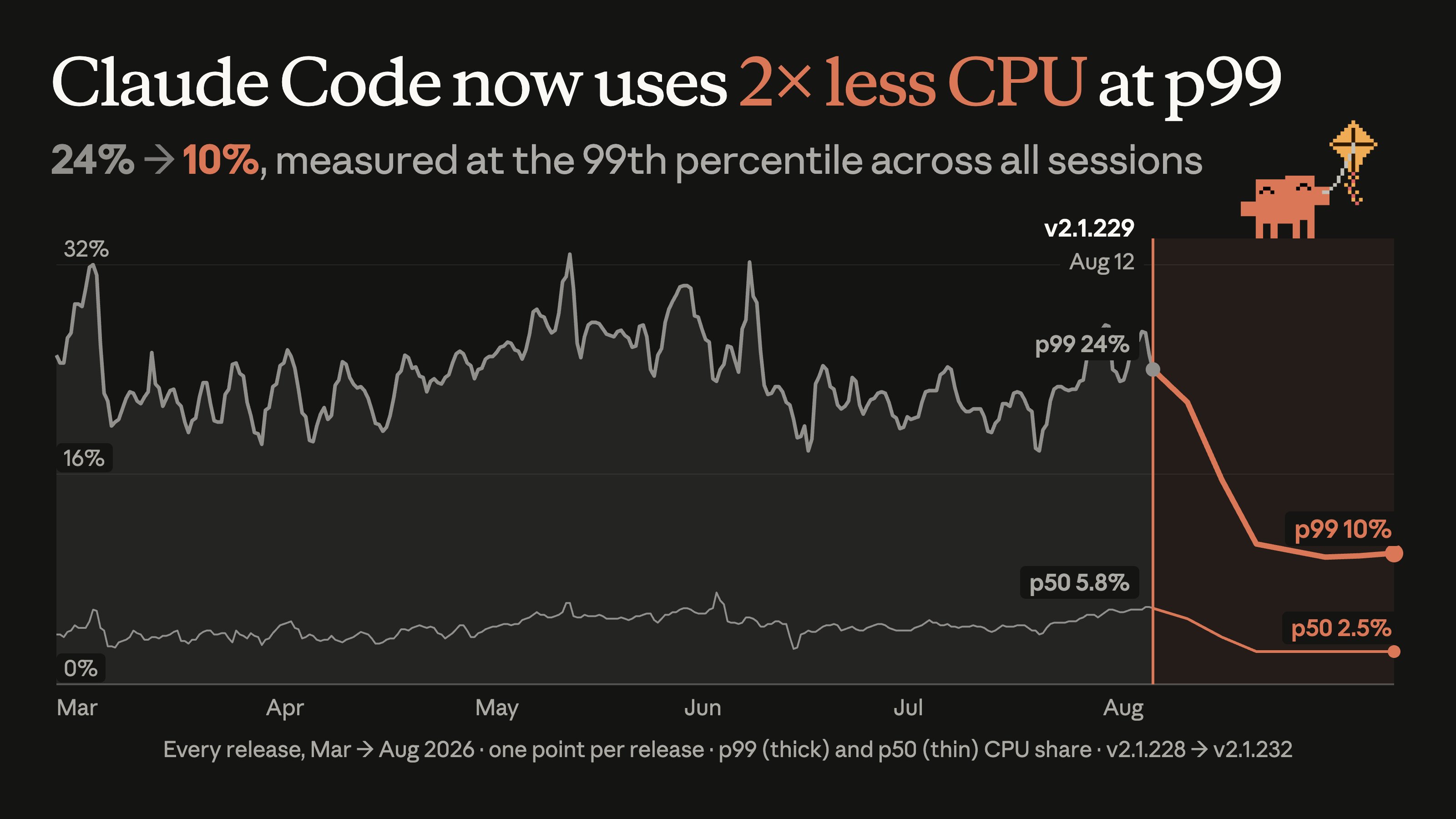
For Claude Code, a large long-running application built on Bun, production CPU usage dropped by 2×: p99 from 24% to 10%, p50 from 5.8% to 2.5%.
For a small "hello world" app, idle CPU usage drops by 5x.
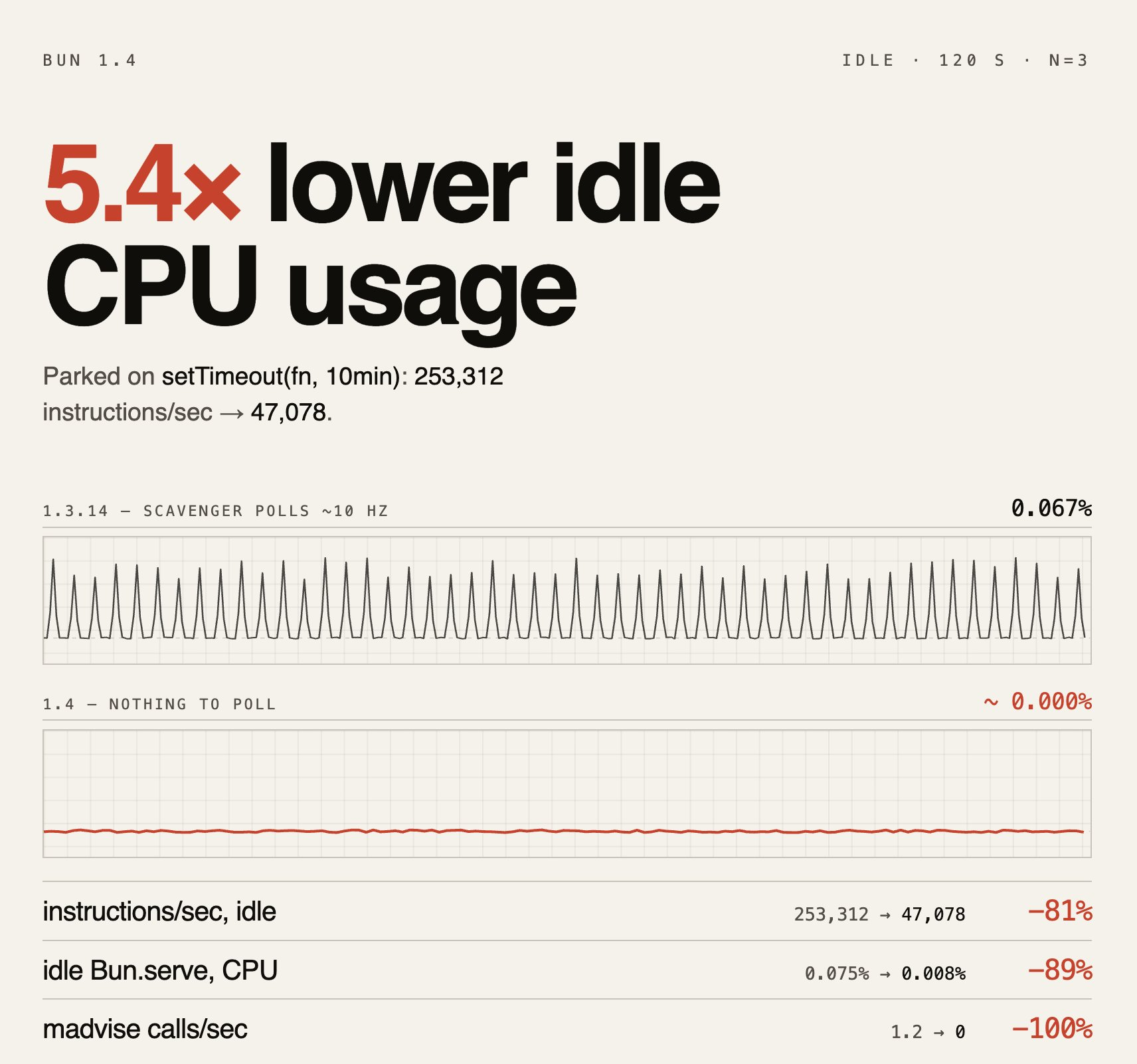
We did this by optimizing when garbage collector timers request a GC, switching how JavaScriptCore visits Strong roots from a linked list to a linked list of segmented arrays, and reducing the number of futex calls, along with the mimalloc changes mentioned earlier.
Memory usage#
Applications using HTTP servers with Bun should see a 13% - 48% memory usage reduction.
Peak memory under load (1,000,000 requests with 64 connections; 100,000 for Next.js and Vite):
| Server | Bun 1.4 | Bun 1.3 | Node.js 26 | Δ vs Bun 1.3 |
|---|---|---|---|---|
| fastify | 120 MB | 233 MB | 156 MB | −48% |
| Express | 92 MB | 169 MB | 145 MB | −46% |
node:http | 81 MB | 135 MB | 107 MB | −40% |
| Elysia | 55 MB | 91 MB | n/a | −40% |
| Next.js | 285 MB | 397 MB | 342 MB | −28% |
Bun.serve | 36 MB | 45 MB | n/a | −20% |
| Vite dev server | 233 MB | 268 MB | 214 MB | −13% |
Server-side rendering with Next.js gets a bigger reduction. On a common App Router pattern that grew without bound in 1.3 (React.cache + no-store fetch in a dynamic route), Bun 1.4 settles at 238 MB over 4,000 pages, under Node's 410 MB.
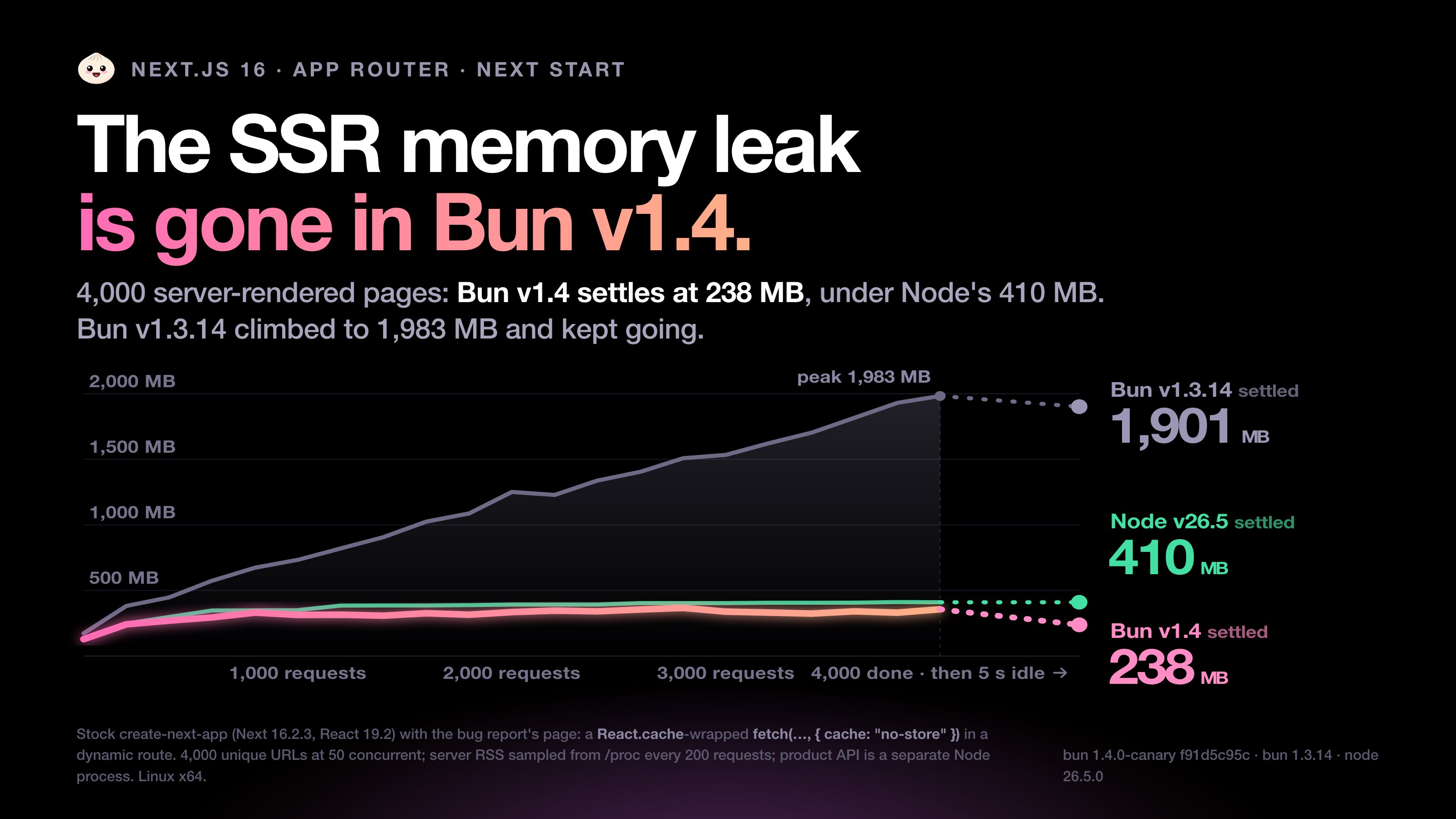 Next.js App Router SSR, 4,000 pages: Bun 1.4 settles at 238 MB, under Node's 410 MB.
Startup#
On Windows, Bun starts 2.5× faster.
hello.js on Windows | Bun 1.4 | Bun 1.3.14 | Node.js 26 |
|---|---|---|---|
| Startup time | 15.5 ms | 39.0 ms | 40.1 ms |
| Peak memory | 16.8 MB | 46.5 MB | 32.5 MB |
On Linux, Bun starts 2× faster and uses less than half the memory.
hello.js on Linux | Bun 1.4 | Bun 1.3 | Node.js 26 |
|---|---|---|---|
| Startup time | 5.1 ms | 10.9 ms | 27.2 ms |
| Peak memory | 14.6 MB | 33.0 MB | 44.5 MB |
Binary size#
On Linux and Windows, Bun gets up to 17% smaller.
| Bun 1.4 | Bun 1.3.14 | |
|---|---|---|
| Linux x64 | 77.0 MB | 88.5 MB |
| Linux arm64 | 76.8 MB | 87.6 MB |
| Windows x64 | 84.8 MB | 93.9 MB |
| Windows arm64 | 75.1 MB | 90.2 MB |
| macOS arm64 | 61.2 MB | 60.2 MB |
| macOS x64 | 66.6 MB | 66.0 MB |
macOS binaries are about 1 MB larger.
Observability#
The tools you already use work with Bun 1.4.
bun --cpu-profwrites a.cpuprofile. Open it in Chrome DevTools or VS Code.bun --heap-profwrites a V8-compatible.heapsnapshot. Open it in Chrome DevTools.node:inspector: aSessioncan start and stop a CPU profile while the app runs, withProfiler.startandProfiler.stop. #25939- Datadog:
dd-tracetraces requests and@datadog/pprofprofiles CPU continuously. #36747 - OpenTelemetry: the
@opentelemetry/instrumentation-httpand@opentelemetry/instrumentation-fspackages from npm work withnode:httpandnode:fsin Bun. Theshimmerandrequire-in-the-middlepackages they depend on can patch bundled code. - Async stack traces: an error from
fs.promises,fetch(), S3, DNS, or crypto points at theawaitin your code, not at native frames.
Some of it is new in Bun.
--cpu-prof-md
--cpu-prof-md writes a CPU profile as Markdown, so you can find the hot function from a terminal: the top functions by self time, the call tree, and who calls whom. Read it over SSH, grep it, paste it into a bug report, or hand it to an LLM.
BUN_CPU_PROFILE=1 turns on the CPU profiler for a process you cannot pass flags to, like a worker started by a framework.
--heap-prof-md
--heap-prof-md writes a heap profile as Markdown, so you can find what is holding memory from a terminal: total size, the types that retain the most, the largest objects, and the chains that keep them alive.
bun build --metafile-md
bun build --metafile-md writes the bundle analysis as Markdown, so you can see why a bundle is big: the largest modules, what each entry point loads, and the chain of imports that pulled each file in.
process.on("memoryPressure")
When the operating system is running low on memory, it notifies Bun, and Bun emits "memoryPressure" on process. Use it to free memory before the OS kills your process: clear a cache, close idle connections, stop idle workers. It works on macOS, Linux, and Windows.
process.on("memoryPressure", (level) => {
  cache.clear();
  pool.drainIdle();
});- macOS:
kqueuewithEVFILT_MEMORYSTATUS, the same event libdispatch uses forDISPATCH_SOURCE_TYPE_MEMORYPRESSURE.levelis"warning"or"critical". - Linux: a PSI trigger written to
/proc/pressure/memory(or the cgroup'smemory.pressure), watched withepollforEPOLLPRI.levelis"critical". - Windows:
CreateMemoryResourceNotification(LowMemoryResourceNotification), waited on withRegisterWaitForSingleObject.levelis"critical".
Streams and bodies#
ReadableStream, WritableStream, and TransformStream are now native. They use less memory, run faster, and pass 100% of the Web Platform Tests.
Four pipelines, each moving 64 MB in 4 KB chunks:
- Download:
fetch()→DecompressionStream("gzip")→TextDecoderStream→for await - Upload:
fs.createReadStream()→CompressionStream("gzip")→fetch()POST body - Transcode:
fs.createReadStream()→TextDecoderStream→TextEncoderStream→fs.createWriteStream() - Subprocess:
fetch()body →catstdin, thencatstdout →for await
Throughput:
| Pipeline | Bun 1.4 | Bun 1.3 | Node.js 26 | Deno 2.9 |
|---|---|---|---|---|
| Download | 1,519 MB/s | n/a | 204 MB/s | 530 MB/s |
| Upload | 179 MB/s | n/a | 78 MB/s | 137 MB/s |
| Transcode | 132 MB/s | 116 MB/s | 52 MB/s | 91 MB/s |
| Subprocess | 751 MB/s | 505 MB/s | 256 MB/s | 170 MB/s |
Peak memory:
| Pipeline | Bun 1.4 | Bun 1.3 | Node.js 26.7 | Deno 2.9 |
|---|---|---|---|---|
| Download | 57 MB | n/a | 86 MB | 64 MB |
| Upload | 60 MB | n/a | 84 MB | 61 MB |
| Transcode | 62 MB | 92 MB | 72 MB | 57 MB |
| Subprocess | 65 MB | 207 MB | 106 MB | 114 MB |
All four runtimes run the same script. The file streams use Readable.toWeb() and Writable.toWeb() from node:stream. Bun 1.3 is missing CompressionStream and DecompressionStream, so those rows are n/a.
Benchmark code: native-pipeline.mjs and serve-body.mjs
// End-to-end pipelines between native stream types (fetch body, DecompressionStream, TextDecoderStream,
// file streams via node:stream Readable/Writable.toWeb, child_process pipes). Portable: Bun, Node, Deno.
// Run: <runtime> native-pipeline.mjs --scenario=prep                       (writes the 64 MiB fixture files once)
//      <runtime> native-pipeline.mjs --scenario=download-gunzip-decode --server=http://127.0.0.1:39872
//      <runtime> native-pipeline.mjs --scenario=file-gzip-upload --server=http://127.0.0.1:39872
//      <runtime> native-pipeline.mjs --scenario=file-decode-encode-file
//      <runtime> native-pipeline.mjs --scenario=spawn-passthrough --server=http://127.0.0.1:39872
// Server: `bun run serve-body.mjs --gzip`. 64 MiB payloads/files, 4 KiB chunks end to end. Wrap in /usr/bin/time -v for peak RSS.
import fs from "node:fs";
import { Readable, Writable } from "node:stream";
import { spawn } from "node:child_process";

const MB = 1024 * 1024;
const CHUNK = 4096;
const BYTES = 64 * MB;
const argv = globalThis.process?.argv ?? [];
const arg = (k, d) =>
  argv.find((a) => a.startsWith(`--${k}=`))?.slice(k.length + 3) ?? d;
const scenario = arg("scenario", "prep");
const server = arg("server");
const dir = arg("dir", "/tmp/native-pipeline");
const JSON_FILE = `${dir}/json-64mb.txt`;
const UTF8_FILE = `${dir}/utf8-64mb.txt`;
const OUT_FILE = `${dir}/out-${scenario}.txt`;

const jsonTemplate = new TextEncoder()
  .encode(
    JSON.stringify({
      messages: Array.from({ length: 700 }, (_, i) => ({
        id: i,
        role: i % 2 ? "assistant" : "user",
        ts: 1700000000 + i,
        body: "the quick brown fox jumps over the lazy dog " + i,
      })),
    }),
  )
  .slice(0, CHUNK);
const utf8Text = (
  "hello world \u{1F30A} stream ✨ café naïve 中文 " + "x".repeat(40)
).repeat(2000);
const utf8Template = new TextEncoder().encode(utf8Text).slice(0, CHUNK);
// Keep the UTF-8 fixture valid at 64 KiB chunk boundaries: cut the template at a char boundary.
const utf8Chunk = (() => {
  let end = utf8Template.byteLength;
  while ((utf8Template[end - 1] & 0xc0) === 0x80) end--;
  if (end < utf8Template.byteLength) end--; // drop the lead byte of the truncated char too
  return utf8Template.slice(0, end);
})();

const countBytes = async (rs) => {
  let n = 0;
  for await (const v of rs)
    n += typeof v === "string" ? v.length : v.byteLength;
  return n;
};

async function prep() {
  fs.mkdirSync(dir, { recursive: true });
  const write = (path, template, varyByte) => {
    if (fs.existsSync(path) && fs.statSync(path).size === BYTES) return;
    const fd = fs.openSync(path, "w");
    let written = 0,
      i = 0;
    const buf = new Uint8Array(template.byteLength);
    while (written < BYTES) {
      buf.set(template);
      if (varyByte) buf[0] = 32 + (i++ & 63);
      fs.writeSync(fd, buf);
      written += buf.byteLength;
    }
    fs.closeSync(fd);
    console.log(`wrote ${path} (${(written / MB).toFixed(0)} MiB)`);
  };
  write(JSON_FILE, jsonTemplate, true);
  write(UTF8_FILE, utf8Chunk, false);
}

const scenarios = {
  // fetch(gzip body) -> DecompressionStream -> TextDecoderStream -> for await (count chars). MB/s over decompressed bytes.
  "download-gunzip-decode": async () => {
    const res = await fetch(`${server}/gzip`);
    const expected = +res.headers.get("x-uncompressed-length");
    const chars = await countBytes(
      res.body
        .pipeThrough(new DecompressionStream("gzip"))
        .pipeThrough(new TextDecoderStream()),
    );
    if (chars !== expected)
      throw new Error(
        `decoded ${chars} chars, expected ${expected} (ASCII payload)`,
      );
    return expected;
  },
  // fs.createReadStream(64 MiB, 4 KiB reads) -> CompressionStream -> fetch POST body; server returns bytes received. MB/s over input bytes.
  "file-gzip-upload": async () => {
    const body = Readable.toWeb(
      fs.createReadStream(JSON_FILE, { highWaterMark: CHUNK }),
    ).pipeThrough(new CompressionStream("gzip"));
    const res = await fetch(`${server}/upload`, {
      method: "POST",
      body,
      duplex: "half",
    });
    const received = +(await res.text());
    if (!(received > 0 && received < BYTES))
      throw new Error(`server received ${received} bytes`);
    return fs.statSync(JSON_FILE).size;
  },
  // fs.createReadStream(64 MiB utf-8, 4 KiB reads) -> TextDecoderStream -> TextEncoderStream -> fs.createWriteStream. MB/s over file bytes.
  "file-decode-encode-file": async () => {
    await Readable.toWeb(
      fs.createReadStream(UTF8_FILE, { highWaterMark: CHUNK }),
    )
      .pipeThrough(new TextDecoderStream())
      .pipeThrough(new TextEncoderStream())
      .pipeTo(Writable.toWeb(fs.createWriteStream(OUT_FILE)));
    const n = fs.statSync(OUT_FILE).size;
    if (n !== fs.statSync(UTF8_FILE).size) throw new Error(`wrote ${n} bytes`);
    fs.unlinkSync(OUT_FILE);
    return n;
  },
  // fetch(64 MiB body in 4 KiB chunks).body -> cat stdin ; cat stdout -> for await. MB/s over body bytes.
  "spawn-passthrough": async () => {
    const child = spawn("cat", [], { stdio: ["pipe", "pipe", "inherit"] });
    const res = await fetch(`${server}/?bytes=${BYTES}&chunk=${CHUNK}`);
    const [, n] = await Promise.all([
      res.body.pipeTo(Writable.toWeb(child.stdin)),
      countBytes(Readable.toWeb(child.stdout)),
    ]);
    await new Promise((r) => child.on("close", r));
    if (n !== BYTES) throw new Error(`got ${n} bytes from cat`);
    return n;
  },
};

if (scenario === "prep") {
  await prep();
} else {
  const fn = scenarios[scenario];
  if (!fn)
    throw new Error(
      `unknown --scenario=${scenario}; prep | ${Object.keys(scenarios).join(
        " | ",
      )}`,
    );
  if (scenario !== "file-decode-encode-file" && !server)
    throw new Error("--server=URL required (bun run serve-body.mjs --gzip)");
  const t0 = performance.now();
  const bytes = await fn();
  const ms = performance.now() - t0;
  console.log(
    `${scenario.padEnd(26)} ${(bytes / MB / (ms / 1000))
      .toFixed(0)
      .padStart(6)} MB/s  ${ms.toFixed(0).padStart(6)} ms  ${(
      bytes / MB
    ).toFixed(0)} MiB`,
  );
}
// Streaming-body server for streams-throughput.mjs --scenario=fetch and native-pipeline.mjs.
// Run: bun run serve-body.mjs [--gzip] (listens on 127.0.0.1:39872)
// GET /?bytes=N&chunk=C fresh C-byte chunks (default 65536), N bytes total
// GET /gzip 64 MiB of JSON-like text gzip-compressed once at startup (--gzip), served in 4 KiB chunks,
// no content-encoding header (the client decompresses explicitly)
// POST /upload drains the request body, responds with the byte count
const MB = 1024 * 1024;
const CHUNK = 64 * 1024;
const argv = process.argv;
const GZIP_BYTES = 64 * MB;
const GZIP_CHUNK = 4096;
const jsonTemplate = new TextEncoder()
.encode(
JSON.stringify({
messages: Array.from({ length: 700 }, (_, i) => ({
id: i,
role: i % 2 ? "assistant" : "user",
ts: 1700000000 + i,
body: "the quick brown fox jumps over the lazy dog " + i,
})),
}),
)
.slice(0, CHUNK);
const jsonSource = (total) => {
const count = Math.ceil(total / CHUNK);
let i = 0;
return new ReadableStream({
pull(c) {
if (i < count) {
const b = new Uint8Array(CHUNK);
b.set(jsonTemplate);
b[0] = 32 + (i++ & 63);
c.enqueue(b);
} else c.close();
},
});
};
let gzipped = null;
if (argv.includes("--gzip")) {
const t0 = performance.now();
gzipped = new Uint8Array(
await new Response(
jsonSource(GZIP_BYTES).pipeThrough(new CompressionStream("gzip")),
).arrayBuffer(),
);
console.log(
`pre-compressed ${GZIP_BYTES / MB} MiB -> ${(
gzipped.byteLength / MB
).toFixed(1)} MiB gzip in ${(performance.now() - t0).toFixed(0)} ms`,
);
}
Bun.serve({
port: 39872,
hostname: "127.0.0.1",
idleTimeout: 255,
maxRequestBodySize: 8 * 1024 * MB,
async fetch(req) {
const url = new URL(req.url);
if (req.method === "POST" && url.pathname === "/upload") {
let n = 0;
for await (const c of req.body) n += c.byteLength;
return new Response(String(n));
}
if (url.pathname === "/gzip") {
if (!gzipped) return new Response("start with --gzip", { status: 500 });
let off = 0;
const body = new ReadableStream({
pull(c) {
if (off < gzipped.byteLength) {
c.enqueue(
gzipped.slice(
off,
Math.min(off + GZIP_CHUNK, gzipped.byteLength),
),
);
off += GZIP_CHUNK;
} else c.close();
},
});
return new Response(body, {
headers: {
"content-type": "application/gzip",
"x-uncompressed-length": String(GZIP_BYTES),
},
});
}
const total = +url.searchParams.get("bytes");
const chunk = +(url.searchParams.get("chunk") ?? CHUNK);
const count = Math.ceil(total / chunk);
let i = 0;
const body = new ReadableStream({
pull(c) {
if (i < count) c.enqueue(new Uint8Array(chunk).fill(i++ & 0xff));
else c.close();
},
});
return new Response(body, { headers: { "content-length": String(total) } });
},
});
console.log("listening on http://127.0.0.1:39872");Response.clone() and Request.clone() no longer copy every chunk into the second branch. The clone shares the body's chunks with the original.
A 64 MB streaming body, res.clone(), then read both bodies:
| Runtime | Peak memory | Time |
|---|---|---|
| Bun 1.4 | 220 MB | 96 ms |
| Bun 1.3 | 311 MB | 129 ms |
| Node.js 26 | 382 MB | 230 ms |
| Deno 2.9 | 297 MB | 134 ms |
Reading only the clone, and never the original:
| Runtime | Peak memory | Time |
|---|---|---|
| Bun 1.4 | 155 MB | 63 ms |
| Bun 1.3 | 243 MB | 98 ms |
| Node.js 26 | 318 MB | 162 ms |
| Deno 2.9 | 233 MB | 104 ms |
The two arrayBuffer() results account for 128 MB of the peak in the first table. Bun 1.4 saves one full copy of the body in both cases.
Benchmark code: response-clone.mjs
// Response.clone() and ReadableStream.tee() with fresh 64 KiB buffers. Peak RSS (via /usr/bin/time -v) is the point.
// Run: bun run response-clone.mjs --scenario=clone-both --bytes=67108864
//      node response-clone.mjs --scenario=clone-chain --depth=100 --bytes=104857600
//      deno run -A response-clone.mjs --scenario=tee --bytes=2147483648
// clone-both:  res.clone(), then read both bodies concurrently.
// clone-only:  res.clone(), read only the clone; the original is never read.
// clone-chain: clone a streaming Response N times, read only the last clone.
// tee:         split a stream and drain both branches concurrently. MB/s is over the source bytes.
const MB = 1024 * 1024;
const CHUNK = 64 * 1024;
const argv = globalThis.process?.argv ?? [];
const arg = (k, d) =>
  argv.find((a) => a.startsWith(`--${k}=`))?.slice(k.length + 3) ?? d;
const scenario = arg("scenario", "clone-chain");
const DEPTH = +arg("depth", 100);
const BYTES = +arg(
  "bytes",
  { "tee": 2048 * MB, "clone-chain": 100 * MB }[scenario] ?? 1024 * MB,
);

const freshSource = (total) => {
  const count = Math.ceil(total / CHUNK);
  let i = 0;
  return new ReadableStream({
    pull(c) {
      if (i < count) c.enqueue(new Uint8Array(CHUNK).fill(i++ & 0xff));
      else c.close();
    },
  });
};
const drain = async (rs) => {
  const r = rs.getReader();
  let n = 0;
  for (;;) {
    const { done, value } = await r.read();
    if (done) return n;
    n += value.byteLength;
  }
};

const scenarios = {
  "clone-both": async () => {
    const res = new Response(freshSource(BYTES));
    const c = res.clone();
    const [a, b] = await Promise.all([res.arrayBuffer(), c.arrayBuffer()]);
    if (a.byteLength !== b.byteLength) throw new Error("clone mismatch");
    return a.byteLength;
  },
  "clone-only": async () => {
    const res = new Response(freshSource(BYTES));
    const c = res.clone();
    return (await c.arrayBuffer()).byteLength;
  },
  "clone-chain": async () => {
    let cur = new Response(freshSource(BYTES));
    const chain = [cur];
    for (let i = 0; i < DEPTH; i++) chain.push((cur = cur.clone()));
    return (await chain.at(-1).arrayBuffer()).byteLength;
  },
  "tee": async () => {
    const [a, b] = freshSource(BYTES).tee();
    const [x, y] = await Promise.all([drain(a), drain(b)]);
    if (x !== y) throw new Error("branch mismatch");
    return x;
  },
};
const fn = scenarios[scenario];
if (!fn)
  throw new Error(
    `unknown --scenario=${scenario}; clone-both | clone-only | clone-chain | tee`,
  );

const rss0 = globalThis.process?.memoryUsage?.().rss ?? 0;
const t0 = performance.now();
const got = await fn();
const ms = performance.now() - t0;
if (got !== BYTES)
  throw new Error(`${scenario}: read ${got} bytes, expected ${BYTES}`);
const rssDelta = ((globalThis.process?.memoryUsage?.().rss ?? 0) - rss0) / MB;
console.log(
  `${scenario.padEnd(12)} ${(BYTES / MB / (ms / 1000))
    .toFixed(0)
    .padStart(6)} MB/s  ${ms.toFixed(0).padStart(6)} ms  ${
    BYTES / MB
  } MiB  rss +${rssDelta.toFixed(0)} MB`,
);
CompressionStream & DecompressionStream are now implemented natively. Bun 1.3 did not have them.
1 GB of JSON text through a gzip stream, 64 KB chunks:
| Stream | Bun 1.4 | Node.js 26 | Deno 2.9 |
|---|---|---|---|
| CompressionStream | 152 MB/s | 135 MB/s | 130 MB/s |
| DecompressionStream | 2,291 MB/s | 491 MB/s | 679 MB/s |
Compression is bound by zlib itself, so the runtimes are close. Decompression is where the native stream path shows.
Benchmark code: compression-stream.mjs
// CompressionStream / DecompressionStream throughput on JSON-like text, generated in fresh 64 KiB chunks.
// Run: bun run compression-stream.mjs --scenario=compress --format=gzip --bytes=1073741824
//      node compression-stream.mjs --scenario=decompress --format=deflate
//      deno run -A compression-stream.mjs --scenario=compress
// MB/s is over uncompressed bytes. `decompress` compresses the input first (untimed), then times the inflate.
const MB = 1024 * 1024;
const CHUNK = 64 * 1024;
const argv = globalThis.process?.argv ?? [];
const arg = (k, d) =>
  argv.find((a) => a.startsWith(`--${k}=`))?.slice(k.length + 3) ?? d;
const scenario = arg("scenario", "compress");
const format = arg("format", "gzip");
const BYTES = +arg("bytes", 1024 * MB);

const template = new TextEncoder()
  .encode(
    JSON.stringify({
      messages: Array.from({ length: 700 }, (_, i) => ({
        id: i,
        role: i % 2 ? "assistant" : "user",
        ts: 1700000000 + i,
        body: "the quick brown fox jumps over the lazy dog " + i,
      })),
    }),
  )
  .slice(0, CHUNK);

const jsonSource = (total) => {
  const count = Math.ceil(total / CHUNK);
  let i = 0;
  return new ReadableStream({
    pull(c) {
      if (i < count) {
        const b = new Uint8Array(CHUNK);
        b.set(template);
        b[0] = 32 + (i++ & 63);
        c.enqueue(b);
      } else c.close();
    },
  });
};
const drain = async (rs) => {
  const r = rs.getReader();
  let n = 0;
  for (;;) {
    const { done, value } = await r.read();
    if (done) return n;
    n += value.byteLength;
  }
};
const collect = async (rs) => {
  const parts = [];
  const r = rs.getReader();
  for (;;) {
    const { done, value } = await r.read();
    if (done) break;
    parts.push(value);
  }
  const out = new Uint8Array(parts.reduce((n, p) => n + p.byteLength, 0));
  let off = 0;
  for (const p of parts) out.set(p, off), (off += p.byteLength);
  return out;
};
const chunked = (buf) =>
  new ReadableStream({
    start(c) {
      for (let i = 0; i < buf.byteLength; i += CHUNK)
        c.enqueue(buf.subarray(i, Math.min(i + CHUNK, buf.byteLength)));
      c.close();
    },
  });

let run;
if (scenario === "compress")
  run = () =>
    drain(jsonSource(BYTES).pipeThrough(new CompressionStream(format)));
else if (scenario === "decompress") {
  const compressed = await collect(
    jsonSource(BYTES).pipeThrough(new CompressionStream(format)),
  );
  run = () =>
    drain(chunked(compressed).pipeThrough(new DecompressionStream(format)));
} else throw new Error(`unknown --scenario=${scenario}; compress | decompress`);

const t0 = performance.now();
const got = await run();
const ms = performance.now() - t0;
if (scenario === "decompress" && got !== BYTES)
  throw new Error(`inflated ${got} bytes, expected ${BYTES}`);
console.log(
  `${scenario} (${format})`.padEnd(22) +
    ` ${(BYTES / MB / (ms / 1000)).toFixed(0).padStart(6)} MB/s  ${ms
      .toFixed(0)
      .padStart(6)} ms  ${BYTES / MB} MiB`,
);
TextDecoderStream & TextEncoderStream use about half the memory of Bun 1.3.
Peak memory, 1 GB of mixed UTF-8 text, 64 KB chunks:
| Stream | Bun 1.4 | Bun 1.3 | Node.js 26 | Deno 2.9 |
|---|---|---|---|---|
| TextEncoderStream | 44 MB | 110 MB | 182 MB | 52 MB |
| TextDecoderStream | 56 MB | 119 MB | 68 MB | 55 MB |
Throughput, same run:
| Stream | Bun 1.4 | Bun 1.3 | Node.js 26 | Deno 2.9 |
|---|---|---|---|---|
| TextEncoderStream | 1,963 MB/s | 1,881 MB/s | 75 MB/s | 612 MB/s |
| TextDecoderStream | 1,489 MB/s | 1,507 MB/s | 1,540 MB/s | 1,059 MB/s |
Benchmark code: text-encoder-stream.mjs
// TextEncoderStream / TextDecoderStream throughput on mixed multi-byte UTF-8, fresh 64 KiB chunks.
// Run: bun run text-encoder-stream.mjs --scenario=encode --bytes=1073741824
//      node text-encoder-stream.mjs --scenario=decode
//      deno run -A text-encoder-stream.mjs --scenario=encode
// MB/s is over UTF-8 bytes (encoder output / decoder input).
const MB = 1024 * 1024;
const CHUNK = 64 * 1024;
const argv = globalThis.process?.argv ?? [];
const arg = (k, d) =>
  argv.find((a) => a.startsWith(`--${k}=`))?.slice(k.length + 3) ?? d;
const scenario = arg("scenario", "encode");
const BYTES = +arg("bytes", 1024 * MB);

const text = (
  "hello world \u{1F30A} stream ✨ café naïve 中文 " + "x".repeat(40)
).repeat(2000);
const utf8Template = new TextEncoder().encode(text).slice(0, CHUNK);
const stringChunk = text.slice(0, CHUNK);
const stringChunkBytes = new TextEncoder().encode(stringChunk).byteLength;

const stringSource = (total) => {
  const count = Math.ceil(total / stringChunkBytes);
  let i = 0;
  return new ReadableStream({
    pull(c) {
      if (i < count)
        c.enqueue(String(i++ & 0xffff).padStart(5, "0") + stringChunk.slice(5));
      else c.close();
    },
  });
};
const bytesSource = (total) => {
  const count = Math.ceil(total / CHUNK);
  let i = 0;
  return new ReadableStream({
    pull(c) {
      if (i < count) {
        const b = new Uint8Array(CHUNK);
        b.set(utf8Template);
        b[0] = 32 + (i++ & 63);
        c.enqueue(b);
      } else c.close();
    },
  });
};
const drain = async (rs) => {
  const r = rs.getReader();
  let n = 0;
  for (;;) {
    const { done, value } = await r.read();
    if (done) return n;
    n += typeof value === "string" ? value.length : value.byteLength;
  }
};

let run, expected;
if (scenario === "encode") {
  const count = Math.ceil(BYTES / stringChunkBytes);
  expected = count * stringChunkBytes;
  run = () => drain(stringSource(BYTES).pipeThrough(new TextEncoderStream()));
} else if (scenario === "decode") {
  expected = null; // output is chars, not bytes
  run = () => drain(bytesSource(BYTES).pipeThrough(new TextDecoderStream()));
} else throw new Error(`unknown --scenario=${scenario}; encode | decode`);

const t0 = performance.now();
const got = await run();
const ms = performance.now() - t0;
if (expected !== null && got !== expected)
  throw new Error(`encoded ${got} bytes, expected ${expected}`);
const bytes = expected ?? Math.ceil(BYTES / CHUNK) * CHUNK;
console.log(
  `${scenario.padEnd(22)} ${(bytes / MB / (ms / 1000))
    .toFixed(0)
    .padStart(6)} MB/s  ${ms.toFixed(0).padStart(6)} ms  ${(bytes / MB).toFixed(
    0,
  )} MiB`,
);
All numbers: AMD EPYC 9R14, Linux x64. Bun 1.3.0, Bun 1.4.0, Node.js 26.7.0, Deno 2.9.5. Median of 3 runs, one process per run, peak RSS from /usr/bin/time -v.
Backpressure#
Bun.serve automatically pauses the ReadableStream request & response bodies when the connection can't accept more data, so a slow or stalled client holds at most one buffer's worth of server memory.
Bun.serve({
  routes: {
    "/": () => {
      return new Response(
        new ReadableStream({
          // pauses when the socket's send buffer fills
          pull(controller) {
            controller.enqueue(new Uint8Array(65536));
          },
        }),
      );
    },
  },
});
fetch() does the same on the receiving side. This also works with TransformStream like CompressionStream & DecompressionStream, and HTMLRewriter.transform, child_process, Bun.spawn, Bun.file(path).stream(), Blob.stream() and more.
pull() outpaces a slow client 3:1. In Bun 1.3 the server buffered every unsent chunk on the heap until the process ran out of memory; in 1.4 pull() pauses when the socket’s send buffer fills and resumes when it drains. Illustrative — each chip is a batch of 64 KB chunks; the ~1 GiB/s figure is from the #32553 repro.We rewrote Bun in Rust#
Bun is now written in Rust - and this is the first release (though Claude Code has been using Bun's Rust port for months now, and Prisma launched Prisma Compute on it). We wrote a blog post about the Rust rewrite that goes into more detail.
What's new#
This release makes Bun's builtin standard library bigger.
Bun.Image v1.3.14#
Bun.Image is a built-in image library.
await Bun.file("photo.jpg")
  .image()
  .resize(1024, 1024, { fit: "inside" })
  .rotate(90)
  .webp({ quality: 85 })
  .write("thumb.webp");

// Stream straight into a Response
return new Response(new Bun.Image(upload).resize(200).jpeg());
Decode, resize, rotate, and encode JPEG, PNG, WebP, GIF, and BMP. HEIC, AVIF, and TIFF work on macOS and Windows.
The API looks like sharp, and no native addon is needed. ICC color profiles like Display P3 survive transcoding.
On a 1080p PNG resized to a 400×400 JPEG, it's 1.38× faster than sharp. On JPEG to WebP, 1.19×. #30032

npm install · 1.38× faster than sharp on decode→resize→encode · #30032Bun.WebView v1.3.12v1.4.0#
Bun.WebView is headless browser automation built into Bun, without Puppeteer or Playwright.
await using view = new Bun.WebView({ width: 800, height: 600 });
await view.navigate("https://bun.sh");
await view.click("a[href='/docs']");
const title = await view.evaluate("document.title");
await Bun.write("page.png", await view.screenshot());
Navigate, click, scroll, run JavaScript, and take screenshots. Clicks and scrolls are real user input.
On macOS it uses the system WebKit, with nothing to install. On macOS, Linux, and Windows it can also drive an installed Chrome, Chromium, or Edge. #39423
Bun.WebView extends EventTarget, returns Blob screenshots, and exposes a .cdp(method, params?) escape hatch for raw Chrome DevTools Protocol commands. See the docs for advanced usage.
 DocsGuidesBlog
all-in-one toolkit
npm install — a real browser (WebKit on macOS, or an installed Chrome/Edge via CDP) driven by five awaits. Clicks arrive as trusted input (event.isTrusted === true). Illustrative render — see the docs.Bun.markdown v1.3.8v1.4.0#
Bun.markdown is a Markdown parser built into Bun.
const html = Bun.markdown.html("# Hello **world**");
// "<h1>Hello <strong>world</strong></h1>\n"

// ANSI terminal output
const ansi = Bun.markdown.render("# Hello\n\n**bold**", {
  heading: (children) => `\x1b[1;4m${children}\x1b[0m\n`,
  paragraph: (children) => children + "\n",
  strong: (children) => `\x1b[1m${children}\x1b[22m`,
});

// React
export default function Page() {
  return Bun.markdown.react(readme);
}
Bun.markdown.html() gives you an HTML string. Bun.markdown.react() gives you React elements, and you can swap in your own component for any tag. Bun.markdown.render() gives you a callback per element, for things like terminal output.
GFM tables, strikethrough, task lists, and autolinks are supported, .md is a bundler loader, and the parser runs in linear time on adversarial input.
The HTML output is not sanitized: raw HTML, event-handler attributes, and javascript: hrefs pass through verbatim.
Bun.cron() v1.3.11v1.4.0#
Bun.cron() registers a scheduled job with the operating system: crontab on Linux, launchd on macOS, Task Scheduler on Windows.
Your script exports a scheduled(controller) handler, the same shape as Cloudflare Workers Cron Triggers.
Standard 5-field cron syntax works, including named days and @daily. #26999
// Register an OS-level cron job
await Bun.cron("./worker.ts", "30 2 * * MON", "weekly-report");

// Parse a cron expression → next matching UTC Date
const next = Bun.cron.parse("*/15 * * * *");

// worker.ts
export default {
  async scheduled(controller) {
    // controller.cron === "30 2 * * 1"
    // controller.scheduledTime === 1737340200000
    await doWork();
  },
};
You can also pass a function instead of a file. Bun runs it on the event loop, with no system cron involved.
Jobs never overlap, and using stops the job when it goes out of scope.
using job = Bun.cron("*/5 * * * *", async () => {
  await cleanupTempFiles();
});
job.cron; // "*/5 * * * *"
job.unref(); // allow process exit
job.stop(); // cancel (or let `using` dispose)
Bun.cron schedules run in local time by default, with a new { tz } option for explicit timezones; parse() rejects from timestamps outside the ECMAScript Date range. #35122 #29282
Bun.Terminal v1.3.5v1.4.0#
Bun.Terminal is a built-in pseudo-terminal, so you can drive bash, vim, or htop from JavaScript without node-pty.
Pass terminal to Bun.spawn, write input, resize, and read the colored output. It works on Linux, macOS, and Windows. #25415 #29522
const proc = Bun.spawn(["bash"], {
  terminal: {
    cols: 80,
    rows: 24,
    data(term, data) {
      process.stdout.write(data);
    },
  },
});

proc.terminal.write("echo Hello from PTY!\n");
bun run --parallel v1.3.9v1.4.0#
bun run --parallel runs multiple package.json scripts concurrently with name-prefixed output. Glob-match script names, fan out across every workspace with --filter, and keep going past failures with --no-exit-on-error. This replaces tools like npm-run-all and concurrently. #26551
# Run "build" and "test" concurrentlybun run --parallel build test# Glob-matched script namesbun run --parallel "build:*"# Run "build" in every workspace packagebun run --parallel --filter '*' build# Keep going even if one package failsbun run --parallel --no-exit-on-error --filter '*' testEach line of output is prefixed with the script name (or package:script under --filter), and prebuild/postbuild hooks are grouped with their main script so dependency order is preserved. --sequential runs scripts one at a time with the same prefixed output and filtering.
3x faster bun:ffi v1.4.0#
bun:ffi now runs on FFI built into JavaScriptCore, replacing TinyCC. We added native support for FFI to JavaScriptCore.
| Bun 1.3 | Bun 1.4 | ||
|---|---|---|---|
| no-op call | 2.13 ns | 0.70 ns | 3.0× |
new CString(ptr) | 92.5 ns | 24.1 ns | 3.8× |
| opentui layout reads (1,000) | 2.08× |
The new buffer_length argument type passes a TypedArray's length alongside its pointer, so the two can't disagree.
import { dlopen } from "bun:ffi";

const { symbols } = dlopen("libhash.so", {
  hash: { args: ["buffer", "buffer_length"], returns: "cstring" },
});

const digest = symbols.hash(data, data);
typeof digest; // "string"
returns: "cstring" now gives you a plain string. NULL gives you null.
When a call site gets hot, the JIT compiles it into a direct call to the C function. It already knows the argument types from the signature, so it passes unboxed values in registers and skips the type checks and boxing a normal call would do.
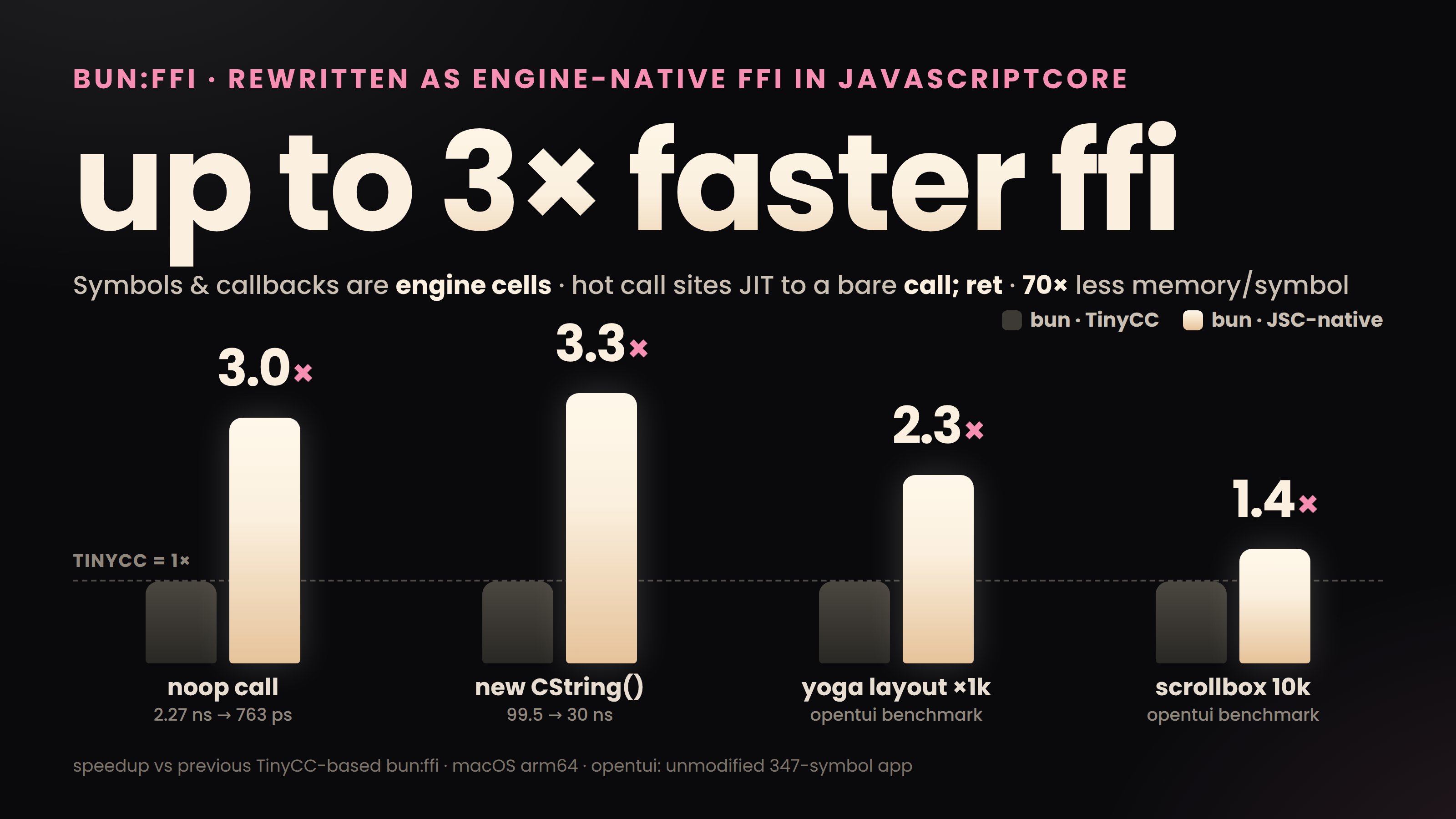 bun:ffi gets up to 3x faster
Dev tooling v1.3.2v1.4.0#
--cpu-prof,--cpu-prof-md: A.cpuprofilefor Chrome DevTools, or the same profile as a Markdown report for pasting into a bug or an LLM;BUN_CPU_PROFILE=1for processes you can't pass flags to. #24112 #26327--heap-prof,--heap-prof-md: A V8-compatible.heapsnapshot, or a Markdown report of the biggest types and objects. #26326- Async stack traces: Errors from async native APIs (
fs.promises,Bun.file(), S3, DNS, crypto,fetch) point back to theawaitin your code. #28652 --no-orphans: Bun exits when its parent dies and SIGKILLs every descendant on exit, on Linux, macOS, and Windows. #29930--no-env-file: Skip automatic.envloading in production and CI (env = falseinbunfig.toml). #24767
HTTP/3 in Bun.serve() (experimental) v1.3.14v1.4.0#
Bun.serve() supports HTTP/3. Set http3: true next to tls, and Bun listens on UDP on the same port.
HTTP/1.1 keeps working over TCP, and responses advertise HTTP/3 with an Alt-Svc header so browsers upgrade on their own.
On a static-route benchmark, HTTP/3 is 2.7× faster than HTTPS/1.1 on the same server.
Bun.serve({
  port: 443,
  tls: { ... },
  http3: true,        // also listen on UDP/443 for HTTP/3
  // h1: false,    // optional: serve HTTP/3 only
  fetch(req) {
    return new Response("hi");
  },
});
Experimental: zero-round-trip connection resumption is disabled, server.upgrade() returns false over H3, and unix: sockets skip the H3 listener. Don't ship http3: true to production yet. #29768
HTTP/2 & HTTP/3 in fetch() (experimental) v1.3.14v1.4.0#
fetch() now supports HTTP/2 and HTTP/3. Pass protocol: "http2" or protocol: "http3".
const [a, b, c] = await Promise.all([
  fetch("https://api.example.com/a", { protocol: "http2" }),
  fetch("https://api.example.com/b", { protocol: "http2" }),
  fetch("https://api.example.com/c", { protocol: "http2" }),
]);

const res = await fetch("https://example.com", { protocol: "http3" });
Over HTTP/2, concurrent requests to the same origin share one connection. Redirects, decompression, and streaming work the same as they do over HTTP/1.1.
To turn them on everywhere, set BUN_FEATURE_FLAG_EXPERIMENTAL_HTTP2_CLIENT=1 or pass --experimental-http3-fetch. With the HTTP/3 flag, Bun remembers which origins support it and uses it for later requests on its own.
Serve files & folders v1.4.0#
Bun.serve() routes can now serve a directory.
Files stream with sendfile. Content-Type, ETag, Last-Modified, 304, and Range are handled for you, and index.html is served for directories.
This replaces express.static, serve-static, and sirv. #36156
Bun.serve({
  routes: {
    "/static/*": { dir: "./public" },
  },
});
When serving files from disk, paths are normalized before lookup and on Linux files are opened with openat2 with O_RESOLVE_BENEATH, so a symlink inside the directory can't reach above it.
Range and conditional requests v1.3.13v1.4.0#
Bun.serve honors Range headers for file responses, so video seeking and resumable downloads work. Both static routes and Bun.file() bodies return 206 Partial Content.
Static routes and Bun.file() responses also handle conditional requests. If-None-Match and If-Modified-Since get a 304, and If-Match and If-Unmodified-Since get a 412 when the precondition fails.
Bun.serve({
  routes: {
    "/video.mp4": new Response(Bun.file("./video.mp4")),
    "/logo.png": new Response(Bun.file("./logo.png")),
  },
});
curl -H 'Range: bytes=0-1023' localhost:3000/video.mp4HTTP/1.1 206 Partial Content
Content-Range: bytes 0-1023/104857600curl -H 'If-None-Match: "1a2b3c"' localhost:3000/logo.pngHTTP/1.1 304 Not ModifiedHTML routes sourcemaps disabled in production v1.4.0#
In production, Bun.serve no longer serves sourcemaps for HTML routes, so your original source stays on your server.
Development mode still serves them. Set sourcemap under [serve.static] in bunfig.toml to pick explicitly. #36982
[serve.static]
sourcemap = "linked"
fetch() request compression v1.4.0#
fetch() gains a compress option. It compresses the request body before sending and sets the Content-Encoding header automatically. It supports gzip, deflate, br, and zstd, with an optional compression level. Buffered bodies (string, ArrayBuffer, TypedArray, Blob) are compressed, and Content-Length reflects the compressed size. Streaming bodies pass through unchanged. #32416
await fetch(url, {
  method: "POST",
  body: largeJsonString,
  compress: "gzip", // or true, "deflate", "br", "zstd", { encoding, level }
});
fetch() proxy headers v1.3.4#
fetch()'s proxy option now also accepts an object with url and headers, letting you send custom headers (like Proxy-Authorization) directly to the proxy server, whether the destination is HTTPS or plain HTTP. #25090
await fetch(url, {
  proxy: {
    url: "http://proxy.example.com:8080",
    headers: { "Proxy-Authorization": "Bearer token" },
  },
});
TLS session resumption v1.4.0#
A second cold connection to an origin resumes at 1 RTT. A 32-entry LRU caches BoringSSL client sessions per origin, so reconnecting after the keep-alive pool evicts skips the full handshake and certificate-chain walk.
Connection reuse v1.3.10v1.4.0#
fetch() reuses connections through an HTTPS proxy, and reuses them for requests with custom TLS options like a client certificate or a custom CA. #28611 #37715 #27385
Also built in v1.3.3v1.4.0#
Bun.JSON5:Bun.JSON5.parse()/stringify(); import.json5files directly. Replaces json5.Bun.JSONL:parse()and streamingparseChunk()for newline-delimited JSON. Replaces ndjson.Bun.JSONC.parse(): JSON with comments and trailing commas, the parser behindtsconfig.json. Replaces jsonc-parser.Bun.XML: SIMD XML parser and serializer; import.xmlfiles directly. Replaces fast-xml-parser and xml2js.Bun.TOML: TOML v1.1.0, 708/708 oftoml-test; newstringify(). Replaces @iarna/toml.Bun.Archive: Create and extract tarballs off the main thread. Replaces tar.Bun.sliceAnsi(),Bun.wrapAnsi(),Bun.stringWidth(): Terminal-column-aware slicing, wrapping, and measurement, ANSI and grapheme aware. Replaces slice-ansi, cli-truncate, wrap-ansi, and string-width.URLPattern: The Web API, 408 WPT passing. Replaces path-to-regexp.CompressionStream/DecompressionStream: Web-standard streams forgzip,deflate,deflate-raw, plusbrotliandzstd.Response.textStream(): AReadableStream<string>of the body decoded as UTF-8.process.on("memoryPressure"): The OS's low-memory notification on macOS, Linux, and Windows.- ML-DSA and ML-KEM: NIST post-quantum signatures and key encapsulation in
crypto.subtleandnode:crypto. Bun.spawn({ cgroup }): Place a child in a cgroup before it starts, on Linux.bun repl: Native REPL: highlighting, history, tab completion,-e/-p.bun ./README.md: Renders Markdown to the terminal, no VM started. Replaces glow.
bun install#
bun install is an npm-compatible package manager.
On a T3-stack Next.js app, bun install is many times faster than yarn, pnpm, and npm, and uses a fraction of the memory.
That holds for a first install, a fresh checkout, CI with and without a cache, and a no-op reinstall:
| Scenario | bunv1.4 | npmv12.0.2 | pnpmv11.21.0 | yarnv1.22.22 |
|---|---|---|---|---|
First install, ever no cache · no lockfile · no node_modules | 1.41s 15× faster 376 MB | 18.1s 503 MB | 13.5s 1.8 GB | 20.5s 498 MB |
Fresh checkout, warm cache no lockfile yet · every package already in the cache | 251ms 30× faster 52 MB | 7.61s 798 MB | 2.38s 1.1 GB | 1.83s 204 MB |
CI without a cache lockfile committed · every tarball fetched from the registry | 951ms 19× faster 214 MB | 4.92s 455 MB | 11.7s 2.7 GB | 17.6s 323 MB |
CI with a warm cache lockfile committed · dependency cache restored · node_modules rebuilt | 210ms 21× faster 12 MB | 4.45s 698 MB | 1.92s 1.4 GB | 1.76s 205 MB |
node_modules there, cache gone already installed · only the dependency cache was cleared | 12ms 33× faster 12 MB | 384ms 129 MB | 399ms 141 MB | 212ms 107 MB |
Everything already up to date the reinstall after nothing changed | 12ms 33× faster 12 MB | 337ms 114 MB | 400ms 141 MB | 211ms 107 MB |
Linux x64, EPYC 9R14 · bench/install in oven-sh/bun · each package manager with its own lockfile and node_modules, state prepared per scenario before every run, every package manager at defaults · medians of 3, peak memory is the largest of the 3 runs
Global virtual store: up to 7x faster installs v1.3.14v1.4.0#
bun install --linker=isolated now uses a shared global virtual store. Packages are extracted once into Bun's cache and symlinked into each project's node_modules/.bun/ store, instead of being copied into node_modules on every install. #29489
On a warm isolated install, copying packages into node_modules (clonefileat() on macOS) was 95% of main-thread time, and macOS runs only one of those calls at a time.
Once a package exists anywhere on the machine, later installs do one symlink() per package instead of one clonefileat().
On the common CI path (lockfile present, cache warm, node_modules wiped), a 1,400-package install is 7x faster. The global store is opt-in: it applies when you select the isolated linker, which is not the default for existing projects.
# bunfig.toml
[install]
linker = "isolated"
bun pm diff v1.4.0#
bun pm diff shows you what changed between two versions of a package.
It starts with a summary: which files changed, any new install scripts, and any new imports of child_process, fs, net, or vm. Then it shows the diff.
Minified files are un-minified before diffing, and formatting-only changes are skipped, so you see the lines that actually changed. #39229
bun pm diff react # the version in bun.lock → latestbun pm diff react@18.2.0 19.0.0 # two published versionsbun pm diff ./vendored-pkg pkg@2.1.0 # a folder against a published versionbun pm diff react-dom@18.2.0 18.3.1 '*.min.js'bun audit fix v1.4.0#
bun audit fix upgrades vulnerable packages to a safe version and installs.
If a fix needs a new major version, it tells you, and --latest lets it do that. --dry-run shows what it would change. #38333
bun audit fixfixing:
ms@0.7.0 → 0.7.1
lodash@4.17.20 → 4.17.21
package.json: 4.17.20 → 4.17.21
blocked by a dependent's range:
minimatch@0.3.0 → 3.0.2
express@3.21.2 depends on minimatch@0.3.0
Fixed 2 vulnerabilities in 2 packages
1 vulnerability remainingbun dedupe v1.4.0#
bun dedupe removes duplicate versions of packages from bun.lock.
If you have esbuild@0.15.10 and esbuild@0.15.11 and one version satisfies both, you end up with one. It never changes package.json, and --check fails CI if there are duplicates. #38333
bun dedupebun dedupe v1.4.0 (abc12345)
↳ esbuild 0.15.10 → 0.15.11
↳ react 18.2.0 → 18.3.1
2 duplicate versions removed, 3 packages installed (checked 5 packages) [12.00ms]bun prune v1.4.0#
bun prune deletes packages from node_modules that aren't in bun.lock anymore.
bun prune --production also deletes devDependencies, so you can build with them and ship without them. #38333
bun prune --productionbun prune v1.4.0 (abc12345)
- typescript@5.4.0
- @types/node@20.11.5
2 packages removed (checked 948) [22.00ms]COPY package.json bun.lock ./
RUN bun install --frozen-lockfile
COPY . .
RUN bun run build
RUN bun prune --productionbun pm licenses v1.4.0#
bun pm licenses lists your dependencies by license.
--json gives you machine-readable output, and --prod skips devDependencies. #38333
bun pm licenses --prod --json > licenses.jsonbun update updates transitive dependencies v1.4.0#
bun update now updates the dependencies of your dependencies too, not just the ones in your package.json.
bun updatebun update zodbun update '@types/*' --latestbun update <name> updates that package everywhere it appears, and bun update '@types/*' takes a pattern. #38333
bun add --filter v1.4.0#
bun add, bun remove, and bun update accept --filter, so you can add a package to one workspace from the root of your monorepo.
bun add zod --filter apibun run --filter 'web...' build--filter 'web...' means web and everything it depends on. --filter '...web' means everything that depends on web.
bun add --catalog v1.4.0#
bun add <pkg> --catalog adds the package to your root catalog and writes "catalog:" in the workspace's package.json.
bun add react --catalogIf the package is already in your default catalog, plain bun add uses it.
Nested overrides v1.4.0#
You can now override a dependency's dependency without overriding it everywhere. npm's nested form, yarn's a/b, and pnpm's a>b all work, and an override can be scoped to a version range.
{
  "overrides": {
    "express": { "qs": "6.13.0" },
    "lodash@<4.17.21": "4.17.21"
  }
}
Lockfile integrity for GitHub and tarball dependencies v1.3.10#
bun.lock now records a SHA-512 hash for GitHub and tarball dependencies, the same way it always has for npm packages. Existing lockfiles pick up the hashes on the next install.
["pkg@github:user/repo#ref", {}, "resolved-commit"]
["pkg@github:user/repo#ref", {}, "resolved-commit", "sha512-..."]
trustedDependencies only auto-trusts the npm registry v1.3.5#
Bun's default trusted-dependencies list applies only to packages from the npm registry.
A file:, link:, git:, or github: dependency named esbuild gets no trust from the real esbuild's entry. To run its lifecycle scripts, list it in trustedDependencies yourself.
{
  "dependencies": {
    "esbuild": "github:some-fork/esbuild#main"
  },
  "trustedDependencies": ["esbuild"]
}
Trusted-dependency names, .npmrc scope names, and local file: paths are compared by their full bytes rather than a hash, and registry credentials stay scoped to their configured host — never sent cross-origin, downgraded to http://, or printed in error or verbose output.
nativeDependencies and ignoreScripts v1.3.2#
For packages that ship prebuilt binaries as per-platform optionalDependencies (esbuild and @esbuild/darwin-arm64), Bun links the right binary directly instead of running postinstall. List them in nativeDependencies.
ignoreScripts skips a package's lifecycle scripts entirely, even if it is also in trustedDependencies. #24283
Configure both in package.json, or disable native binary linking with BUN_FEATURE_FLAG_DISABLE_NATIVE_DEPENDENCY_LINKER=1 and script skipping with BUN_FEATURE_FLAG_DISABLE_IGNORE_SCRIPTS=1.
{
  "nativeDependencies": ["esbuild", "my-custom-package"],
  "ignoreScripts": ["sharp", "another-package"]
}
bun test#
bun test --parallel runs test files across worker processes. --shard splits them across CI machines. --timings balances both by how long each file takes. --changed runs only the tests your diff touches.
bun test --changed=main # only what your branch touchesbun test --parallel --timings=timings.json --update-timingsbun test --parallel --shard=1/3 --timings=timings.json # in CI, per machinebun test --parallel v1.3.13v1.4.0#
bun test --parallel[=N] runs test files across N worker processes (defaulting to your CPU count). Files go to whichever worker frees up next. #29354
bun test --parallelbun test --parallel=4 --isolateCoverage and JUnit output are merged across workers. --bail stops every worker on the first failure.
--parallel implies --isolate (below). --no-isolate turns that off, so each worker keeps one global and one module registry for every file it runs.
Each worker exposes its 1-indexed slot as JEST_WORKER_ID / BUN_TEST_WORKER_ID, so Jest setups that key databases or ports off JEST_WORKER_ID work unchanged. Preload scripts with top-level await complete before any worker starts running tests.
--parallel=4 hands each file to whichever worker’s queue is shortest — so the 1.8s sql/postgres.test.ts outlier ties up one lane while the other three keep going, and all four finish within ~7% of each other. Durations illustrative. #29354bun test --isolate v1.3.13v1.4.0#
bun test --isolate runs each test file in a fresh JavaScript global object, in the same process. This is how Jest and Vitest behave by default. It makes "passes alone, fails in the full suite" bugs go away. #29354
bun test --isolateBetween files, Bun:
- creates a new
globalThis, so properties a file put onglobalThis, patched built-ins, and module-level state are gone - clears the ESM and CommonJS module registries, so every file re-evaluates its imports
- closes servers, sockets, file watchers, and subprocesses the file left open, cancels its timers, and restores fake timers
- re-runs
--preloadscripts in the new global
Transpiled source and bytecode are cached at the process level and shared across globals. The second file to import a module skips reading, transpiling, and parsing it. Only the module's top-level code runs again.
Bun 1.4 fixes several stability problems from the first release of --isolate:
- Fake timers a file left installed no longer leak into the next file. #36385
- Subprocesses started at module scope are killed when the file ends, instead of outliving the run. #38750
process.chdir()in one file no longer changes the working directory of the next file. #36175- Servers, sockets, and other handles a file leaked no longer pin its global object in memory. #31793
- A
--preloadscript with top-levelawaitfinishes before the first test runs. #30888 - Native addons (N-API) work across files, instead of pointing at the previous file's global. #30216
- Fixed a crash when garbage collection ran during the swap between two files. #29573
- The debugger resolves breakpoints in files loaded under
--isolate. #37352
bun test --shard v1.3.13v1.4.0#
bun test --shard=M/N splits your test files across multiple CI runners. Files are sorted deterministically and distributed round-robin so every machine sees the same partition, with 1-based indexing matching Jest, Vitest, and Playwright. Works alongside --changed and --randomize. An empty shard exits 0 instead of failing. #29366
# In a matrix of 3 jobs:bun test --shard=1/3bun test --shard=2/3bun test --shard=3/3bun test --timings v1.4.0#
--timings=<path> reads per-file durations from a previous run so --shard and --parallel balance by wall time instead of file count. --update-timings records the durations. #36814
bun test --timings=timings.json --update-timings # record per-file durationsbun test --shard=1/3 --timings=timings.json # cut shards by equal timebun test --parallel --timings=timings.json # workers start slowest firstWith timings, each shard gets about the same total time instead of the same number of files. Files that share imports stay together, so the module cache stays warm.
--parallel starts each worker on its slowest file first. The timings file is written slowest-first, so it doubles as a slow-test report.
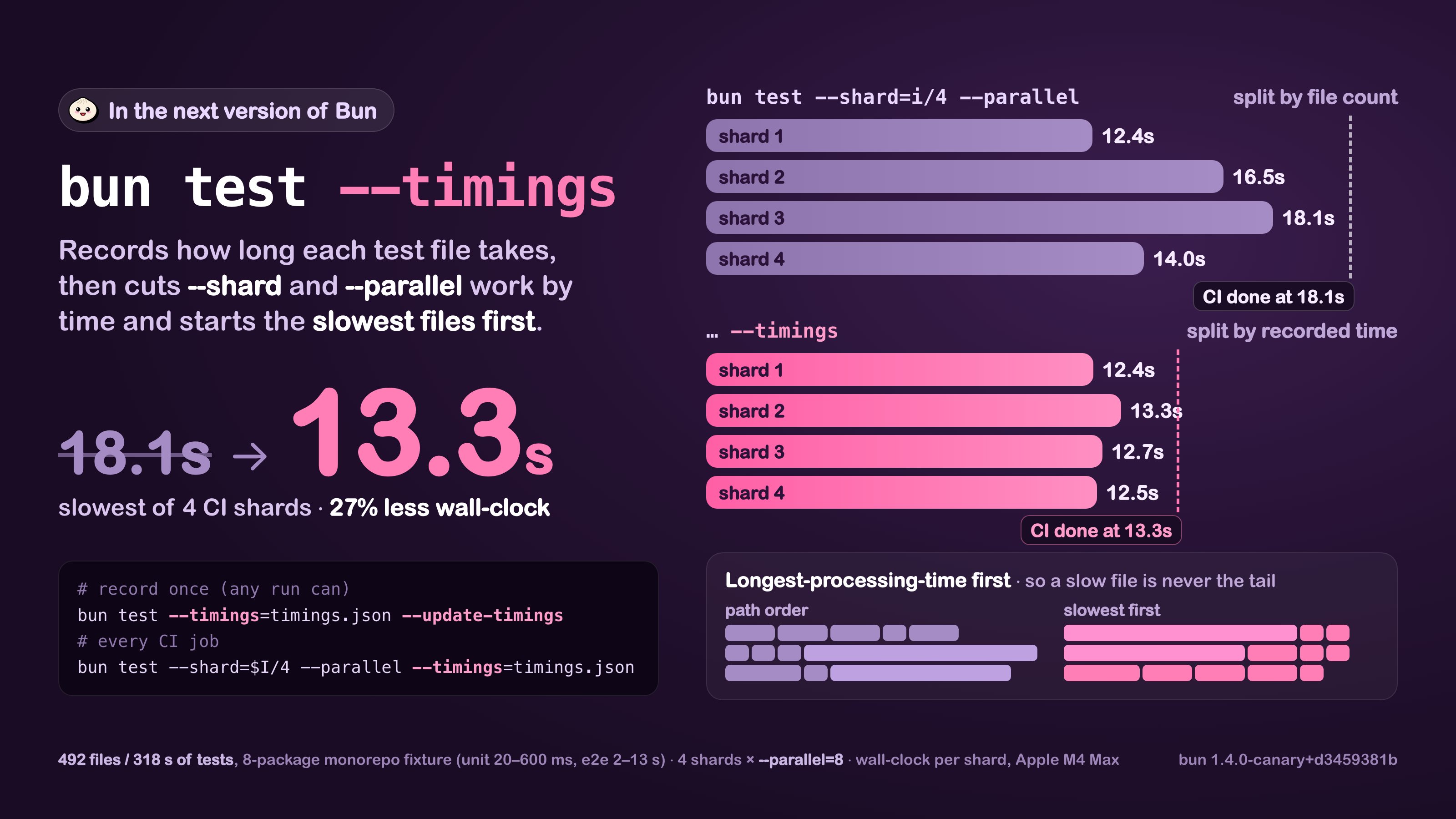 `bun test --timings` records how long each test file takes; `bun test --parallel --shard=i/N` uses timings to split CI shards via longest-processing-time-first scheduling, making large test suites run faster
bun test --changed v1.3.13v1.4.0#
bun test --changed runs only the test files affected by your uncommitted changes, or by the diff against a branch or commit with --changed=main. The flag is vitest-compatible. #29262
bun test --changed # uncommitted (unstaged + staged + untracked)bun test --changed=HEAD~1 # diff against a commit / branch / tagbun test --changed=mainbun test --changed --watch # re-filters on every restartBun scans every test file's imports, asks git which files changed, and walks the import graph backwards to find the tests that reach them.
tsconfig paths aliases like @/* work. With --watch, editing any source file re-filters on restart.
node_modules), then walks it backwards from whatever git diff reports.bun test --retry v1.3.3v1.4.0#
test() accepts { retry: n } to re-run a flaky test up to n times, and { repeats: n } to run it n times and fail if any run fails.
bun test --retry <N> sets a default for the whole suite. #23713 #26866
test(
  "flaky network call",
  async () => {
    await fetch("https://example.com");
  },
  { retry: 5 },
);

test(
  "stress",
  () => {
    if (Math.random() < 0.1) throw new Error("uh oh!");
  },
  { repeats: 20 },
);
jest.useFakeTimers() v1.3.4v1.4.0#
jest.useFakeTimers() lets you control setTimeout, setInterval, and Date from your tests.
@testing-library/react's waitFor detects the fake timers and advances them instead of waiting in real time. #23764 #25915
import { jest, test, expect } from "bun:test";

test("debounce", () => {
  jest.useFakeTimers();
  let called = 0;
  setTimeout(() => called++, 1000);
  jest.advanceTimersByTime(1000);
  expect(called).toBe(1);
  jest.useRealTimers();
});
jest.setSystemTime() works with advanceTimersByTime(), and Bun.cron schedules can be driven by the fake clock. #33623
bun build#
Built-in React Compiler v1.4.0#
bun build --react-compiler (or reactCompiler: true in Bun.build()) runs React's auto-memoization compiler on your components and hooks with no Babel or SWC in the loop. The compiler runs inside Bun's own parser, so there is no separate parse/print round-trip.
On a large React codebase (~860 components), enabling it adds 71 ms to the build (394 ms → 465 ms), about 20× faster than the Babel plugin's 9.15 s on the same input. A full --compile build finishes in 3.62 s vs 13.04 s (3.6×). #32504
await Bun.build({
entrypoints: ["./src/index.tsx"],
outdir: "./dist",
reactCompiler: true,
});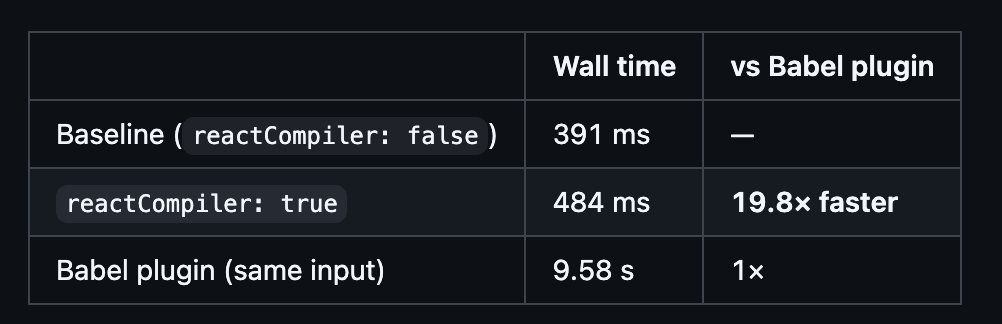 `bun build --react-compiler` runs the React Compiler in Rust. On a large React codebase, it's 19x faster than the Babel plugin
Barrel import optimization v1.3.10v1.4.0#
When you write import { Button } from "antd", Bun skips the hundreds of files behind the names you didn't import.
Packages that declare "sideEffects": false get this automatically. For everything else, opt in with optimizeImports. #26892
await Bun.build({
  entrypoints: ["./src/index.tsx"],
  optimizeImports: ["antd", "@mui/material"],
});Compile-time feature flags with bun:bundle v1.3.5#
feature("FLAG") from bun:bundle becomes true or false at build time, and the dead branch is removed.
Set flags with --feature=FLAG or features: [...] in Bun.build(). They work in bun build, bun run, and bun test. #25462
import { feature } from "bun:bundle";

if (feature("SUPER_SECRET")) {
  console.log("Secret feature enabled!");
}

// bun build --feature=SUPER_SECRET index.ts
In-memory files in Bun.build() v1.3.6#
Bun.build() accepts a files option: a map of paths to strings, Blobs, or TypedArrays. Use it to bundle entirely from memory or mix virtual modules with real files on disk — virtual paths take precedence. Handy for codegen, or for stubbing a module in tests without touching disk. #25852
await Bun.build({
  entrypoints: ["/app/index.ts"],
  files: {
    "/app/index.ts": `import { greet } from "./greet.ts"; console.log(greet("World"));`,
    "/app/greet.ts": `export function greet(name: string) { return "Hello, " + name + "!"; }`,
  },
});
Single-file HTML with --compile --target=browser v1.3.10#
bun build --compile --target=browser produces one HTML file with every script, stylesheet, and asset inlined.
You can double-click it and open it from file://, with no web server. #27056
bun build ./index.html --compile --target=browser --outdir=dist# → dist/index.html (everything inlined, zero external requests)metafile: true v1.3.6v1.4.0#
Bun.build() supports metafile: true, returning build metadata in esbuild's metafile format: a full map of inputs, outputs, imports, exports, and byte sizes. result.metafile works as-is with https://esbuild.github.io/analyze/ and anything else that reads esbuild's format. #25842
const result = await Bun.build({
  entrypoints: ["./index.js"],
  metafile: true,
});

console.log(result.metafile.inputs);
console.log(result.metafile.outputs);
--metafile-md v1.3.8v1.4.0#
bun build --metafile-md writes the module graph as a Markdown report: a quick summary, the largest input files, per-entry-point breakdowns, dependency chains, and a grep-friendly raw section. The report is plain Markdown, so you can paste it into an LLM to ask why a bundle is large. #26441
bun build entry.js --metafile-md --outdir=distbun build entry.js --metafile-md=analysis.md --outdir=distbun build entry.js --metafile=meta.json --metafile-md=meta.md --outdir=distStandard TC39 decorators v1.3.10v1.4.0#
You can now use standard TC39 decorators in Bun.
function logged(value, { kind, name }) {
  if (kind === "method") {
    return function (...args) {
      console.log(`calling ${name}`);
      return value.call(this, ...args);
    };
  }
}

class C {
  @logged
  greet() {}
}
These are the decorators you get when experimentalDecorators is off in tsconfig.json. They work on classes, methods, fields, accessors, and private members.
Bun passes the esbuild decorator test suite.
--asset v1.4.0#
bun build --compile --asset <path> embeds a file or a whole directory into the executable, keeping the original filenames.
Use it for a public/ folder, templates, or a SvelteKit client/ build. path.join(import.meta.dir, ...) finds them the same way it does on disk. #36302
node:fs now treats /$bunfs/ as a real directory tree: existsSync, statSync, lstatSync, accessSync, readdirSync, and fs.promises.readdir (including { withFileTypes: true } and { recursive: true }) all work on embedded paths, so static-file servers that enumerate a directory at startup run unmodified inside a compiled binary.
bun build ./build/index.js --compile \ --asset ./build/client --asset ./build/prerendered \
--outfile server./server # every route + static asset served from the binaryBytecode compilation for ES modules v1.3.9v1.4.0#
--bytecode now supports ES modules. --bytecode --format=esm requires --compile, and enables top-level await, import.meta, dynamic imports, and code splitting in bytecode-compiled binaries; previously --bytecode forced CommonJS output. #26402
Code splitting on 20,000-module graphs is 14× faster v1.4.0#
The code-splitting reachability walk is now BFS and O(V+E). A 20,000-module diamond-shaped DAG links in 320 ms, from 4.65 s. The tree-shaking liveness, TLA validation, CSS-order, and part-visitor passes run on explicit stacks. So linear import chains of thousands of modules link without stack growth. #35310 #34554
Faster#
Between Bun 1.3 and 1.4 we bumped our WebKit pin 39 times, pulling in roughly eight months of upstream JavaScriptCore work; the regex engine, Promises, and most String/Array builtins moved from self-hosted JavaScript to C++, and Bun swapped in zlib-ng and SIMD kernels for its own hot paths.
new URL() is up to 4.6× faster v1.4.0#
Bun's URL parser was rewritten. WebKit's new parser does the parsing. On Bun's side, href reuses the input string, the last base URL is cached, and hosts that are already ASCII punycode skip ICU.
| Operation | Bun 1.3 | Bun 1.4 | Node.js 26 |
|---|---|---|---|
new URL("http://localhost:3000/api/users/42") | 349 ns | 75 ns | 232 ns |
new URL("../x", base) | 523 ns | 168 ns | 612 ns |
url.href | 16 ns | 5 ns | 8 ns |
Faster RegExp v1.4.0#
The RegExp performance gap between JavaScriptCore and V8 has been fixed.
marked.parse() gets 138× faster. On an 80 KB Markdown fixture, it runs in ~6 ms, from 912 ms.
isbot gets 200× faster. One call on a typical user agent takes 1.07 µs, from 218 µs in Bun 1.3. Node.js 26 takes 1.47 µs.
Benchmark code: isbot-bench.mjs
import { isbot } from "isbot"; // isbot@5.2.1

const uas = [
  "Mozilla/5.0 (Windows NT 10.0; Win64; x64) AppleWebKit/537.36 (KHTML, like Gecko) Chrome/126.0.0.0 Safari/537.36",
  "Mozilla/5.0 (Macintosh; Intel Mac OS X 14_5) AppleWebKit/605.1.15 (KHTML, like Gecko) Version/17.5 Safari/605.1.15",
  "Mozilla/5.0 (iPhone; CPU iPhone OS 17_5 like Mac OS X) AppleWebKit/605.1.15 (KHTML, like Gecko) Mobile/15E148",
  "Mozilla/5.0 (compatible; Googlebot/2.1; +http://www.google.com/bot.html)",
  "curl/8.7.1",
  "Mozilla/5.0 (Linux; Android 14; Pixel 8) AppleWebKit/537.36 (KHTML, like Gecko) Chrome/126.0.0.0 Mobile Safari/537.36",
  "Mozilla/5.0 (X11; Linux x86_64; rv:128.0) Gecko/20100101 Firefox/128.0",
  "Slackbot-LinkExpanding 1.0 (+https://api.slack.com/robots)",
];

let hits = 0;
for (let i = 0; i < 20_000; i++)
  for (const ua of uas) hits += isbot(ua) ? 1 : 0; // warm up

const N = 200_000;
const t0 = performance.now();
for (let i = 0; i < N; i++) for (const ua of uas) hits += isbot(ua) ? 1 : 0;
const ms = performance.now() - t0;
console.log(`${((ms * 1e6) / (N * uas.length)).toFixed(0)} ns/call`, hits);
node:zlib uses zlib-ng v1.3.13v1.4.0#
Bun now uses zlib-ng, the same library Node.js 24 and Chromium use, for node:zlib, gzipped fetch() responses, and everything else that compresses. It picks the fastest code path for your CPU at runtime. #29433
Time per call on 1 MB of JSON, default level:
| Encoding | Operation | Bun 1.4 | Bun 1.3 | Node.js 26 | Deno 2.9 |
|---|---|---|---|---|---|
| gzip | gzipSync | 9.36 ms | 9.11 ms | 10.27 ms | 9.76 ms |
| gzip | gunzipSync | 1.28 ms | 1.56 ms | 2.11 ms | 2.06 ms |
| deflate | inflateSync | 1.21 ms | 1.54 ms | 1.95 ms | 2.07 ms |
| brotli | brotliDecompressSync | 1.38 ms | 1.40 ms | 2.11 ms | 2.39 ms |
| zstd | zstdCompressSync | 2.09 ms | 2.18 ms | 2.09 ms | 2.18 ms |
| zstd | zstdDecompressSync | 0.81 ms | 0.73 ms | 1.57 ms | 1.65 ms |
Peak memory, same runs:
| Encoding | Operation | Bun 1.4 | Bun 1.3 | Node.js 26 | Deno 2.9 |
|---|---|---|---|---|---|
| gzip | gzipSync | 50 MB | 74 MB | 75 MB | 69 MB |
| gzip | gunzipSync | 62 MB | 94 MB | 125 MB | 129 MB |
| deflate | inflateSync | 63 MB | 94 MB | 126 MB | 128 MB |
| brotli | brotliDecompressSync | 73 MB | 110 MB | 129 MB | 130 MB |
| zstd | zstdCompressSync | 55 MB | 79 MB | 77 MB | 71 MB |
| zstd | zstdDecompressSync | 62 MB | 95 MB | 128 MB | 136 MB |
Compression speed depends on the input. On JSON, gzip compression is the same speed as Bun 1.3. On repetitive HTML, gzipSync on 1 MB takes 3.9 ms instead of 5.75 ms. Decompression is about 20% faster on everything, and peak memory is 25–35 MB lower.
Benchmark code: zlib-bench.mjs
// node:zlib benchmark: compress/decompress a JSON-like text buffer, one scenario per process.
// Usage: <runtime> zlib-bench.mjs <gzip|deflate|brotli|zstd> <sync|async> <compress|decompress> [level] [--bytes=N] [--iters=N]
//   e.g. bun zlib-bench.mjs gzip sync compress --bytes=1048576 --iters=50
//        node zlib-bench.mjs brotli async compress
//        deno run -A zlib-bench.mjs zstd sync decompress 3
// --bytes: input size (default 64 MiB). --iters: timed iterations (default 1); with >1, warms up
// 5 iterations and reports the median. Prints one JSON line: {encoding, api, op, level, ms, iters,
// inputBytes, compressedBytes}. Wrap with `/usr/bin/time -v` to get peak RSS.
import * as zlib from "node:zlib";

const flags = Object.fromEntries(
  process.argv
    .slice(2)
    .filter((a) => a.startsWith("--"))
    .map((a) => a.slice(2).split("=")),
);
const [encoding, api, op, levelArg] = process.argv
  .slice(2)
  .filter((a) => !a.startsWith("--"));
const level = levelArg === undefined ? undefined : Number(levelArg);
const TARGET = Number(flags.bytes ?? 64 * 1024 * 1024);
const ITERS = Number(flags.iters ?? 1);

// Deterministic JSON-lines text; a few fields vary per record so it is not trivially repetitive.
function makeInput() {
  let seed = 0x9e3779b9;
  const rnd = () => (seed = (seed * 1103515245 + 12345) >>> 0) / 2 ** 32;
  const cities = [
    "Berlin",
    "Tokyo",
    "Austin",
    "Lagos",
    "Lima",
    "Oslo",
    "Pune",
    "Quito",
  ];
  const words = [
    "alpha",
    "bravo",
    "charlie",
    "delta",
    "echo",
    "foxtrot",
    "golf",
    "hotel",
    "india",
    "juliet",
  ];
  const parts = [];
  let size = 0;
  for (let i = 0; size < TARGET; i++) {
    const tags = Array.from(
      { length: 3 },
      () => words[(rnd() * words.length) | 0],
    );
    const rec = {
      id: i,
      uuid: `${((rnd() * 2 ** 32) >>> 0)
        .toString(16)
        .padStart(8, "0")}-4c1e-8a2b-${i.toString(16).padStart(12, "0")}`,
      user: `user_${(rnd() * 50000) | 0}`,
      email: `person${(rnd() * 1e6) | 0}@example.com`,
      city: cities[(rnd() * cities.length) | 0],
      score: Math.round(rnd() * 10000) / 100,
      active: rnd() > 0.5,
      tags,
      ts: 1700000000000 + ((rnd() * 1e9) | 0),
      note:
        "lorem ipsum dolor sit amet, consectetur adipiscing elit " +
        words[i % words.length],
    };
    const line = JSON.stringify(rec) + "\n";
    parts.push(line);
    size += line.length;
  }
  return Buffer.from(parts.join(""), "latin1");
}

const fns = {
  gzip: [zlib.gzipSync, zlib.gzip, zlib.gunzipSync, zlib.gunzip],
  deflate: [zlib.deflateSync, zlib.deflate, zlib.inflateSync, zlib.inflate],
  brotli: [
    zlib.brotliCompressSync,
    zlib.brotliCompress,
    zlib.brotliDecompressSync,
    zlib.brotliDecompress,
  ],
  zstd: [
    zlib.zstdCompressSync,
    zlib.zstdCompress,
    zlib.zstdDecompressSync,
    zlib.zstdDecompress,
  ],
};
const [cSync, cAsync, dSync, dAsync] = fns[encoding];
if (!cSync) {
  console.log(JSON.stringify({ encoding, api, op, error: "unsupported" }));
  process.exit(0);
}

const opts =
  level === undefined
    ? {}
    : encoding === "brotli"
    ? { params: { [zlib.constants.BROTLI_PARAM_QUALITY]: level } }
    : { level };

const input = makeInput();
const compressed = op === "decompress" ? cSync(input, opts) : null;
const [syncFn, asyncFn, data] =
  op === "decompress" ? [dSync, dAsync, compressed] : [cSync, cAsync, input];

const once = () =>
  new Promise((resolve, reject) => {
    const t0 = performance.now();
    if (api === "sync")
      return resolve([syncFn(data, opts), performance.now() - t0]);
    asyncFn(data, opts, (err, out) =>
      err ? reject(err) : resolve([out, performance.now() - t0]),
    );
  });

let out,
  times = [];
if (ITERS > 1) for (let i = 0; i < 5; i++) await once();
for (let i = 0; i < ITERS; i++) {
  const [o, ms] = await once();
  out = o;
  times.push(ms);
}
times.sort((a, b) => a - b);
const ms = times[times.length >> 1];
console.log(
  JSON.stringify({
    encoding,
    api,
    op,
    level: level ?? "default",
    ms: Math.round(ms * 1000) / 1000,
    iters: ITERS,
    inputBytes: input.length,
    compressedBytes: op === "decompress" ? compressed.length : out.length,
  }),
);
Buffer.from(str, "hex") is 8× faster and "base64url" 46× faster v1.4.0#
Buffer.from(str, "hex") and Buffer.from(str, "base64url") decode with SIMD.
Decoding 1 MiB:
| Encoding | Bun 1.4 | Bun 1.3 | Node.js 26 | Deno 2.9 |
|---|---|---|---|---|
hex | 128 µs | 1,035 µs | 743 µs | 3,863 µs |
base64url | 84 µs | 3,897 µs | 68 µs | 104 µs |
Decoding 128 KiB:
| Encoding | Bun 1.4 | Bun 1.3 | Node.js 26 | Deno 2.9 |
|---|---|---|---|---|
hex | 15.1 µs | 130.6 µs | 102.7 µs | 494.0 µs |
base64url | 11.6 µs | 486.2 µs | 17.0 µs | 14.4 µs |
Benchmark code: buffer-from-bench.mjs
import { Buffer } from "node:buffer";

const sizes = [1024, 128 * 1024, 1024 * 1024];
const raw = (n) => {
  const b = Buffer.alloc(n);
  for (let i = 0; i < n; i++) b[i] = (i * 2654435761) >>> 24;
  return b;
};

for (const enc of ["hex", "base64", "base64url"]) {
  for (const n of sizes) {
    const str = raw(n).toString(enc);
    let sink = 0;
    for (let i = 0; i < 200; i++) sink += Buffer.from(str, enc).length; // warm up
    const iters = n >= 1024 * 1024 ? 300 : n >= 128 * 1024 ? 2000 : 100000;
    const times = [];
    for (let rep = 0; rep < 5; rep++) {
      const t0 = performance.now();
      for (let i = 0; i < iters; i++) sink += Buffer.from(str, enc).length;
      times.push(((performance.now() - t0) * 1000) / iters);
    }
    times.sort((a, b) => a - b);
    console.log(enc, n / 1024, "KiB", times[2].toFixed(2), "µs/op");
  }
}
Source map decoding is 3.1× faster v1.4.0#
Source map decoding uses SIMD. new SourceMap(json) on a 9.5 MB map takes 12 ms, 3.1× faster than before and 24× faster than Node.js. #32556
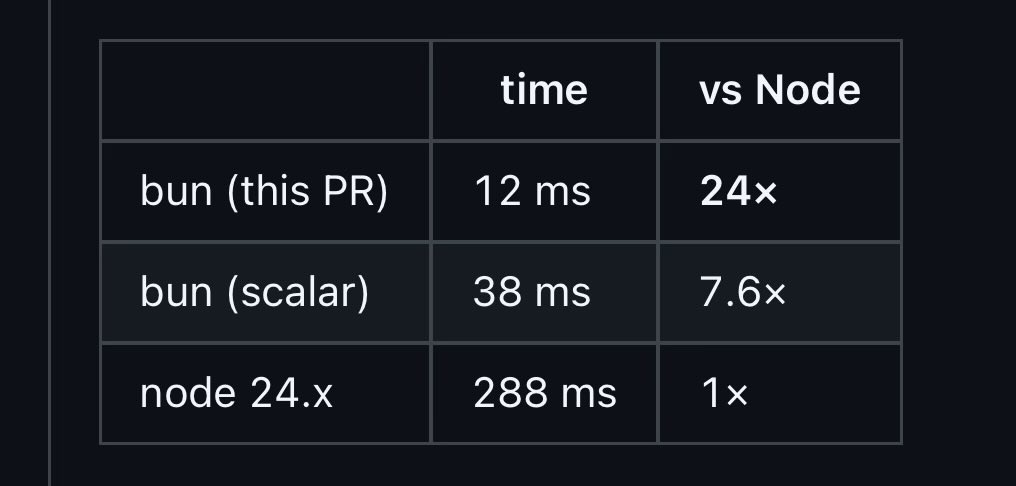 `new SourceMap(payload)` & sourcemap decoding gets up to 3x faster
Promises are 1.5–2.4× faster v1.4.0#
JavaScriptCore rewrote their Promise implementation to reduce overhead.
Time per operation, 2 million iterations:
| Operation | Bun 1.4 | Bun 1.3 |
|---|---|---|
Promise.race of 4 promises | 142 ns | 342 ns |
Promise.all of 4 promises | 207 ns | 316 ns |
Promise.allSettled of 4 promises | 253 ns | 411 ns |
await a resolved promise | 84 ns | 143 ns |
.then() chain of 4 | 172 ns | 332 ns |
async function with no await | 37 ns | 89 ns |
Memory: 1,000,000 pending promises resolved at once.
| Bun 1.4 | Bun 1.3 | |
|---|---|---|
| Peak memory | 251 MB | 668 MB |
| Time to settle | 12.5 ms | 39.0 ms |
Benchmark code: promise-bench.mjs and promise-rss.mjs
// Promise microbenchmarks. Prints ns/op per operation as JSON.
// Usage: bun promise-bench.mjs | node promise-bench.mjs | deno run -A promise-bench.mjs
const WARMUP = 1e5;
const ITERS = 2e6;

const p1 = Promise.resolve(1),
  p2 = Promise.resolve(2),
  p3 = Promise.resolve(3),
  p4 = Promise.resolve(4);
const arr = [p1, p2, p3, p4];
async function noAwait(x) {
  return x;
}

const benches = {
  "Promise.race (4 resolved)": () => Promise.race(arr),
  "Promise.all (4 resolved)": () => Promise.all(arr),
  "Promise.allSettled (4 resolved)": () => Promise.allSettled(arr),
  "await resolved promise": async () => {
    await p1;
  },
  ".then() chain of 4": () =>
    p1
      .then((x) => x)
      .then((x) => x)
      .then((x) => x)
      .then((x) => x),
  "async fn, no await": () => noAwait(1),
};

async function time(fn, n) {
  const t0 = performance.now();
  for (let i = 0; i < n; i++) await fn();
  return ((performance.now() - t0) * 1e6) / n;
}

const results = {};
for (const [name, fn] of Object.entries(benches)) {
  await time(fn, WARMUP);
  results[name] = Math.round((await time(fn, ITERS)) * 10) / 10;
}
console.log(JSON.stringify(results));
// promise-rss.mjs: peak memory of 1,000,000 pending promises resolved at once
const N = 1_000_000;
const resolvers = [];
const promises = Array.from(
{ length: N },
() => new Promise((r) => resolvers.push(r)),
);
const all = Promise.all(promises);
for (const r of resolvers) r(1);
const t0 = performance.now();
await all;
console.log(
`${N} promises settled in ${(performance.now() - t0).toFixed(1)} ms`,
);Security#
Bun 1.4 includes a lot of security fixes. We recommend everyone update. Most of them change nothing you'd notice. They are listed under Security hardening in the changelog. The handful below tighten a default, in most cases a TLS certificate check. That can turn a connection that worked on 1.3 into a verification error. Advisories will go up on GitHub once people have had time to upgrade.
checkServerIdentity runs before fetch() sends the request v1.4.0#
When you pass tls: { checkServerIdentity } to fetch(), the callback runs after the TLS handshake and before any of the request is written, and again on each redirect hop. If it returns an Error, fetch() rejects with that error and nothing is sent.
await fetch("https://api.example.com/upload", {
  method: "POST",
  body: secretPayload,
  tls: {
    checkServerIdentity(hostname, cert) {
      if (cert.fingerprint256 !== PINNED) return new Error("pin mismatch");
    },
  },
});
// nothing is sent until checkServerIdentity returns undefined
If you pin a certificate this way and the URL redirects through a host with a different one, the callback now sees that certificate too, so either accept every hop's certificate there or pass redirect: "manual" and follow Location yourself.
tls.connect now uses host as the default servername v1.3.13#
tls.connect({ host, port }) without a servername now uses host for both SNI and the certificate identity check. This matches Node.js. Connecting by IP address or to localhost now fails with ERR_TLS_CERT_ALTNAME_INVALID when the certificate was issued for another name. This applies whether you call tls.connect() yourself or a driver like pg or ioredis does. Pass the certificate's name as servername. Or pass checkServerIdentity: () => undefined if you deliberately trust the server by its CA alone.
tls.connect({
  host: "10.0.0.12",
  port: 5432,
  ca,
  servername: "db.internal",
});
Bun.connect and Bun.listen enforce rejectUnauthorized v1.4.0#
Bun.connect({ tls }), socket.upgradeTLS(), and Bun.listen() with requestCert: true now default to rejectUnauthorized: true, as node:tls and fetch() do. The usual case is a Bun.connect() to a dev or staging server with a self-signed or private-CA certificate and no ca. It does not throw. The handshake handler runs with socket.authorized set to false. Writes return -1. The socket closes without delivering data. Pass the CA in tls, or pass rejectUnauthorized: false (NODE_TLS_REJECT_UNAUTHORIZED=0 is honored here too).
RedisClient enforces TLS hostname verification v1.3.14#
A rediss:// RedisClient checks the server certificate against the host in the URL, as the Postgres and MySQL clients do, and rejects the first command with ERR_TLS_CERT_ALTNAME_INVALID on a mismatch. If you reach Redis by IP or through a port-forward to localhost, connect by the name on the certificate instead, or pass tls: { rejectUnauthorized: false }.
HTTP request parsing hardening in Bun.serve v1.3.4#
Bun.serve() answers 400 and closes the connection for more kinds of malformed Content-Length and Transfer-Encoding headers and chunked bodies. Browsers, curl, fetch() and reverse proxies send none of them. If a hand-written client starts getting 400 responses, look at its framing headers first; Bun does not call your fetch handler or log anything for most of these.
Tarball extraction hardening v1.3.6#
Tarball extraction for github: and URL dependencies and bun create templates skips entries that would land outside the package directory. If one of those is missing a file after the upgrade and you get Cannot find module for it, look in its repo for a symlink that points outside the package, and replace it with the real file or a relative link.
Platforms#
Native FreeBSD builds v1.3.14v1.4.0#
Bun now ships official FreeBSD binaries for x86_64 and aarch64. On FreeBSD 14.3+ the full runtime (Bun.serve(), fetch(), node:fs, node:os, Bun.spawn) works on a stock install with no extra system packages. This is a native port built against FreeBSD's own kernel APIs, not a Linux compatibility layer. #29676
curl -fsSL https://bun.sh/install | bashuname -smFreeBSD amd64bun --version1.4.0Windows on ARM64 v1.3.7v1.4.0#
Bun now builds natively for Windows on ARM64. Surface, Snapdragon X, and Ampere-based Windows machines run Bun natively. #26215
PS> powershell -c "irm bun.sh/install.ps1|iex"
PS> $env:PROCESSOR_ARCHITECTURE
ARM64
PS> bun --version
1.4.0
Experimental Android support v1.4.0#
Bun ships experimental Android builds for aarch64 and x64 with every release.
Linux glibc minimum drops to 2.17 v1.3.13#
Bun's minimum glibc requirement on Linux drops from 2.26 to 2.17. Bun now runs on RHEL/CentOS 7, Amazon Linux 1, and ARM64 Linux distributions without needing a separate compatibility build. #29461
ldd --versionldd (GNU libc) 2.17bun --version1.4.0Fallback for in-memory files on older Linux kernels v1.3.13#
On Linux kernels older than 3.17, like RHEL 7, Bun detects that memfd_create is missing once and falls back. The documented minimum kernel is now 3.10. #29465
BUN_FEATURE_FLAG_DISABLE_MEMFD=1 bun run server.tsReady for TypeScript 7#
bun init and the React templates ship a tsconfig.json that works with TypeScript 7, and @types/bun resolves cleanly against it. #28542 #39341
{
  "compilerOptions": {
    "types": ["bun"]
  }
}
Sub-15 ms timers on Windows v1.4.0#
On Windows, setTimeout(fn, 1) fires in about 1.4 ms instead of 15.5 ms. Timers no longer round to the 15.6 ms system tick. #34834
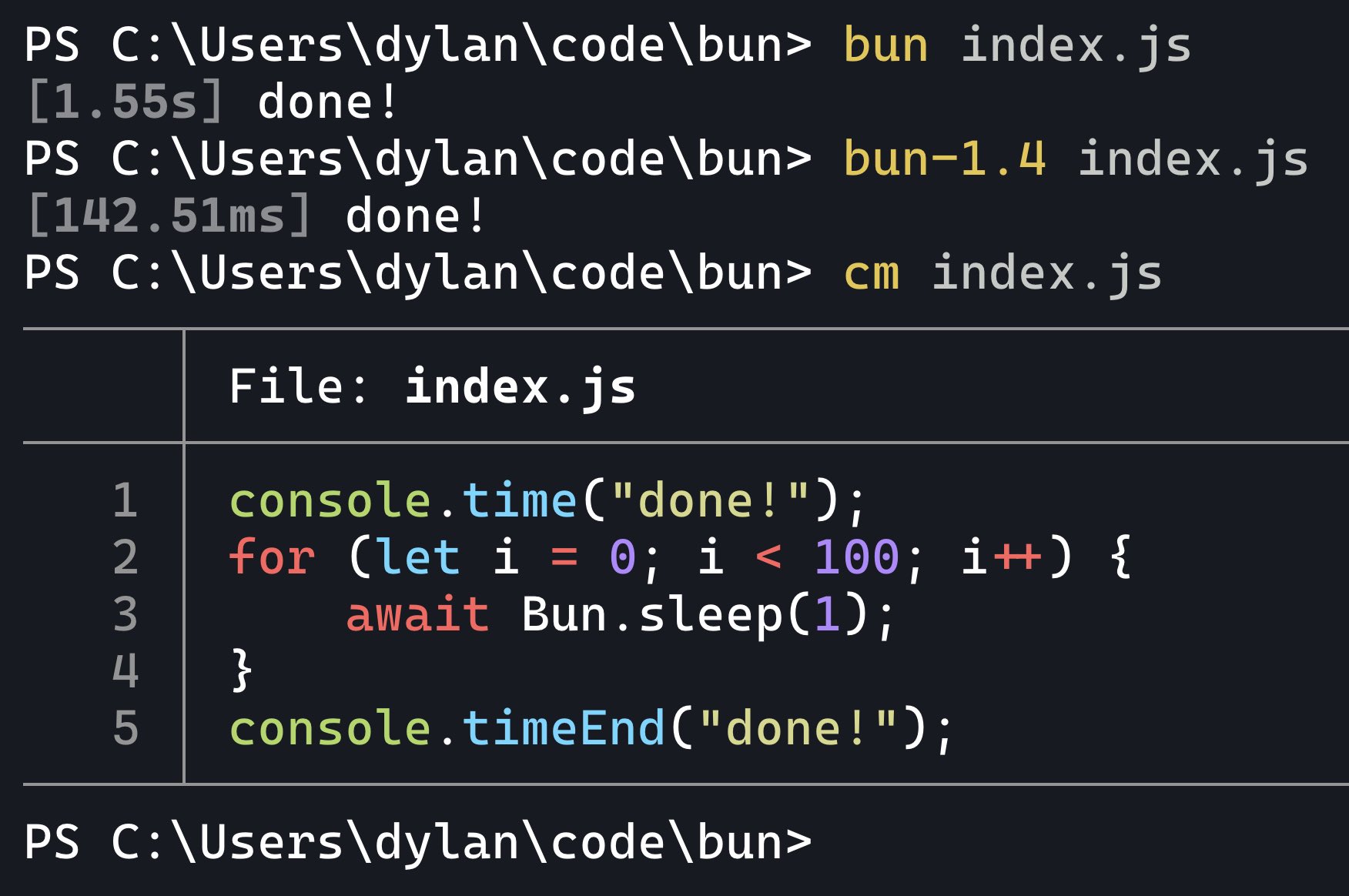 Improved timer accuracy on Windows makes `Bun.sleep` faster
Bun runs inside an AppContainer v1.4.0#
Bun runs inside a Windows AppContainer, so embedders can sandbox it with a lowbox token.
bun install, bun run, Bun.spawn, child_process.fork, and Bun.Terminal all work inside the container.
Bun also now works on read-only directories like Program Files and read-only network shares, and no longer fails when an ancestor directory isn't readable.
Upgrading to 1.4#
Most code is unaffected. Five changes are the most likely to need a line in your project:
- Node.js 26:
process.versions.modulesis now147. Packages that pick a prebuilt native addon byNODE_MODULE_VERSIONneed a build for147.res.writeHeader()is gone; useres.writeHead(). Paused-modereadable.read()returns one chunk. #31991 - New monorepos default to the isolated linker.
bun.lockrecordsconfigVersion: 1. Existing lockfiles keep the hoisted linker. To opt out, pinlinker = "hoisted"inbunfig.toml. #24236 - Bun invoked as
node(bun --bun,bunx --bun, anodesymlink) does not load.envfiles. This matches Node. Pass--env-fileto keep them. #36610 Bun.YAMLfollows YAML 1.2:yes/no/on/offare strings.on:in a GitHub Actions workflow parses as"on". #25537Bun.TOMLandbunfig.tomlare strict: unquoted strings, missing newlines between pairs, and integers pastNumber.MAX_SAFE_INTEGERareSyntaxErrors. #32953
Every behavior change in 1.4
Node.js 26: NODE_MODULE_VERSION 147, res.writeHeader() removed, paused read() returns one chunk v1.4.0#
Bun now reports Node.js 26. Three things change:
process.versions.modulesis147. Packages that pick a prebuilt native addon byNODE_MODULE_VERSIONneed a build for147.res.writeHeader()innode:httpis removed. Callres.writeHead().- In paused mode,
readable.read()with no size returns one buffered chunk. Before, it returned the whole buffer. (setEncoding()keeps the old behavior.) Loop until it returnsnull.
res.writeHeader(200, { "Content-Type": "text/plain" });
res.writeHead(200, { "Content-Type": "text/plain" });
x64 builds are now baseline-only v1.4.0#
x64 releases now ship only the baseline build. The separate build compiled with -march=haswell is gone. The -baseline download URLs and npm packages still exist and contain the same binary. Existing install scripts and bun upgrade keep working. The CPU lacks AVX support startup warning is removed. #34782
Temporal is now defined by default, and toEqual() compares Temporal objects by value v1.4.0#
Temporal and Date.prototype.toTemporalInstant are now defined. Set BUN_JSC_useTemporal=0 to turn them off. Bun.deepEquals(), toEqual(), toStrictEqual(), and util.isDeepStrictEqual() now compare Temporal objects by value. Before, any two instances of the same class were equal. #32978 #37024
Bun.deepEquals(
  Temporal.PlainDate.from("2020-01-01"),
  Temporal.PlainDate.from("1999-12-31"),
); // falsebun:ffi: cstring values are plain strings and CString no longer has .ptr v1.4.0#
bun:ffi is now engine-native. This changes four things:
- A
returns: "cstring"value or acstringcallback argument is a plain string. ANULLpointer isnull. new CString(ptr)returns a string with no.ptr,.byteLength, or.arrayBuffer. Keep the original pointer if you need to free it.napi_envandnapi_valueargument types throwTypeErroroutsidecc().dlopen()and the other entry points throwTypeErrorwhen the JIT is disabled.
const str = new CString(ptr);
my_library_free(str.ptr);
my_library_free(ptr);
bun build --compile no longer auto-loads tsconfig.json or package.json at runtime v1.3.4#
Standalone executables built with bun build --compile no longer auto-load tsconfig.json or package.json from the runtime working directory. Before, a compiled binary could pick up unrelated config files from the directory it ran in. To opt back in, pass --compile-autoload-tsconfig / --compile-autoload-package-json (or compile.autoloadTsconfig / compile.autoloadPackageJson in Bun.build()). .env and bunfig.toml still auto-load by default. They keep their existing --compile-autoload-dotenv / --compile-autoload-bunfig flags. #25340
bun install defaults to the isolated linker for new monorepos v1.3.2#
New monorepos (projects with workspaces) now use linker: "isolated". This is a symlinked node_modules layout that prevents phantom dependencies. bun.lock records a configVersion. Existing lockfiles (config version 0) keep the hoisted linker they were created with. Your node_modules layout does not change on upgrade. #24236
# bunfig.toml: pin the old behavior if you need it
[install]
linker = "hoisted"
bun.lock is now lockfileVersion: 2 v1.4.0#
New lockfiles use version 2. Version 2 adds two stricter parse-time checks:
- npm packages resolved to a tarball outside your configured registry must carry an integrity hash.
- git dependency entries are validated to block path traversal (no
/,\, or..).
Lockfiles written as v0/v1 keep loading without these checks. Existing projects do not break. Run bun install to migrate.
{
  "lockfileVersion": 1,
  "lockfileVersion": 2,
  "workspaces": { ... },
Bun invoked as node no longer loads .env files v1.4.0#
When Bun runs as node (under bun --bun, bunx --bun, or a node symlink to Bun), it no longer loads .env, .env.local, or .env.{development,production,test}. This matches Node.js. bun file.js still loads them. A package.json script that calls node under bun --bun run now sees those variables as undefined. To keep them, pass --env-file to node. #36610
"scripts": {
  "check": "node ./check.js"
  "check": "node --env-file=.env ./check.js"
Bun.YAML now parses yes/no/on/off as strings, not booleans v1.3.5#
Bun.YAML now parses booleans per the YAML 1.2 spec. yes/no/on/off/y/Y are plain strings, not booleans. These are YAML 1.1 legacy values that the 1.2 spec dropped. An on: key in a GitHub Actions workflow file now parses as the string "on", not true. Only true/True/TRUE and false/False/FALSE resolve to booleans. #25537
Bun.YAML.parse("on: push");
// { on: "push" }
Bun.TOML.parse() and bunfig.toml are stricter and throw SyntaxError v1.4.0#
The rewritten Bun.TOML parser throws SyntaxError instead of BuildMessage. It rejects TOML that the old parser let through:
- unquoted string values
- missing newlines between key/value pairs
- integers outside
Number.MAX_SAFE_INTEGER
A bunfig.toml with an unquoted value now fails at startup with TOML Parse error: Strings must be quoted. Quote the value. #32953
[install]
linker = isolated
linker = "isolated"
.xml imports now return the parsed document instead of the file path v1.4.0#
import or require() of a .xml file now returns the same object as Bun.XML.parse(). This applies at runtime and in bun build. Before, it returned the file's path. A file that does not parse throws at runtime and fails the build. To keep getting the path, pass --loader .xml:file. #37048
import "." and import ".." now resolve as directories v1.4.0#
"." and ".." in import and require() now resolve to the directory's index file or package.json main. This matches Node.js. Before, they resolved to a sibling file with the directory's name. So "." inside lib/run.ts loaded lib.ts; it now loads lib/index.ts. To keep the sibling, name it. #36969
import { e } from ".";
import { e } from "../lib";
.css imports at runtime now export {} instead of the file path v1.4.0#
At runtime, the default export of a .css import is now {}. This applies to import, require(), dynamic import(), and Workers. Before, it was the file's absolute path as a string. bun build already emitted {}. .module.css still differs from bun build, which emits a class-name map. #35163
"jsx": "react-jsx" in tsconfig.json now emits jsx instead of jsxDEV v1.4.0#
With "jsx": "react-jsx", bun run and bun build now import jsx and jsxs from <pkg>/jsx-runtime. Before, both imported jsxDEV from <pkg>/jsx-dev-runtime unless NODE_ENV=production or --production was set. An explicit NODE_ENV still wins. To keep the development runtime, set "jsx": "react-jsxdev". #34422
{
  "compilerOptions": {
    "jsx": "react-jsx"
    "jsx": "react-jsxdev"
  }
}
useDefineForClassFields: false in tsconfig.json is now honored v1.4.0#
With useDefineForClassFields: false, Bun now does what tsc does:
- Instance field initializers move into the constructor, after parameter-property assignments.
- Plain declaration-only fields are dropped.
Before, the option was ignored. An initializer that reads a parameter property now works instead of throwing. Private and decorated fields keep their declarations. Static fields and classes with a computed non-literal field key are left as they were. To keep the old output, remove the option. #36664
Bun.Socket#setKeepAlive() now treats initialDelay as milliseconds v1.4.0#
setKeepAlive(true, delay) on a Bun.Socket now divides delay by 1000 before setting TCP_KEEPIDLE, as documented. Before, the raw value was used as seconds, so 4000 meant 4000 seconds. A value under 1000 now divides to 0 and leaves TCP_KEEPIDLE unchanged. Code that passed seconds should pass milliseconds. setKeepAlive(true) now returns true instead of false. net.Socket#setKeepAlive() still sets the same kernel value as before. #34269
socket.setKeepAlive(true, 60);
socket.setKeepAlive(true, 60_000);
Bun.mmap({ offset }) now starts the view at offset v1.4.0#
Bun.mmap(path, { offset }) now returns a view whose index 0 is the byte at offset. Before, offset was rounded down to a page boundary. The view started at that boundary, for reads and for writes through { shared: true }. Remove any offset % pageSize adjustment you added to compensate. #34120
const m = Bun.mmap("data.bin", { offset: 100 });
m[0]; // byte 0 of the file
m[0]; // byte 100 of the file
Bun.cron.parse() and in-process Bun.cron() now use local time v1.4.0#
Bun.cron.parse() and the in-process Bun.cron(schedule, handler) overload now read schedules in the process's local time zone. Before, they used UTC. This matches the OS-registered overload. "0 9 * * *" under TZ=America/Los_Angeles now means 9:00 Pacific. To keep the old times, pass { tz: "UTC" }. Both accept it as a new final argument. #35122
Bun.cron("0 9 * * *", handler);
Bun.cron("0 9 * * *", handler, { tz: "UTC" });
Bun.$ now globs only patterns written in the template itself v1.4.0#
Glob characters that arrive through ${...}, a shell variable, command substitution, or quoted text are now literal. Only *, **, and braces written directly in the template expand. ?, [...], and a leading ! are literal everywhere. Before, $`echo ${"**/"}*` matched recursively. It now fails with no matches found. Write the pattern in the template instead. #31220
await $`echo ${"**/"}*`;
await $`echo **/*`;
fs.rmdir no longer accepts { recursive: true } v1.4.0#
Passing recursive: true to fs.rmdir now throws ERR_INVALID_ARG_VALUE. This matches Node.js, which removed the option after a long deprecation. Use fs.rm instead. #31830
await fs.rmdir("build", { recursive: true });
await fs.rm("build", { recursive: true, force: true });
X509Certificate serial and modulus are now uppercase hex v1.4.0#
X509Certificate#serialNumber, .toLegacyObject().modulus, and tls.TLSSocket#getPeerCertificate() now return uppercase hex. This matches Node.js and openssl x509 -serial. If you pin certificates against a lowercase serial string, normalize the case first. #31519
const { serialNumber } = new X509Certificate(pem);
// "3b8e2a..."
// "3B8E2A..."
tls.createServer({ requestCert: true }) now rejects unverified client certificates v1.4.0#
A node:tls server with requestCert: true and no explicit rejectUnauthorized now applies the default of true. A connection whose client certificate does not verify is destroyed, and the server emits tlsClientError. Before, it reached your handler with authorized: false. To keep admitting those clients, pass rejectUnauthorized: false. #31322
tls.createServer({
  ca,
  requestCert: true,
  rejectUnauthorized: false,
});
dgram.Socket now throws synchronously on a second bind() and after close() v1.4.0#
Two node:dgram changes, both matching Node.js:
bind()on a socket that is already bound throwsERR_SOCKET_ALREADY_BOUND. Before, it emitted anerrorevent.bind(),send(),address(),remoteAddress(), andclose()on a closed socket throwERR_SOCKET_DGRAM_NOT_RUNNING. Before, they threw an uncodedTypeError(or, forbind(), emitted anerrorevent).
Code that handled a second bind() in an error listener needs a try/catch. #33037 #33024
dns.lookup() now uses the system resolver on Linux v1.4.0#
On Linux, dns.lookup(), dns.promises.lookup(), and hostname resolution in net.connect() now go through getaddrinfo(), as in Node.js. Before, they used c-ares. Names that only systemd-resolved or a split-DNS VPN knows now resolve. Before, they failed with getaddrinfo EREFUSED. dns.setServers() no longer affects these calls. dns.resolve*() and Bun.dns.lookup() still use c-ares. If you need the old behavior for a lookup, pass { backend: "c-ares" } to Bun.dns.lookup(). #37383
Exceptions thrown in node:fs, node:dns, and crypto.pbkdf2 callbacks are now uncaughtException v1.4.0#
An exception thrown inside a node:fs, node:dns, or crypto.pbkdf2() callback now reaches process.on("uncaughtException"), as in Node.js. Before, it surfaced as an unhandledRejection. A handler registered there no longer sees it. Move the handler. #34660
fs.readFile("config.json", () => { throw new Error("bad config"); });
process.on("unhandledRejection", onError);
process.on("uncaughtException", onError);
net.Server and tls.Server no longer auto-resume accepted sockets; tls.Server checks requestCert and rejectUnauthorized literally v1.4.0#
- Sockets accepted by
net.Serverortls.Serverare no longer resumed automatically. Bytes that arrive before a'data'listener is attached are buffered, as in Node.js. - Only a literal
rejectUnauthorized: falsedisables verification. This applies totls.connect()andtls.Server. Before,nulldid too. requestCertmust be literallytrue.- A
tls.Serverno longer readsNODE_TLS_REJECT_UNAUTHORIZEDfor its default. handshakeTimeoutnow also emits the socket's'timeout'event (after'tlsClientError'). It leaves the socket open instead of destroying it.- An exception thrown in an
onreadcallback or'secureConnection'listener is now an uncaught exception.
tls.createServer({
  key,
  cert,
  ca,
  requestCert: 1,
  rejectUnauthorized: null,
  requestCert: true,
  rejectUnauthorized: false,
});
fetch() responses and Bun.serve requests now combine duplicate headers with , v1.4.0#
Duplicate headers on a fetch() response or a Bun.serve request are now joined with , , per the Fetch spec. Before, only the last value was kept. Common headers were already combined. This change affects the rest, including every custom header. fetch() responses also keep empty values now. A header sent with no value reads "" instead of null. Set-Cookie still comes back as separate values from getSetCookie(). #31734
// X-Dup: first
// X-Dup: second
res.headers.get("x-dup");
// "second"
// "first, second"
Request#clone() and Response#clone() now throw once the body has been read v1.4.0#
clone() on a Request or Response whose body has been read, or whose stream is locked, now throws TypeError: Body is disturbed or locked (ERR_BODY_ALREADY_USED). This is per the Fetch spec. It includes the request passed to Bun.serve route handlers. Before, clone() succeeded and the problem showed up later, as an empty body or an error when the clone was read. Call clone() before reading the body. #33129
const text = await req.text();
const copy = req.clone();
const copy = req.clone();
const text = await req.text();
fetch() network errors are now TypeError, and a failed body read sets bodyUsed v1.4.0#
fetch() and response body reads now reject a network error with a TypeError. Before, it was a plain Error. .code (for example ECONNRESET) is still set. After a body read fails, bodyUsed is true. A second read rejects with ERR_BODY_ALREADY_USED instead of the socket error. Issue a new fetch() to retry. fetch(request) with a request whose stream body was already used now rejects with the same TypeError before connecting. #35855 #36499
const res = await fetch(url); // connection drops mid-body
await res.text(); // rejects with Error, code "ECONNRESET"
await res.text(); // rejects with TypeError, code "ECONNRESET"
Bun.serve({ inspector }) has been removed v1.3.14#
The undocumented inspector: true option is now silently ignored. It mounted a /bun:inspect debugger WebSocket on your HTTP port. It predated bun --inspect and was never in the public types. Use the --inspect flag to attach a debugger. #29613
Bun.serve({ inspector: true, fetch });
Bun.serve({ fetch });
bun --inspect server.tsserver.publish() and ws.publish() now return 0 or -1 under backpressure v1.4.0#
server.publish(), ws.publish(), ws.publishText(), and ws.publishBinary() now return:
0if the message was dropped for any subscriber, or the topic had no subscribers-1if any subscriber has backpressure- the byte count otherwise
Before, they returned the byte count whenever the topic had a subscriber, even when the data was discarded. Code that compares the return value against the byte count should treat 0 as dropped and -1 as queued. #32889
server.stop() now closes idle connections and waits for in-flight requests v1.4.0#
server.stop() now closes idle keep-alive connections immediately. It closes busy ones once their response is sent. It resolves when the last connection has closed. Before, it closed only the listener and resolved while requests were still being served. It now stays pending on a connection that has sent part of a request and stopped. server.stop(true) closes such connections. It now works after a graceful stop() too. #35130 #37074
WebSocket (global) no longer accepts an agent option v1.3.6#
The non-standard agent option on the Web-standard WebSocket constructor is removed. Node.js's global WebSocket uses an undici dispatcher, not an http.Agent. The ws package's WebSocket, which Bun polyfills natively, now accepts agent instead. This matches its documented API. #25935
const ws = new WebSocket(url, { agent });          // global
import WebSocket from "ws";
const ws = new WebSocket(url, { agent }); // ws moduleWebSocket#close(), ping(), and pong() now validate their arguments v1.4.0#
close() now throws InvalidAccessError for a code other than 1000 to 1003, 1007 to 1014, or 3000 to 4999. It throws SyntaxError for a reason longer than 123 UTF-8 bytes. Before, an invalid code went out unchecked. With the default code, an over-long reason was silently sent as empty. ping() and pong() on the WebSocket client, ServerWebSocket, and the ws package now throw RangeError for a payload over 125 bytes. Before, they sent it. Shorten the reason or payload. #32820 #35030
WebSocket now fails the handshake if a requested subprotocol is not negotiated v1.4.0#
new WebSocket(url, protocols) now closes with code 1002 when the server's 101 response omits Sec-WebSocket-Protocol. This is per RFC 6455 and matches browsers. Before, it opened with ws.protocol === "". Fix the server to echo a protocol, or stop passing protocols. Connections that request no subprotocol are unaffected. #33072
WebSocket#close() no longer fires close before it returns v1.4.0#
ws.close() and ws.terminate() on a WebSocket client now queue the close event, as in Node.js and browsers. When the call returns, readyState is CLOSING and onclose has not run yet. Code that read CLOSED on the next line, or relied on onclose having run, should await the close event instead. #27259
ws.close();
ws.readyState; // 3, CLOSED
ws.readyState; // 2, CLOSING
jest.resetAllMocks() now drops mock implementations v1.4.0#
jest.resetAllMocks() and vi.resetAllMocks() now reset every mock's implementation as well as its call history. This matches Jest. Before, they behaved like clearAllMocks(). After the reset, a jest.fn(() => 42) returns undefined. A spyOn() spy returns undefined until mockRestore(). If you only want the call history cleared, call clearAllMocks(). #33374
afterEach(() => {
  jest.resetAllMocks();
  jest.clearAllMocks();
});
expect().toContain() now compares with === instead of Object.is v1.4.0#
toContain() in bun:test now compares array and iterable elements with === instead of Object.is. This matches Jest. expect([-0]).toContain(0) passes and expect([NaN]).toContain(NaN) fails. toBe() still uses Object.is. toContainEqual() still uses deep equality. #32950
expect(values).toContain(NaN);
expect([...values].some(Number.isNaN)).toBe(true);
Bun.sql now decodes MySQL DATETIME and TIMESTAMP as UTC v1.4.0#
MySQL DATETIME and TIMESTAMP columns are now decoded as UTC. This matches how Bun.sql encodes them, so a Date round-trips unchanged. Before, it came back shifted by the machine's UTC offset on any host not running in UTC. Postgres timestamp read through .simple() is decoded as UTC too. timestamptz is unaffected. Remove any offset correction you added. #31212
await sql`INSERT INTO t (dt) VALUES (${new Date("2024-06-15T12:00:00Z")})`;
const [{ dt }] = await sql`SELECT dt FROM t`;
dt.toISOString(); // "2024-06-15T16:00:00.000Z" under TZ=America/New_York
dt.toISOString(); // "2024-06-15T12:00:00.000Z"
Bun.sql now parses MariaDB 10.5+ JSON columns instead of returning strings v1.4.0#
On MariaDB 10.5 and later, Bun.sql now parses JSON columns and JSON function results such as JSON_OBJECT() and JSON_EXTRACT(). Before, it returned the JSON text as a string. A json column holding {"b": 1} now reads as the object { b: 1 }. Remove the JSON.parse(). #37130
const [row] = await sql`SELECT a FROM t`;
const a = JSON.parse(row.a);
const a = row.a; // { b: 1 }
Other behavior changes v1.4.0#
The
bun feedbackcommand is removed. #38444Bun.password.hash()with argon2 now requiresmemoryCostof at least 8. Hashes made by Bun 1.3 with a lowermemoryCoststill verify. #39596bun updatenow moves transitive packages.bun update <name>errors (exit 1) on a name nothing depends on. Before, it added the package.--production/--prodonupdatemeans "only updatedependenciesandoptionalDependencies".-iupdates only the selection. #38333A project's
bunfig.tomlnow overrides any.npmrcfor the same key. #38333bun install <pkg> --filter xnow editsx, not the root.bun add y --filter xno longer installs a package namedx.add/remove --filter '*'no longer includes the root. #38333A plain
bun add xin a workspace whose default catalog listsxnow writescatalog:.audit fixmay rewrite exact pins.--frozen-lockfile --lockfile-onlywrites nothing. Overrides/catalog changes fail frozen installs. #38333Projects with
catalog:peers or deadpkg@rangeoverride rows see one-time lockfile churn after upgrading. Lockfiles that use nested or version-scoped overrides arelockfileVersion: 3. Older Bun cannot read version 3. Turborepo and Nx changes to accept it are open upstream. Dependabot needs nothing. #38333bun initnow writes typescript^7. Before, it wrote^5, or nothing in the React templates. A fresh project installs TypeScript 7. #33265 #39341bun initwith a non-TTY stdin (CI, a pipedspawn) now behaves asbun init -y. Before, it opened the template picker. #35165bun update -iwith a non-TTY stdin now exits with code1and an error. Before, it opened the picker. Usebun updateorbun outdated. #35165bun updatewith no package names now rewrites the rootcatalogandcatalogsentries (to the newest version with--latest). It leavescatalog:references in workspacepackage.jsonfiles in place. Before, it replaced them with^<version>. With--recursiveor--filter, it rewrites each selected workspace'spackage.json. It touches the root catalog only when the root is selected. #36304 #36360 #36379bun installandbun removenow drop a package frombun.lockwhen only an optional peer still points at it. A lockfile whose nested optional-peer placement differs from a fresh install may be rewritten once, on the first install after upgrading. #35681trustedDependenciesand--trustentries now match the exact package name. Before, they matched a truncated name hash. A package that only collides with an entry's hash no longer runs lifecycle scripts. If you meant to trust it, add the package's exact name. Entries loaded from a legacybun.lockbstill match by hash. #31218bun install --registry <url>no longer sends the configured registry's credentials to<url>when it is a different host, or when it downgrades fromhttps://tohttp://. #36165workspace:ranges are now honored only in the root and workspacepackage.jsonfiles. Inside a downloaded package, they fail to resolve like any other unknown range. Before, they created a workspace package. #37669Bun.JSONC.parse()now throwsSyntaxErroron invalid input. Before, it threw aBuildMessage.Bun.JSONC.parse("")also throwsSyntaxError. Before, it returned{}. #35066Wildcard
exportsandimportstargets inpackage.jsonthat do not name an existing file are now retried with each known extension, or with.tsin place of.js. A subpath such as@modelcontextprotocol/sdk/server/stdionow resolves. Before, it failed withCannot find module. #36299bun buildnow bundles an unresolvablerequire(),require.resolve(), orawait import()insidecatchas a runtime throw. Before, it failed withCould not resolve. #35659Assigning to an imported binding is no longer a parse error at runtime. The module loads, and the assignment throws
TypeErrorwhen reached.bun buildstill reports it as an error. #36046bun build --target browsernow honors a package'sbrowserfield entry for a Node builtin ("crypto": falseor a remap). Before, it bundled the polyfill. It also resolvesrequire()of a package that hasjsnext:mainbut nomodulefield to itsmain, as it already did formodule. #35447 #36597A bundled
import * as nsnamespace now enumerates its exports in sorted order. The spec requires this, and unbundled code already did it. Update snapshots that pinned the old order. #35957bun build --minifyno longer generates a bare$identifier. That identifier shadowed jQuery's$when a bundle was loaded as a classic script. #35668ESM imports of builtin modules (
node:fs,node:process,node:module), andexport * from "bun"or a non-literalimport()of"bun", no longer evaluate every lazy export at import time. Each export is evaluated when something first binds to it. For"bun", a property that throws when constructed (Bun.rediswith an invalidREDIS_URL) now throws at the binding that uses it. Before, it failed the whole module. #37525 #37714 #37726bun build --metafilenow sets a bundled import'spathto the imported file'sinputskey (src/b/shared.js). Before, it was the raw specifier or an absolute path, sometafile.inputs[path]never matched. #34534Bun.randomUUIDv7()now throwsRangeErrorfor a timestamp of2**48or more. Before, values up to2**53 - 1were truncated to 48 bits. It also throws for aNaNtimestamp, an invalidDate, or aDatebefore 1970. Before, these were encoded as0. #34021Bun.udpSocket({ connect: { port } })now throws for a port outside1to65535. Before, it connected to port0and dropped every datagram. #34029Bun.YAML.parse()now throwsSyntaxErroron a NUL byte. Before, it silently stopped there. If you pad a buffer with zeros, pad with newlines instead.Bun.color()output changed for"ansi-16"(a real 16-color escape such as\x1b[91m),"hsl"and"lab"(valid CSS such ashsl(0, 100%, 50%)), and near-black"ansi-256"colors. A 24-bit number such as0xff0000is now opaque. Before, it had alpha0. #33328 #33046Bun.Cookienow serializesExpireslikeDate#toUTCString(). Before, the weekday was one day off, the day was unpadded, and the zone was-0000instead ofGMT. Update tests that assert the old string. #32926structuredClone(),self.postMessage()inside a worker, andnew Worker(path, { transferList })now throwTypeErrorfor a transfer entry that is not an object, such asnull. Before, they skipped it. #32809bun:ffiviewSource()andnew JSCallback()now throw on invalid arguments. Before,viewSource()returned the error, andJSCallbackreturned an instance whoseptrwasundefined. #34396Bun.FileSystemRouter.match()now returnsnullfor a non-empty path string that does not start with/. Before,"Xtop"matched/top. Full URLs are unaffected. #34028Bun.Terminal#write()now returns the full input length, because the whole input is buffered. Before, it returned only the bytes flushed synchronously, and re-sending the rest duplicated input.drainnow fires on POSIX. #34289new Bun.RedisClient(url)now throwsInvalid database number in Redis URL: "notadb"when the URL path is not a database index, such asredis://host/notadb. Before, it connected to database0. #34039Bun.spawn()andBun.spawnSync()now throwERR_INVALID_ARG_VALUEfor a NUL byte inargv0orcwd. Before,argv0was silently cut at the NUL.Bun.$now fails withambiguous redirectwhen a redirect target such as> *.txtexpands to more than one word. Before, the words were joined into one path. #34324Nine input validation hardening rounds tightened input validation and bounds checks across the runtime. Each PR lists the subsystems it touched.
Bun.spawn()andBun.spawnSync()now throwERR_OUT_OF_RANGEfortimeout: NaNandERR_UNKNOWN_SIGNALforkillSignal: 0. Before,timeout: NaNmeant no timeout, andkillSignal: 0sent a no-op signal. The child kept running either way. #35348Bun.spawn()andBun.spawnSync()now throwAbortError(withcauseset tosignal.reason) for asignalthat is already aborted. No process is created. Before,Bun.spawn()started the child and then killed it, andBun.spawnSync()ran it to completion.bun:sqlitedb.close()now finalizes everydb.query()statement, not only the cached ones.db.prepare()statements keep working until finalized.db.close(true)finalizes those too. Before, it threwdatabase is locked. A statement thatclose()finalized throws when used. #36573 #36793bun:sqliterow objects andstmt.columnNamesnow keep a column aliasedAS "". Before, it was dropped, and a trailing one made.all()return a number.columnNamesnow throws afterfinalize(). #34925Two robustness passes changed several edge cases.
Bun.spawn({ stdout: typedArray })throws instead of aborting.FileSystemRouterno longer matches a URL shorter than the route pattern. CSS serialization escapes identifiers consistently. Workers readprocess.envat runtime instead of at transpile time. The PR bodies list the rest.S3Client.list()entries now exposechecksumAlgorithm. The misspelledchecksumAlgorithmestill works but is non-enumerable. It no longer appears inObject.keys()orJSON.stringify()output. #36502More inputs that were silently accepted now throw:
- odd-length hex passed to
Bun.CryptoHasher#update() - a primitive
optionsargument toTextDecoder#decode() - invalid arguments to
crypto.createDiffieHellman()(before, returned as an error object) NaNorundefinedseconds inRedisClient#expire()(before, sentEXPIRE key 0)- fractional or beyond-32-bit ports for
Bun.udpSocket(), andcost,timeCost, ormemoryCostvalues forBun.password(before, wrapped or truncated into range) Bun.openInEditor()with no editor found (before, returned silently)- an
fs.write()offsetpast the end of the buffer whenlengthis omitted (before, wrote 0 bytes)
- odd-length hex passed to
new URL(bad)now throws Node'sTypeError: Invalid URLwithcodeandinputset. It rejects an invalid punycodexn--host for special schemes. #34660assert.deepStrictEqual()andutil.isDeepStrictEqual()now compare prototypes, as in Node.js.Bun.deepEquals()andexpect()are unchanged. #34660child_process.spawn()now ignoresoptions.encoding, as Node does.stdoutandstderralways emitBufferchunks. Callchild.stdout.setEncoding()to get strings. #36050N-API status codes on validation and failure paths now match Node 26. For example,
napi_wrap()on a non-object returnsnapi_invalid_arg.napi_reference_ref()returns0once the referent has been collected.napi_get_buffer_info()rejects a bareArrayBuffer. Addons that branch on a specific status see Node's values. #36805 #36850fs.open()now throwsERR_INVALID_ARG_VALUEwhen an object is passed asflags. Before,{}opened the file read-only. #34505fs.rm()andfs.rmSync()now rejectrecursive,force,retryDelay, ormaxRetriesexplicitly set toundefined, as Node does. Omit the key instead. #34505On Windows,
process.binding("uv")and everynode:fserror now use libuv's error numbers (-4058forENOENT). Before, the binding and some fs calls such asfs.access()reported CRT values like-2. POSIX is unchanged. #34505fs.write(),fs.writev(), andfs.readv()now operate at the current file offset whenpositionis not a safe integer (NaN,Infinity, a BigInt), as Node does.fs.createWriteStream()no longer overwrites the start of the file after a short write. #36135fs.appendFile()andfs.appendFileSync()with{ flag: "w" }now truncate the file, as the flag says. Before, they appended. #36553fs.watch()withrecursive: trueon Linux and FreeBSD now emits'error'(for exampleENOSPC, with the subdirectory'spath) for a subdirectory it cannot watch. It keeps watching the rest. Before, the subdirectory was skipped silently. #36415session.remoteSettingsinnode:http2is now{}while the session is connecting or destroyed, as in Node. Before, it wasnull. Reading a setting right afterconnect()now returnsundefinedinstead of throwing.session.localSettingsis{}at that point too. Before the peer's ACK, it shows only the defaults plus yourcustomSettings. #34358node:http2stream.end(chunk)now setsEND_STREAMon theDATAframe carryingchunk, as Node does. Before, it sent an empty frame after it. #34432node:http2pushStream()now reports invalid headers only through its callback, as Node does. The pushed stream no longer also emits'error'. #36551node:testsuites markedskipno longer run their callback. Before, the body ran and its tests were registered.{ skip: true, todo: true }now counts as a skip, not a todo. #34444process.execve()now throws an error carryingcode,syscall,errno, andpathwhen the exec fails. This matches Node 26. Before, it printed an error and aborted.process.titlenow defaults toargv[0]as invoked. Before, it was"bun". #31831require(),(await import()).default, andprocess.getBuiltinModule()now return the same object for a natively implemented builtin such asnode:buffer.module.builtinModulesno longer listsbun:wrap. #31831process.reallyExit()no longer emits'exit'before exiting. This matches Node. If you rely on'exit'listeners running, callprocess.exit(). #34997util.styleText()now follows the Node 26 API. It returns plain text when the target stream (process.stdoutby default) is not a TTY. Pass{ validateStream: false }to always get escape codes.util.inspect()now bracketsArrayBufferinternals ([byteLength]: 4).util.format("%s", date)prints the ISO form.vmmodule namespaces have anullprototype. #34434Warnings are now printed as
(node:PID) [CODE] Name: message. Adding a'warning'listener no longer replaces the default printer (seeprocess). Silence it withprocess.removeAllListeners("warning")or--no-warnings. #31831 #37344crypto.subtleis now a getter onCrypto.prototype. It throwsERR_INVALID_THISwhen read off anything but aCrypto.subtle.importKey("jwk", ...)with a non-JWK object now rejects withDataError. Before, it threwTypeError. An unknown key format is reported asERR_INVALID_ARG_VALUE. #34838fetch()now returns a rejected promise when reading its options throws. Before, it threw synchronously. A synchronoustry/catcharound an unawaited call no longer catches it. #33649Response.redirect(url)now parses and re-serializes an absoluteurlbefore writingLocation.http://example.combecomeshttp://example.com/. A relativeurlis written as-is. A relativeurlcontaining a code point above U+00FF now throwsTypeError. #33126fetch()now rejects the body read when a compressed response with neitherContent-LengthnorTransfer-Encodingis cut off early. Before, it resolved with partial data. #34922fetch()now errors the response body when itssignalaborts, even if the whole body has already arrived. Pending and later reads reject withAbortError(or the abort reason). Before, they resolved with the buffered bytes. This matches Node.js.fetch()now parsesConnection,Transfer-Encoding,Content-Encoding, andUpgradeas token lists. Anyclosetoken disables connection reuse.Transfer-Encoding: gzip, chunkedis framed as chunked instead of rejected.identitycodings are ignored. A connection that carried an HTTP/1.0 response is reused only if the response saidConnection: keep-alive. #36777 #37530fetch()now sends Latin-1 request header values byte-for-byte, per the Fetch spec. Before, it UTF-8 encoded them.cafégoes out as63 61 66 e9. #35338fetch()withredirect: "error"now rejects only on301,302,303,307, and308, per the Fetch spec. Other3xxsuch as304now resolve. Before, they rejected withUnexpectedRedirect. #36539fetch()now treats its idle timeout (still 300 seconds by default) as one deadline for receiving the whole response header block. A server that trickles header bytes now times out. Before, each byte reset the timer. #36145Bun.serve({ port })now throws aRangeErrorfor non-integer, negative, or out-of-range port values. Before, it silently clamped:port: 65536started a server on port 65535, andport: -1bound a random port. Numeric strings andnull/undefinedstill work. #34957Bun.servenow treats a returnedResponsewith a status outside100to999, such asResponse.error(), like a thrown error. It goes toerror()and answers500by default. Before, it wrote an invalid status line. #33400Bun.serveper-method route objects ({ GET: handler }) now answerHEADwith theGEThandler when noHEADkey is set. Before, the request fell through to the next route or404. #32822Bun.serveWebSocket connections now close with code1006and reasonReceived an incorrectly masked framewhen a client sends an unmasked frame, per RFC 6455. Before, the frame was parsed as if it were masked. #32820Bun.servenow answers413and closes the connection when a single chunk of a chunked request carries more than 16 KiB of chunk extensions. This matchesnode:http. #34504Bun.serveHTML routes withdevelopment: falseno longer emitsourceMappingURLordebugIdcomments..mapURLs answer404.[serve.static] sourcemap = "linked"inbunfig.tomlrestores them. #36982Bun.serve({ tls: [...] })now enforcesrequestCertandrejectUnauthorizedset on a per-serverNameentry. Before, they were ignored. Clients of that name without an acceptable certificate are refused. Withhttp3: true, they are enforced over QUIC too. #36174 #37669Bun.servenow answers400to a request whoseTransfer-Encodingnames anything besides a single finalchunked(gzip, chunked,chunked, chunked). Before, such requests got200with the body still encoded.node:httpstill acceptsgzip, chunkedbut now rejectschunked, chunked. #35295server.upgrade()now returnsfalseunless the request hasUpgrade: websocketand a well-formedSec-WebSocket-Key. It answers426whenSec-WebSocket-Versionis not13. Before, anyGETwith a 24-byte key was upgraded. #35298ws.subscribe()andws.unsubscribe()now returnfalseon a closedServerWebSocket(and are typedboolean). #35236ws.send()andpublish()of an in-memoryBlobnow send its bytes as a binary frame. Before, they sent the text[object Blob]. ABun.file()blob throws; read it first. #36032Bun.servestatic and file routes now evaluateIf-MatchandIf-Unmodified-SinceonGETandHEAD. They answer412when the precondition fails. Before, both headers were ignored. #35169new WebSocket(url, { proxy })now throwsSyntaxErrorat construction for a proxy scheme other thanhttporhttps. Before, it failed later withConnection ended. #35147Bun.deepEquals()now distinguishes boxed BigInts and Symbols with different contents (Object(1n)vsObject(2n)). In strict mode (toStrictEqual(),assert.deepStrictEqual()), it also distinguishes a boxed string or typed array that carries extra own properties. Before, all of these compared equal. #34434Bun.sql'sconnectionTimeoutnow bounds the whole handshake. Before, it restarted on every packet. A Postgres server that sends a second authentication request now fails the connection withERR_POSTGRES_UNEXPECTED_MESSAGE. #36308Bun.sqlnow honorsPGSSLMODEfrom the environment. A URL?sslmode=still wins.PGSSLMODE=requireagainst a server without TLS now fails. Before, it connected in plaintext.?ssl=and?ssl-mode=are accepted as spellings.tls: { caFile }enables verification likeca. #36840 #37669Bun.sqlnow decodes a Postgresdate,timestamp, ortimestamptzofinfinityor-infinityas the numberInfinityor-Infinity. Before, it was an invalidDate. Check for it before callingDatemethods on the value. #35121On Linux, Bun no longer sets
prctl(PR_SET_THP_DISABLE)at startup. That flag was inherited acrossexecve. It disabled transparent huge pages in every child process spawned viaBun.spawn,bun run, or lifecycle scripts. Bun's own allocations now opt out per-mapping viaMADV_NOHUGEPAGE. Child processes inherit the system THP setting. #36990
Changelog#
Everything below is the long tail: smaller features, compatibility fixes, and bug fixes, grouped by area. See the full changelog for the complete list.
Runtime#
ServerWebSocket.subscriptions v1.3.2
A new subscriptions getter returns an array of every topic the socket is currently subscribed to. #24299
bun repl v1.3.10v1.4.0
bun repl is now native. It is built directly into the Bun binary instead of lazily downloading a separate npm package on first run. It ships a full TUI:
- syntax highlighting
- the standard terminal line-editing shortcuts (Ctrl-A, Ctrl-E, Ctrl-K)
- persistent history (
~/.bun_repl_history) - tab completion
- multi-line input with automatic continuation detection
- the standard
.help/.load/.save/.editorcommands
It supports top-level await and the _/_error special variables. Bare object literals work too: { a: 1 } no longer needs to be wrapped in parens. #26304
bun repl now supports -e <script> to evaluate and -p <script> to evaluate and print, with full REPL semantics. Shell completions for repl ship for bash, fish, and zsh, and there's a new REPL docs page. #27436
bun repl -e 'console.log(1 + 1)'2bun repl -p '{ a: 1, b: 2 }'{ a: 1, b: 2 }bun repl -p 'await fetch("https://bun.sh").then(r => r.status)'200bun ./README.md v1.3.12
Bun pretty-prints Markdown files directly to your terminal: headings, tables, task lists, blockquotes, syntax-highlighted code blocks, and clickable hyperlinks, with correct alignment for emoji and Chinese/Japanese/Korean characters. No JavaScript VM is started. #28833
bun ./README.mdproject ═══════ │ Render Markdown to the terminal with bun ./README.md. ┌───────────────┬──────────────────────────┐ │ Command │ What it does │ ├───────────────┼──────────────────────────┤ │ bun run build │ parallel build:* scripts │ │ bun profile │ write a .cpuprofile │ └───────────────┴──────────────────────────┘ ┌─ ts │ Bun.serve({ │ fetch: () => new Response("hello"), │ }); └─ ☒ tables ☒ task lists ☐ you, running bun ./README.md (https://bun.com)
Bun.JSON5 v1.3.7v1.4.0
Bun ships a native JSON5 parser. Bun.JSON5.parse() and Bun.JSON5.stringify() are built in, and .json5 files can be imported directly in both the runtime and the bundler with no npm package needed. It passes the official JSON5 test suite. #26439
import config from "./config.json5";

const data = Bun.JSON5.parse(`{
  // comments work
  unquoted: 'single quotes',
  trailing: [1, 2, 3,],
}`);
Bun.JSONL v1.3.7
Bun.JSONL is a built-in newline-delimited JSON parser. It is implemented in C++ on top of JavaScriptCore's optimized JSON parser. Bun.JSONL.parse() parses a complete JSONL string or Uint8Array into an array. Bun.JSONL.parseChunk() parses as many complete values as possible from streaming input. It returns { values, read, done, error }, so you can resume where you left off without losing partial results. It parses ASCII input without an extra copy, skips UTF-8 BOMs automatically, and guards against inputs larger than 4 GB. #26356
const results = Bun.JSONL.parse('{"a":1}\n{"b":2}\n');
// [{ a: 1 }, { b: 2 }]

const chunk = Bun.JSONL.parseChunk('{"id":1}\n{"id":2}\n{"id":3');
chunk.values; // [{ id: 1 }, { id: 2 }]
chunk.read; // 17
chunk.done; // false
Bun.JSONC.parse() v1.3.6v1.4.0
Bun.JSONC.parse() parses JSON with // and /* */ comments and trailing commas. It's the same parser Bun uses internally to read tsconfig.json, exposed as a runtime API alongside Bun.YAML and Bun.TOML. #22115
const config = Bun.JSONC.parse(`{
  // This is a comment
  "name": "my-app",
  "dependencies": {
    "react": "^18.0.0", // trailing comma allowed
  },
}`);
Bun.XML v1.4.0
Bun.XML is a native XML parser. Bun.XML.parse() and Bun.XML.stringify() are built in, and .xml files can be imported directly in both the runtime and the bundler, alongside Bun.TOML, Bun.YAML, and Bun.JSON5. Parsing is ~5× faster than fast-xml-parser and xml2js on ~200 KB feeds. #37048
import feed from "./atom.xml";

Bun.XML.parse(`<order id="A1"><item>Tea</item><item>Mug</item><paid/></order>`);
// { order: { "@id": "A1", item: ["Tea", "Mug"], paid: "" } }

Bun.XML.parse(`<p>Hi <b>you</b></p>`, { compact: false });
// { name: "p", attributes: {}, children: ["Hi ", { name: "b", ... }] }
Bun.TOML v1.4.0
Bun.TOML was rewritten for full TOML v1.1.0 conformance and now passes 708/708 cases in the official toml-test suite.
const cfg = Bun.TOML.parse(`
released = 2026-08-10T12:00:00Z

[package]
name = "app"
`);
cfg.released; // "2026-08-10T12:00:00Z"

Bun.TOML.stringify({ name: "app", deps: { bun: "1.4.0" } });
// name = "app"
//
// [deps]
// bun = "1.4.0"
Bun.Archive v1.3.6
Bun.Archive is a new built-in for creating and extracting tarballs without node-tar or any other dependency.
const archive = Bun.Archive.from({
  "hello.txt": "Hello, World!",
  "data.json": JSON.stringify({ foo: "bar" }),
});

await Bun.Archive.write("archive.tar.gz", archive, "gzip");

// Extract to a directory
await archive.extract("./out");
CompressionStream and DecompressionStream v1.3.3v1.4.0
Bun 1.3.3 added the Web-standard CompressionStream and DecompressionStream APIs, supporting the spec formats gzip, deflate, and deflate-raw plus brotli and zstd as Bun-specific extensions.
const stream = new Blob([data])
  .stream()
  .pipeThrough(new CompressionStream("gzip"));

const compressed = await new Response(stream).arrayBuffer();
URLPattern v1.3.4
Bun now implements the URLPattern Web API for declarative URL matching.
const pattern = new URLPattern({ pathname: "/users/:id" });

pattern.test("https://example.com/users/123"); // true

const result = pattern.exec("https://example.com/users/123");
console.log(result.pathname.groups.id); // "123"
ML-DSA and ML-KEM in crypto.subtle v1.4.0
crypto.subtle supports the NIST post-quantum algorithms:
- ML-DSA (FIPS 204 signatures) at parameter sets 44/65/87, for
sign/verify. - ML-KEM (FIPS 203 key encapsulation) at 768/1024, via four new
SubtleCryptomethods:encapsulateBits,encapsulateKey,decapsulateBits, anddecapsulateKey.
Keys import and export as spki, pkcs8, jwk, raw-public, and raw-seed. They survive structuredClone. #34838
const { publicKey, privateKey } = await crypto.subtle.generateKey(
  "ML-KEM-768",
  true,
  ["encapsulateBits", "decapsulateBits"],
);

// Sender: derive a shared secret + ciphertext from the recipient's public key
const { sharedKey, ciphertext } = await crypto.subtle.encapsulateBits(
  { name: "ML-KEM-768" },
  publicKey,
);

// Recipient: recover the same shared secret from the ciphertext
const secret = await crypto.subtle.decapsulateBits(
  { name: "ML-KEM-768" },
  privateKey,
  ciphertext,
);
ML-DSA and ML-KEM in node:crypto v1.4.0
node:crypto now supports the NIST post-quantum algorithms ML-DSA (FIPS 204 signatures) and ML-KEM (FIPS 203 key encapsulation).
generateKeyPairacceptsml-dsa-44/-65/-87andml-kem-768/-1024.sign()andverify()work with ML-DSA keys.createPublicKey/createPrivateKeyimport PEM, DER, encrypted PKCS#8, and JWK (kty: "AKP").
Seven of Node v26.3.0's upstream test-crypto-pqc-* suites now pass byte-for-byte. ML-KEM-512 and SLH-DSA are not yet available, because BoringSSL does not expose them via EVP_PKEY. crypto.encapsulate()/decapsulate() land in a later release. #34549
import { generateKeyPairSync, sign, verify } from "node:crypto";

const { publicKey, privateKey } = generateKeyPairSync("ml-dsa-65");

const sig = sign(undefined, Buffer.from("hello"), privateKey);
verify(undefined, Buffer.from("hello"), publicKey, sig); // true

publicKey.export({ format: "jwk" });
// { kty: "AKP", alg: "ML-DSA-65", pub: "..." }
Response.textStream() and Request.textStream() v1.4.0
Request and Response now implement textStream(), returning a ReadableStream<string> of the body decoded as UTF-8.
const res = await fetch("https://api.example.com/stream");
for await (const chunk of res.textStream()) {
  process.stdout.write(chunk); // chunk is a string
}
Multi-byte characters split across chunk boundaries are reassembled, a leading BOM is stripped, and invalid sequences become U+FFFD. Bun decodes each body backing directly rather than piping bytes through a TextDecoderStream, so in-memory bodies emit a single string chunk and fetch() responses decode inline as bytes arrive.
process.on("memoryPressure") v1.4.0
A new "memoryPressure" event on process fires when the OS signals low available memory, so applications can drop caches or reap idle subprocesses instead of polling. On macOS, Linux, and Windows, Bun subscribes to the operating system's built-in low-memory notification. The listener does not keep the event loop alive. #32594
process.on("memoryPressure", (level: "warning" | "critical") => {
cache.clear();
});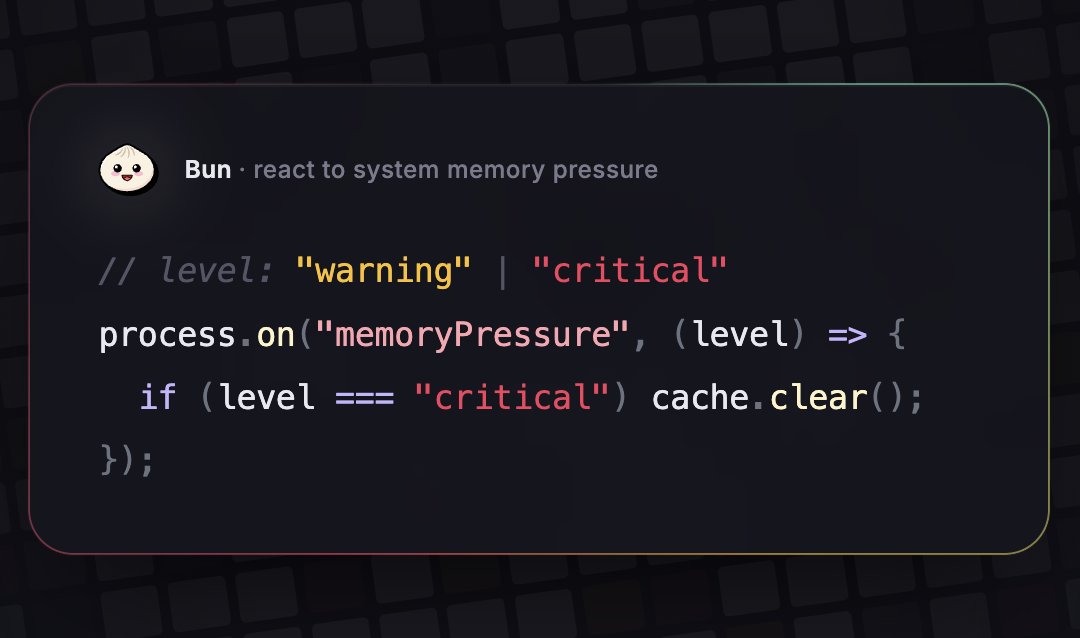 `process` emits a 'memoryPressure' event when the system runs low on memory (thanks @codebytere!)
Bun.sliceAnsi() v1.3.11v1.4.0
Bun.sliceAnsi() slices a string by terminal column width while preserving ANSI colors and terminal hyperlinks, without splitting emoji or other multi-codepoint characters. It replaces the slice-ansi and cli-truncate npm packages, is faster than both, and returns the original string when nothing is cut. #26963
// slice-ansi replacement
Bun.sliceAnsi("\x1b[31mhello\x1b[39m", 1, 4); // "\x1b[31mell\x1b[39m"

// cli-truncate replacement
Bun.sliceAnsi("unicorn", 0, 4, "…"); // "uni…"
Bun.sliceAnsi("unicorn", -4, undefined, "…"); // "…orn"
Bun.wrapAnsi() v1.3.7v1.4.0
Bun.wrapAnsi() is a native, drop-in replacement for the wrap-ansi npm package. It word-wraps text to a column width with the same ANSI/hyperlink/Unicode handling as above, and is up to 88x faster than the JavaScript version. #26061
const wrapped = Bun.wrapAnsi("\x1b[31mThe quick brown fox\x1b[39m", 10);
console.log(wrapped);
// \x1b[31mThe quick\x1b[39m
// \x1b[31mbrown fox\x1b[39m
Bun.stringWidth() v1.3.5v1.4.0
Bun.stringWidth() returns the number of terminal columns a string occupies, accounting for ANSI escape sequences, zero-width Unicode, and multi-codepoint emoji graphemes.
Bun.stringWidth("hello"); // 5
Bun.stringWidth("\x1b[31mhello\x1b[0m"); // 5 (ANSI color)
Bun.stringWidth("\x1b[5A"); // 0 (cursor movement)
Bun.stringWidth("👨👩👧"); // 2 (ZWJ sequence, one grapheme)
Bun.stringWidth("🇺🇸"); // 2 (regional indicator pair)
Bun.stringWidth("\x1b]8;;https://bun.sh\x07Bun\x1b]8;;\x07"); // 3 (terminal hyperlink)It strips every kind of ANSI escape code (color, cursor movement, terminal hyperlinks). It also strips zero-width codepoints such as soft hyphen and combining marks. Emoji measure 2 columns each. That includes flag pairs, skin-tone modifiers, keycaps, and multi-part emoji like 👨👩👧. util.inspect, console.table, and readline use the same implementation. #25447
stringWidth returns the last one — what a terminal actually draws. Same engine backs Bun.sliceAnsi, Bun.wrapAnsi, console.table, and readline. #25447Bun.stringWidth() is 7–56× faster on Chinese, Japanese, and Korean text.
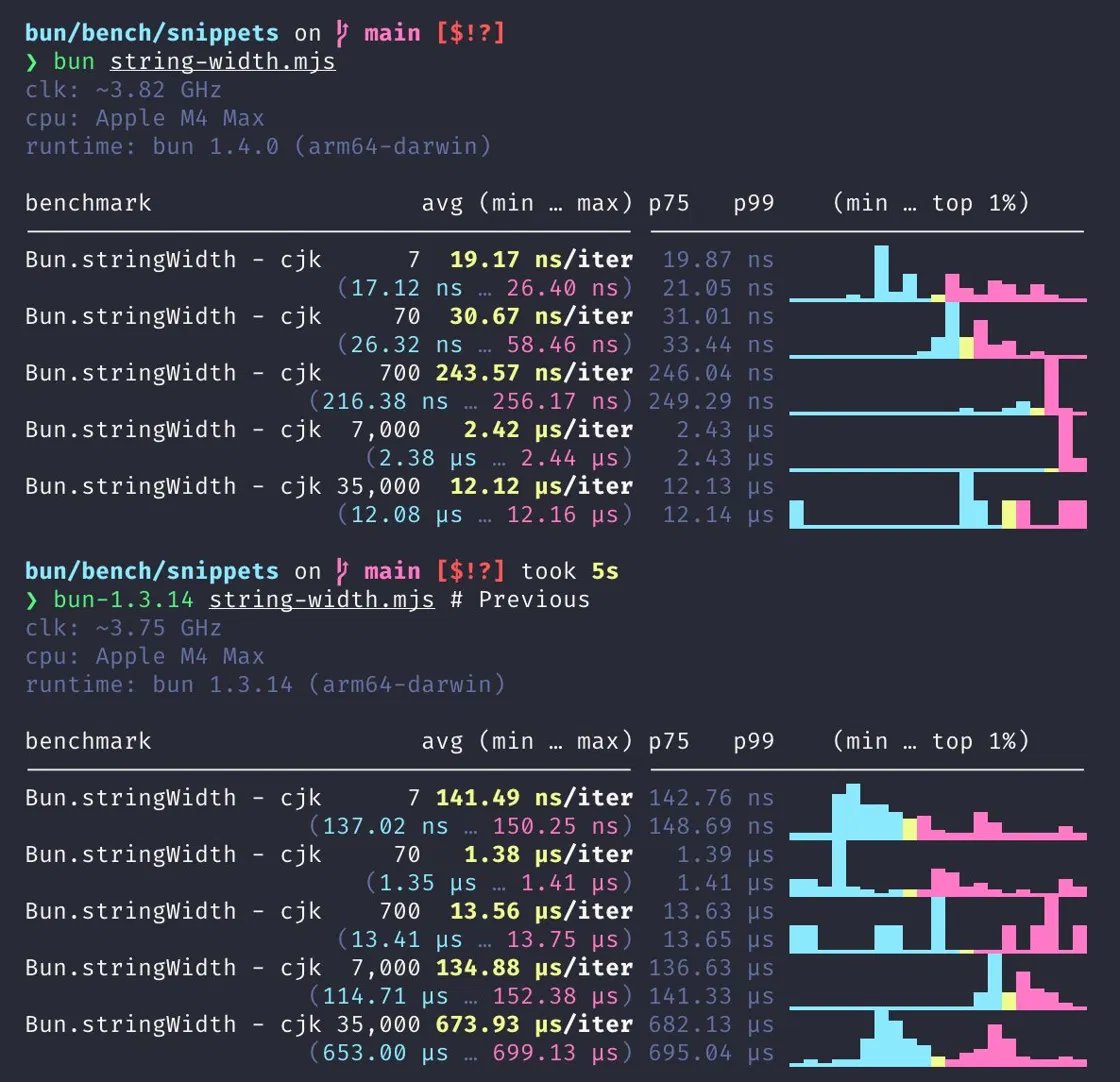 Bun.stringWidth() 处理中文、日文、韩文字符的速度提升了 7~56 倍 Bun.stringWidth() が中国語・日本語・韓国語の文字で 7〜56 倍高速化されました Bun.stringWidth()가 중국어·일본어·한국어 문자에서 7~56배 빨라졌습니다
Bun.spawn({ cgroup }) v1.4.0
On Linux, Bun.spawn() and Bun.spawnSync() accept a cgroup option. It takes the path of an existing cgroup directory, or an open file descriptor for one. The child is placed in the cgroup before it starts running. So limits such as memory.max and pids.max apply from its first instruction, and anything it forks stays inside. If the child exceeds its memory limit, the kernel kills it. The parent is unaffected. Bun only joins the cgroup. Create and configure it first (node:fs is enough), and remove it when you are done.
import { mkdirSync, writeFileSync } from "node:fs";

const dir = "/sys/fs/cgroup/build-jobs";
mkdirSync(dir, { recursive: true });
writeFileSync(`${dir}/memory.max`, String(2 * 1024 ** 3));

const proc = Bun.spawn({ cmd: ["make", "-j8"], cgroup: dir });
On cgroup v2 the child is created inside the cgroup with clone3(CLONE_INTO_CGROUP). Where that is unavailable, Bun writes the child into cgroup.procs before exec. A missing directory fails the spawn with the errno and the path. A frozen cgroup is refused with EBUSY. Otherwise the child would freeze before exec and take the calling thread with it. node:child_process forwards the option. Other platforms ignore it. #37466
Async stack traces from native I/O v1.3.12
Errors thrown from async native APIs like fs.promises, Bun.file(), Bun.S3Client, DNS, crypto, and fetch now include async stack traces that point back to the await in your code. Previously these errors had empty stacks. There was no JavaScript on the call stack when the error was created in native code, so they were effectively impossible to trace. #28652
ENOENT: no such file or directory, open 'foo.txt'
      at async foo (/path/to/app.js:5:8)
The stack is only captured when an error is constructed for rejection, so successful awaits are unaffected.
--cpu-prof v1.3.2
Bun now ships a built-in CPU profiler. Pass --cpu-prof to generate a .cpuprofile in the Chrome CPU Profiler format. It opens directly in Chrome DevTools or VS Code. --cpu-prof-md writes the same profile as a Markdown report: a summary table, top-10 hot functions, self-time and total-time tables, and a call tree. That is useful for pasting into a bug report or feeding to an LLM. --cpu-prof-name, --cpu-prof-dir, and --cpu-prof-interval customize the output path and sampling interval. #24112 #26327 #26620
bun --cpu-prof ./app.ts# Writes CPU.20260615.120000.12345.0.001.cpuprofilebun --cpu-prof-md ./app.ts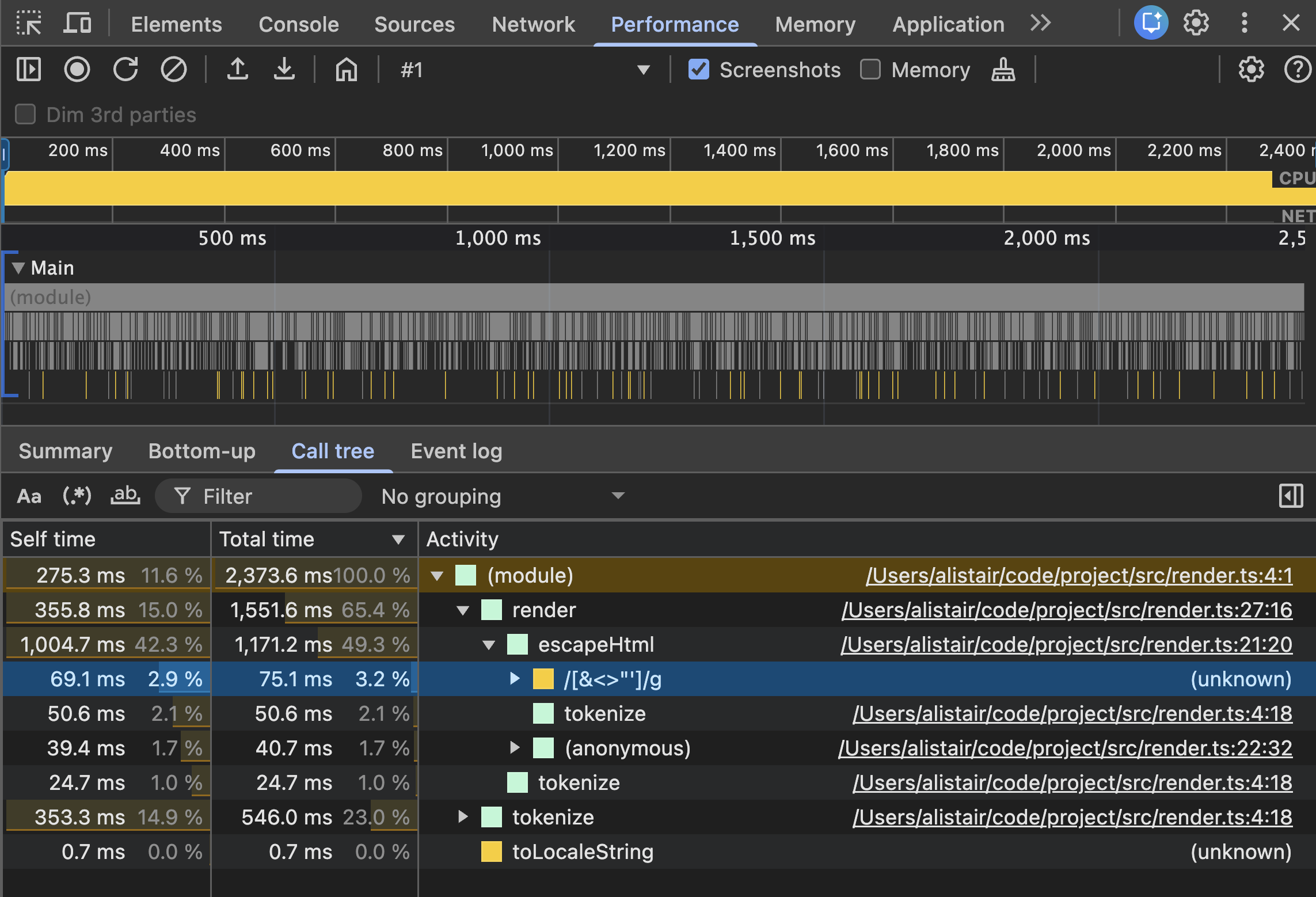 A `bun --cpu-prof` profile opened in Chrome DevTools.
The CPU profiler can be enabled with BUN_CPU_PROFILE=1 (plus optional BUN_CPU_PROFILE_DIR / BUN_CPU_PROFILE_NAME) for processes you can't easily pass --cpu-prof to. #26313
--heap-prof v1.3.7
--heap-prof generates a V8-compatible .heapsnapshot that opens directly in Chrome DevTools, and --heap-prof-md emits a grep-friendly Markdown report with total heap size, top types by retained size, and the largest individual objects. --heap-prof-name and --heap-prof-dir control where the output lands.
# V8-compatible heap snapshot (opens in Chrome DevTools)bun --heap-prof script.js# Markdown heap profile for CLI analysisbun --heap-prof-md script.js--no-env-file v1.3.3
A new --no-env-file flag (and env = false in bunfig.toml) disables Bun's automatic .env loading. This is useful in production and CI. There, environment variables are managed externally and stray .env files should be ignored. Explicit --env-file arguments are still honored. #24767
bun --no-env-file server.ts# bunfig.toml
env = false--no-orphans v1.3.14v1.4.0
A new --no-orphans flag (and [run] noOrphans = true in bunfig, or BUN_FEATURE_FLAG_NO_ORPHANS=1) makes Bun exit when its original parent process dies. It also recursively SIGKILLs all descendants on clean exit. So when your terminal dies, your dev servers die with it. It works on Linux and macOS with no extra thread or file descriptor. On Windows it uses a recursive kill-on-close Job Object plus a parent-process wait (#34768). It applies to bun run <script>, bunx, and --filter. #29930
bun --no-orphans run dev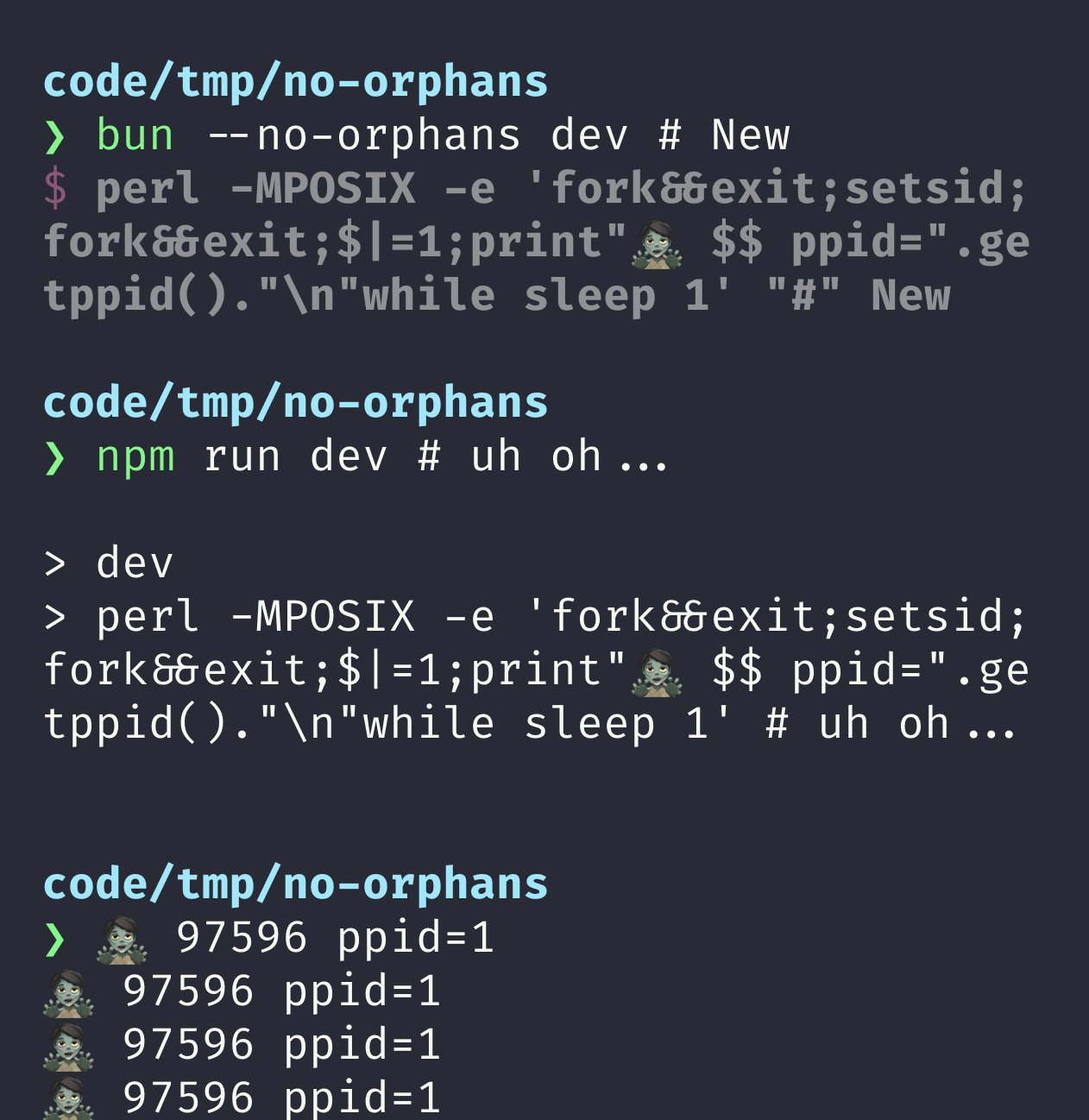 `bun --no-orphans <file|script>` recursively terminates lingering processes on exit
Bun.Transpiler REPL mode v1.3.7
A new replMode option transforms code for interactive REPL evaluation: it captures the last expression's value, hoists declarations so they persist across lines, converts const to let for re-declaration, and auto-detects bare object literals. Pair it with vm.runInContext to build a Node.js-compatible REPL on Bun's transpiler. #26246
Bun.YAML passes 402/402 of yaml-test-suite v1.4.0
Bun.YAML now passes 402/402 yaml-test-suite. This fixes spec-compliance bugs in:
- explicit
?keys - tab indentation
{}-style mappings&anchors on empty values---/...appearing mid-line- the indent and newline-trim modifiers on
|/>strings
YAML.stringify() also now correctly quotes number-like strings ("0e6836", "0123"), strings ending in :, and strings starting with [/{. Cyclic anchors and aliases are supported in parse(). #31527 #37055
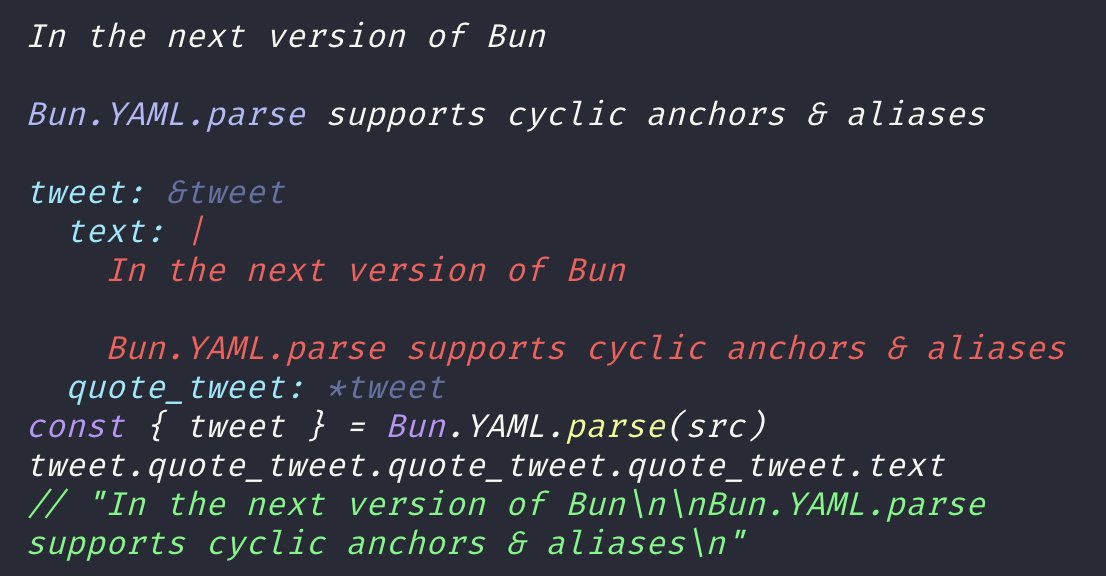 `Bun.YAML.parse` supports cyclic anchors & aliases
WebSocket proxies and Unix sockets v1.3.6v1.4.0
The WebSocket client now supports connecting through HTTP and HTTPS proxies via a new proxy option. It supports ws:// and wss:// over both HTTP and HTTPS proxies, Basic auth via URL credentials, custom proxy headers, and full TLS configuration for the target connection. It also supports Unix domain sockets via ws+unix:// and wss+unix:// URL schemes. These use the same syntax as the npm ws package. #25614 #29203
new WebSocket("wss://example.com", { proxy: "http://user:pass@proxy:8080" });

new WebSocket("ws+unix:///tmp/app.sock:/api/stream?x=1");
WebSocket URL credentials v1.3.7v1.4.0
new WebSocket("ws://user:pass@host") now forwards URL-embedded credentials as a Basic Authorization header. An explicitly provided Authorization header still takes precedence. #26278
SHA-3 and X25519 in Web Crypto v1.3.13
SHA-3 lands in both Web Crypto and node:crypto. crypto.subtle.digest() and HMAC sign/verify now accept SHA3-256/SHA3-384/SHA3-512. createHash/createHmac add sha3-224/256/384/512. crypto.subtle.deriveBits now supports X25519 as well, for deriving a shared secret between two key pairs. Small-order peer public keys are rejected, as RFC 7748 requires. #29323 #29152
await crypto.subtle.digest("SHA3-256", new TextEncoder().encode("hello"));

const bits = await crypto.subtle.deriveBits(
  { name: "X25519", public: bobPublicKey },
  alicePrivateKey,
  256,
);
structuredClone preserves object identity v1.4.0
structuredClone preserves object identity for Date, RegExp, Error subclasses, DOMException, CryptoKey, KeyObject, X509Certificate, Blob, and File: the same instance referenced twice comes back as one object. #32796
Bun.CSRF sessionId v1.4.0
Bun.CSRF.generate() and Bun.CSRF.verify() accept a new sessionId option that binds a token to a specific principal via HMAC associated data. Tokens generated for one session won't verify under another, and verification fails closed if sessionId is supplied on only one side; tokens without sessionId are unchanged. #31215
Bun.udpSocket() connection-refused errors and truncation flags v1.3.12
On Linux, sending to a dead port now fires the error handler with ECONNREFUSED instead of silently timing out. The data callback also gains a fifth flags argument with { truncated: boolean } to detect when a datagram exceeded the receive buffer. #28827
Grapheme clusters for Indic scripts v1.3.7
We rewrote grapheme cluster segmentation with Indic Conjunct Break support. Devanagari and other Indic conjuncts now segment as single clusters. #26376
Bun.S3Client v1.3.1v1.4.0
Bun.S3Client now supports AWS Requester Pays buckets. Pass requestPayer: true on the client or per-operation to send the x-amz-request-payer header on every request, including each part of a multipart upload. #25514
const s3 = new Bun.S3Client({
  bucket: "hl-mainnet-evm-blocks",
  requestPayer: true,
});
const data = await s3.file("0/0/1.rmp.lz4").arrayBuffer();
Other S3 fixes:
write()andwriter()now acceptcontentDispositionandcontentEncoding.presign()honorscontentDispositionandtype.slice(0, N).stream()sends the correctRangeheader.queueSizeis respected instead of being silently overridden to 255.- A memory leak in
list()has been fixed.
#25363 #26149 #25999 #27273 #29813 #23880
Bun.sql is more reliable v1.3.11v1.4.0
const sql = new Bun.SQL({ prepare: false });
await sql`SELECT 1`; // now safe behind PgBouncer transaction pooling- PgBouncer transaction pooling: with
prepare: false, Bun now sends each query in a single round-trip instead of two, so PgBouncer can no longer split it across Postgres connections and return the wrong query's results. #27952 - Docker startup windows: when a pooled connection is accepted then closed before the handshake completes (as happens with Docker while a containerized database is still starting), Bun now retries with exponential backoff until
connectionTimeoutelapses instead of failing every waiting query. #32028
Named parameters in Bun.sql for SQLite v1.4.0
sql.unsafe() and sql.file() accept an object of named parameters for :name, $name, and @name placeholders. Previously an object bound nothing, so a SELECT returned no rows and no error. Keys keep their prefix ({ ":id": 1 }) unless the connection sets strict: true. #37109
SQLite 3.53.0 v1.3.14
bun:sqlite's bundled SQLite is upgraded to 3.53.0; db.close(true) no longer throws "database is locked" after db.transaction(); non-UTF-8 TEXT values under 64 bytes decode leniently to U+FFFD instead of returning "". #27912
Bun.isStandaloneExecutable v1.4.0
Bun.isStandaloneExecutable is a new read-only boolean, true inside a bun build --compile binary; unlike checking Bun.embeddedFiles.length > 0, reading it allocates nothing. #32583
bun init --react=tanstack v1.3.4
bun init --react=tanstack is a new template that scaffolds a TanStack Start project with file-based routing, Vite, and Tailwind, running on Bun. #24648
fetch()#
fetch() response backpressure v1.4.0
fetch() now applies backpressure when streaming a response body. Once a chunk is delivered to JavaScript and nothing has consumed it, the HTTP thread pauses reading from the socket instead of buffering the entire body in memory. Buffered consumers like .text(), .json(), and .arrayBuffer() opt out and still receive the body in one shot. #29831
const res = await fetch("https://example.com/large.bin");
for await (const chunk of res.body) {
  // The HTTP thread pauses reading while this loop is busy,
  // instead of buffering the whole file in memory.
  await process(chunk);
}
HTTPS proxies reuse CONNECT tunnels v1.3.12v1.4.0
fetch() through an HTTPS proxy now reuses CONNECT tunnels. The tunneled TLS session is pooled across sequential requests to the same target. Before, every request paid a fresh CONNECT + TLS handshake. The tunnel is also reused when the request passes tls options such as ca, cert, or key. Previously every such request opened a new connection to the proxy and redid the CONNECT and both TLS handshakes. #37715
Custom TLS options reuse keep-alive connections v1.3.10
fetch() with custom TLS options now reuses keepalive connections. Identical SSL configs (client certificates, custom CA, mTLS) are interned with reference counting for O(1) pointer-equality matching, with an LRU-bounded context cache.
Header name casing is preserved on the wire v1.3.7
fetch() preserves header name casing on the wire instead of lowercasing it. Headers are case-insensitive per RFC 7230, but plenty of real-world servers reject content-type while accepting Content-Type. #26425
HTTP_PROXY is re-read at runtime v1.3.12
process.env.HTTP_PROXY / HTTPS_PROXY / NO_PROXY set at runtime now take effect on the next fetch() call instead of only being read once at startup. #28614
Test runner#
onTestFinished() v1.3.2
bun:test exports onTestFinished(), a Vitest-compatible hook that registers a callback to run after the current test completes, after all afterEach hooks. It can only be called inside a test body, so you can clean up resources that were created during the test. #24038
import { test, onTestFinished } from "bun:test";

test("uses a temp resource", () => {
  const handle = open();
  onTestFinished(() => handle.close());
  // ...
});
bun test --only-failures v1.3.1
bun test --only-failures suppresses output for passing and skipped tests, printing only failures and the final summary. #23312
bun test --only-failurestest/example.test.ts:
(fail) failing test
error: expect(received).toBe(expected)
Expected: 3
Received: 2
5 pass
1 skip
1 fail
Ran 7 tests across 1 file.bun test --path-ignore-patterns v1.3.11
bun test --path-ignore-patterns (and test.pathIgnorePatterns in bunfig.toml) excludes test files by glob, so you can skip integration tests, generated fixtures, or whole directories without renaming files. #28089
bun test --pass-with-no-tests v1.3.1
bun test --pass-with-no-tests exits with code 0 when no tests match, matching Jest and Vitest. Useful in monorepos where a shared pattern runs across packages that may not all contain tests. #23424
bun test --grep v1.3.6
bun test now accepts --grep as an alias for -t / --test-name-pattern, matching Mocha and Jest. #25788
using spy = spyOn(...) v1.3.9
spyOn() and mock() now implement Symbol.dispose, so using spy = spyOn(obj, "method") automatically restores the original implementation when the spy goes out of scope. No manual mockRestore() or afterEach cleanup needed. #26692
The vi global v1.3.1v1.4.0
The vi global (Vitest compatibility alias) is now defined in bun test, so files that call vi.fn() or vi.mock() without importing run unmodified. #23674
Timeouts on beforeAll / afterAll hooks v1.3.2v1.4.0
beforeAll, beforeEach, afterAll, and afterEach now accept a numeric timeout or { timeout } options object as the second argument instead of throwing. #24039
Bundler#
Execute-only standalone binaries on Linux v1.3.12
Standalone executables on Linux now embed the module graph in a segment the OS loads into memory with the rest of the binary. Before, they opened and read their own executable file at startup. bun build --compile binaries start with zero file I/O and run with execute-only permissions (chmod 111). This matches the existing behavior on macOS and Windows. #26923
bun build --compile ./app.ts --outfile=appchmod 111 ./app./app # works, no read permission neededuseDefineForClassFields and "jsx": "react-jsx" in tsconfig.json v1.4.0
useDefineForClassFields: false is honored. Instance field initializers move into the constructor after parameter-property assignments, as tsc does. And "jsx": "react-jsx" selects the production automatic runtime (jsx/jsxs from <pkg>/jsx-runtime). "react-jsxdev" selects jsxDEV. #36664 #34422
Native using and await using for --target=bun v1.3.14v1.4.0
using and await using declarations are no longer lowered to helper functions when targeting Bun. JavaScriptCore supports explicit resource management natively, so the runtime transpiler, bun build --target=bun, and the REPL now emit them as-is. Browser and Node targets continue to lower as before. #29538
var __using = (stack, value, async) => { /* ... */ };
var __callDispose = (stack, error, hasError) => { /* ... */ };
let __stack = [];
try {
  const x = __using(__stack, { [Symbol.dispose]() {} }, 0);
  console.log("hi");
} catch (_) { var _err = _, _hasErr = 1; }
finally { __callDispose(__stack, _err, _hasErr); }
using x = { [Symbol.dispose]() {} };
console.log("hi");
emitDecoratorMetadata implies legacy decorators v1.3.11
Setting emitDecoratorMetadata: true in tsconfig.json now implies legacy decorator semantics even when experimentalDecorators is omitted, fixing NestJS, TypeORM, and Angular projects that crashed with descriptor.value is undefined.
--compile-executable-path v1.3.6
bun build --compile gains --compile-executable-path to point at a local Bun binary instead of downloading one when cross-compiling, and using an already-compiled standalone executable as that base no longer panics or produces a corrupt Mach-O binary.
reactFastRefresh and allowUnresolved in Bun.build() v1.3.6
Bun.build() gains reactFastRefresh: true (works on all targets). It also gains allowUnresolved: string[], which controls which dynamic-import glob shapes are permitted at bundle time. Other fixes:
definevalues starting with*,?,(, or)are now correctly auto-quoted.- Calling
Bun.build()from inside a macro throws a clear deadlock error instead of hanging. - Repeated in-process builds no longer panic after ~2000 iterations.
browser field remaps for Node builtins v1.4.0
--target=browser now applies package.json "browser" remaps to Node builtins before falling back to Bun's polyfills. It also applies them to main/index resolutions written without an extension. jszip bundles at 149 KB instead of 459 KB. The legacy jsnext:main field gets the same module→main fallback. #36597 #36620 #35447
Code splitting on 20,000-module graphs is 14× faster v1.4.0
The code-splitting reachability walk is now BFS and O(V+E), taking a 20,000-module diamond-shaped DAG from 4.65 s to 320 ms. Separately, the tree-shaking liveness, TLA validation, CSS-order, and part-visitor passes moved from recursion to explicit stacks, so linear import chains of thousands of modules no longer stack-overflow.
Node.js compatibility#
node:http v1.3.4v1.4.0
The node:http client has been rewritten as a direct port of Node's _http_client.js. It replaces the previous fetch()-based shim. http.ClientRequest now runs on net/tls sockets, Node's own HTTP parser, and an Agent socket pool. So keep-alive reuse, Upgrade/CONNECT, 1xx 'information' events, and createConnection all behave exactly as they do in Node.
import http from "node:http";

const agent = new http.Agent({ keepAlive: true, maxSockets: 4 });

const req = http.request({ host: "example.com", agent }, (res) => {
  res.on("data", (chunk) => process.stdout.write(chunk));
});
req.on("information", (info) => console.log("1xx:", info.statusCode));
req.end();
Keep-alive agents reuse sockets exactly as in Node: subsequent requests through an http.Agent with keepAlive: true are 65.9% faster, with 190% higher overall throughput. #24351
On the server, headersTimeout, requestTimeout, and keepAliveTimeout fire with Node's connectionsCheckingInterval sweep and raw 408 reply. Also:
- HTTP/1.1 pipelining is supported with
maxRequestsPerSocket. closeIdleConnections()andcloseAllConnections()count correctly.- Connection sockets are real
net.Socketinstances with Node's'connection'/'clientError'/'close'lifecycle. - Per-server
insecureHTTPParserandmaxHeaderSizeare honored.
import http from "node:http";

const server = http.createServer((req, res) => res.end("ok"));
server.headersTimeout = 10_000; // 408 if headers not complete in 10s
server.requestTimeout = 30_000; // 408 if request not complete in 30s
server.keepAliveTimeout = 5_000; // close idle keep-alive sockets after 5s
server.listen(3000);
node:http2 v1.4.0
node:http2 has a spec-compliant HTTP/2 parser. Server push works end to end via pushStream() and createPushResponse(), and Node API parity now covers raw headers, graceful connection shutdown, and respondWithFD. 93.2% of Node v26.3.0's byte-identical test suite passes. #31584
import http2 from "node:http2";

const server = http2.createSecureServer({ key, cert });
server.on("stream", (stream, headers) => {
  stream.pushStream({ ":path": "/app.css" }, (err, push) => {
    push.respondWithFile("./public/app.css", { "content-type": "text/css" });
  });
  stream.respond({ ":status": 200, "content-type": "text/html" });
  stream.end("<link rel=stylesheet href=/app.css>");
});
node:net and node:tls v1.4.0
socket.end() now half-closes the connection instead of full-closing it. resetAndDestroy(), write-after-end errors, and ECONNRESET shapes are now correct. net.Socket#connect() and Bun.connect() accept localAddress and localPort. These bind outgoing sockets to a specific local interface. TLS gains:
'session'and'keylog'events- structured OpenSSL errors (
err.code/err.library/err.reason) SNICallback/ALPNCallback- PFX support
import tls from "node:tls";
import { appendFileSync } from "node:fs";

const socket = tls.connect(443, "example.com", { servername: "example.com" });
socket.on("keylog", (line) => appendFileSync("keys.log", line)); // for Wireshark decryption
socket.on("session", (session) => {
  // Session ticket for TLS resumption
});
node:worker_threads v1.4.0
A worker with an unsettled top-level await exits with code 13. process.abort() inside a worker ends only that worker. node:worker_threads gains:
postMessageToThread()and the'workerMessage'eventmarkAsUntransferable/markAsUncloneableenv: SHARE_ENV- captured stdio (
{ stdout: true }) - worker introspection (
getHeapStatistics(),cpuUsage(),startCpuProfile())
MessagePort's close() callback timing, 'close' event delivery to both ends of a channel, and DataCloneError transfer-list messages now pass Node's own suite. That suite is at 73.9% overall, up from ~37% in Bun 1.3.
import { Worker, SHARE_ENV } from "node:worker_threads";

const w = new Worker("./worker.js", {
  env: SHARE_ENV, // live, write-through process.env
  stdout: true, // captured stdio
});
w.stdout.pipe(process.stdout);

const stats = await w.getHeapStatistics();
node:fs v1.4.0
fs.cp and cpSync get Node's full ERR_FS_CP_* error semantics, fs.watch gains the ignore option, and fs.promises.watch gains AbortSignal support. node:fs now passes 97.5% of Node v26.3.0's fs tests (99.1% excluding tests that require --expose-internals).
import { watch } from "node:fs/promises";

const ac = new AbortController();
for await (const { eventType, filename } of watch("./src", {
  recursive: true,
  ignore: (path) => path.includes("node_modules"),
  signal: ac.signal,
})) {
  console.log(eventType, filename);
}
node:stream v1.4.0
The experimental stream/iter and zlib/iter APIs land behind --experimental-stream-iter, readable.read() returns one buffered chunk at a time (Node 26's semver-major change), and pipeline() reports the real failure ahead of any internal AbortError. node:stream passes 96.9% of Node v26.3.0's stream tests.
// bun --experimental-stream-iter app.js
import { map, filter } from "node:stream/iter";
import { createReadStream } from "node:fs";

const lines = createReadStream("access.log", "utf8");
for await (const hit of filter(
  map(lines, (l) => l.trim()),
  (l) => l.includes("POST"),
)) {
  console.log(hit);
}
process v1.4.0
Setting process.env.TZ now updates existing Date instances. process.env now behaves like Node's: assigned values are coerced to strings, and structuredClone(process.env) works. --no-warnings, --trace-warnings, --trace-deprecation, --redirect-warnings, and --disable-warning are all wired up. process jumps from 60.5% to 84.2% on Node v26.3.0's tests. #31831
const now = new Date();
process.env.TZ = "America/Los_Angeles";
console.log(now.toString()); // existing Date reflects the new timezone

process.env.PORT = 3000;
console.log(process.env.PORT); // "3000" (coerced to string)
AsyncLocalStorage v1.4.0
AsyncLocalStorage gains the Node 26 defaultValue/name constructor options and AsyncLocalStorage.prototype.withScope(). AsyncResource.bind() now preserves the original function's .length and this. Coverage of Node's async_hooks tests doubles to 50%. #31825
import { AsyncLocalStorage } from "node:async_hooks";

const requestId = new AsyncLocalStorage({
  name: "requestId",
  defaultValue: "-",
});

{
  using scope = requestId.withScope(crypto.randomUUID());
  console.log(requestId.getStore()); // the UUID
}
console.log(requestId.getStore()); // "-"
node:vm v1.4.0
Top-level await in a SourceTextModule resumes after the await, and node:vm adds the v26 module-linking API (linkRequests(), instantiate(), moduleRequests, hasTopLevelAwait()) and implements microtaskMode: 'afterEvaluate', taking Node v26.3.0's vm suite from 72% to 97%. #32018
import vm from "node:vm";

const ctx = vm.createContext({ console }, { microtaskMode: "afterEvaluate" });
const mod = new vm.SourceTextModule(
  `export const n = await Promise.resolve(42);`,
  { context: ctx },
);
await mod.linkRequests(() => {});
mod.instantiate();
await mod.evaluate();
console.log(mod.namespace.n); // 42
node:cluster v1.4.0
node:cluster shares sockets between workers. Bun 1.4 implements round-robin scheduling (the primary accepts connections and hands the file descriptors to workers over IPC), SCHED_NONE shared handles, UDP clustering, and worker.send(msg, socket) handle passing. #31829
import cluster from "node:cluster";
import http from "node:http";
import { availableParallelism } from "node:os";

if (cluster.isPrimary) {
  for (let i = 0; i < availableParallelism(); i++) cluster.fork();
} else {
  http
    .createServer((req, res) => res.end(`hello from ${process.pid}`))
    .listen(3000);
}
vitest --coverage v1.4.0
node:inspector now implements the V8 Profiler coverage methods, so vitest --coverage with the default v8 provider works under Bun. Per-file statement, branch, function, and line percentages, and the uncovered-line report, match Node exactly on the same project. #32476
bun --bun vitest run --coverage % Coverage report from v8
-----------|---------|----------|---------|---------|-------------------
File | % Stmts | % Branch | % Funcs | % Lines | Uncovered Line #s
-----------|---------|----------|---------|---------|-------------------
All files | 87.43 | 76.19 | 88.88 | 87.43 |chrome://inspect v1.4.0
inspector.open(), inspector.url(), inspector.close(), and inspector.waitForDebugger() are implemented. Bun starts a WebSocket server that speaks the Chrome DevTools Protocol. It serves the same discovery endpoints as Node and prints Node's Debugger listening on ws://... line. So chrome://inspect and VS Code's debugger discover and attach to a running Bun process. #32479
import inspector from "node:inspector";

inspector.open(9229, "127.0.0.1");
console.log(inspector.url()); // ws://127.0.0.1:9229/...
inspector.waitForDebugger(); // blocks until DevTools attaches
node:test v1.4.0
Subtests work. t.test(), t.describe(), and top-level test()/describe() called inside a running test now execute inline instead of throwing NotImplementedError. node:test also gains:
t.plan()andt.waitFor()getTestContext()mock.timersandmock.property()- runtime
t.skip()/t.todo() - test tags
- custom assertions via
assert.register() (t, done) => {}callback tests
t.mock is now a per-test tracker. It resets automatically when the test finishes. 20 of Node v26.3.0's test_runner tests now pass, up from 7. #32631
import { test } from "node:test";

test("parent", async (t) => {
  t.plan(2);
  await t.test("a", () => {});
  await t.test("b", () => {});
});

test("timers", (t) => {
  t.mock.timers.enable({ apis: ["setTimeout", "Date"] });
  let fired = false;
  setTimeout(() => (fired = true), 1000);
  t.mock.timers.tick(1000);
  t.assert.strictEqual(fired, true);
});
node:test gains the programmatic run() API. Each file runs in its own child process. The returned TestsStream emits Node's event sequence (test:enqueue/dequeue, test:pass/fail, per-file and run-level test:summary) as both events and objectMode chunks. Node v26's expectFailure option lands. A throwing body is the expected outcome. A passing one fails with failureType: 'expectedFailure'. Two divergences reachable from plain bun test are also fixed. A skipped describe no longer runs its callback. { skip: true, todo: true } is treated as a skip. Node v26.3.0's test_runner suite goes from 20 to 26 of 81 passing. #34444
import { run } from "node:test";

const stream = run({ files: ["./a.test.js", "./b.test.js"] });
stream.on("test:fail", ({ name, details }) =>
  console.error(name, details.error.message),
);
node:quic v1.4.0
node:quic is now implemented. It is backed by lsquic, which Bun already vendors for HTTP/3. The full experimental Node v26 API is covered:
listen()andconnect()- bidirectional and unidirectional streams
- HTTP/3 and raw-QUIC applications
- datagrams
- 0-RTT session resumption
- path migration
- stateless resets
- per-SNI certificates
- qlog and keylog
All 235 vendored Node v26.3.0 node:quic tests pass on a release build. #32602
Bun-to-Bun runs at 1.31× Node-to-Node throughput (64,591 vs 49,239 req/s, one HTTP/3 stream per request at concurrency 50, Linux x64). Node's published binaries compile QUIC out, so running the same code there requires a from-source --experimental-quic build.
import { listen } from "node:quic";

const endpoint = await listen(
  (session) => {
    session.onstream = (stream) => stream.closed.catch(() => {});
  },
  {
    sni: { "*": { keys: [key], certs: [cert] } },
    onheaders() {
      this.sendHeaders({ ":status": "200" });
      this.writer.endSync();
    },
  },
);
node:sqlite v1.3.2v1.4.0
node:sqlite is now implemented. It passes all 18 of Node v26.3.0's test-sqlite-* files (319 subtests, 0 failures, 4 skips, on Linux x64). macOS skips more, because Apple's system libsqlite3 omits some features. It is backed by the same bundled SQLite as bun:sqlite. Supported:
DatabaseSyncandStatementSyncbackup()- sessions and changesets
- user-defined scalar, aggregate, and window functions
- the authorizer callback
process.versions.sqlite
import { DatabaseSync } from "node:sqlite";
const db = new DatabaseSync(":memory:");
db.exec(`CREATE TABLE data(key INTEGER PRIMARY KEY, value TEXT) STRICT`);
const insert = db.prepare("INSERT INTO data (key, value) VALUES (?, ?)");
insert.run(1, "hello");
insert.run(2, "world");
console.log(db.prepare("SELECT * FROM data ORDER BY key").all());
// [ { key: 1, value: 'hello' }, { key: 2, value: 'world' } ]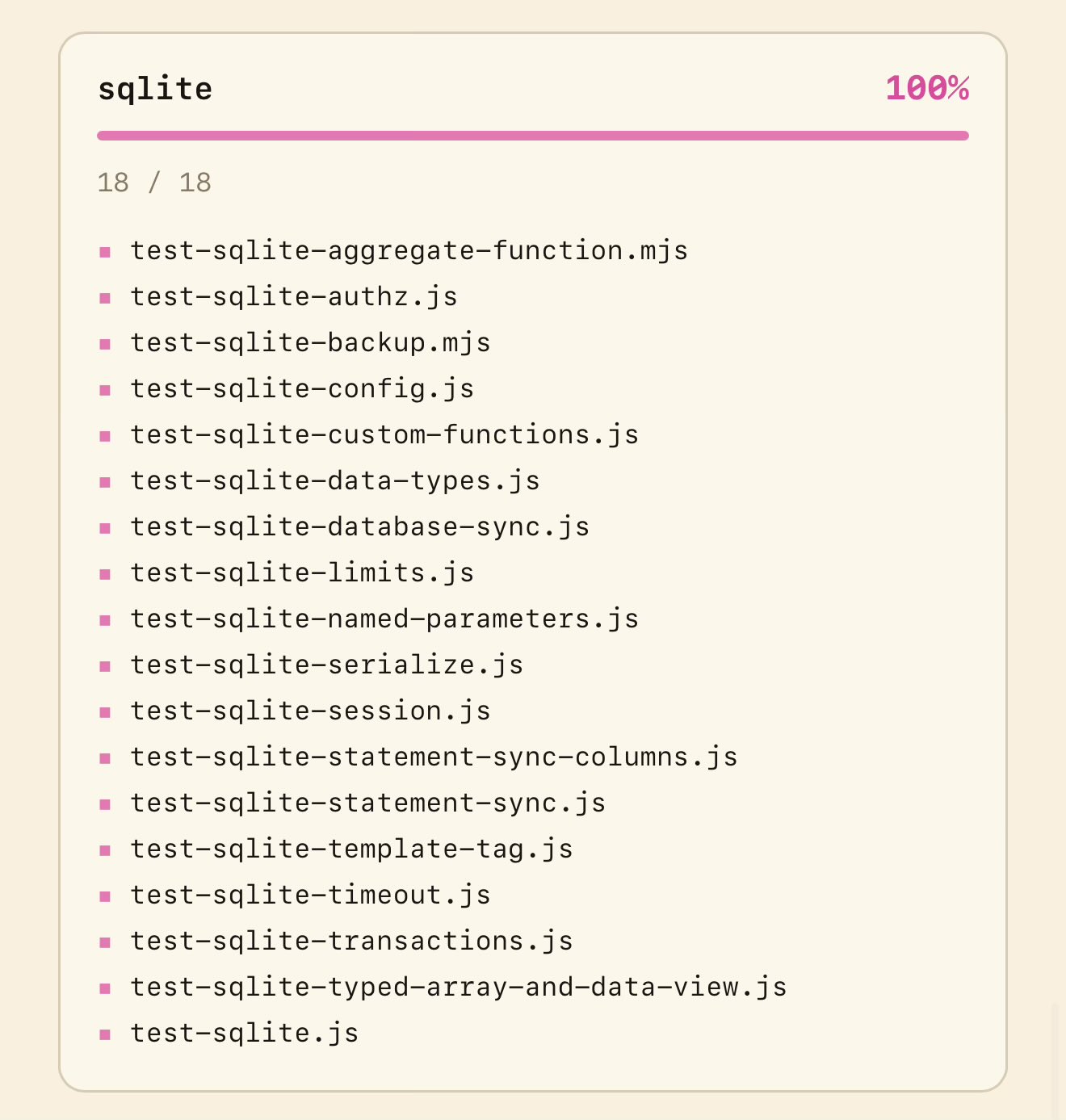 node:sqlite is fully implemented and passes 100% of Node.js’ test suite
vm.Script,vm.SourceTextModule, andvm.compileFunctionrelease their results to GC; a GC-root cycle between the script and its fetcher retained every call forever, so after 500 iterations and a GC, retainedScriptobjects drop from +500 to +0. #28493fs.createReadStream().pipe(serverResponse)completes whenServerResponseis used standalone without an underlying socket;writableNeedDraindefaulted totrue, pausing piped streams, which broke Vite's static file serving and other connect-to-web middleware adapters. #24137Module._resolveFilenameforwardsoptions.pathsto overridden resolvers and honors custom paths when called directly, whichbun --bun next buildon Next.js 16 + React Compiler + Turbopack depends on. #24325
node:repl v1.4.0
node:repl is now a working port of Node v26.3.0's REPL. Before, it was a stub that threw on use. It passes 75.2% of Node's repl tests. This includes line editing and keybindings, multi-line continuation (unfinished statements get a | prompt instead of a syntax error), top-level await, tab completion, and persistent history. A new --interactive flag drops you straight into it. For interactive use, prefer bun repl, which has Bun-specific features like syntax highlighting. --interactive and node:repl are for tools that programmatically embed Node's REPL. #31827
bun --interactiveconst res = await fetch("https://bun.sh")res.status200node:trace_events v1.4.0
node:trace_events is now fully implemented. It passes 100% of Node v26.3.0's trace tests. Bun supports --trace-events-enabled, --trace-event-categories, and --trace-event-file-pattern. It writes node_trace.${rotation}.log in Chrome trace format. It instruments timers, fs, and http with category-gated events that are zero-cost when tracing is off. #31824
bun --trace-events-enabled --trace-event-categories=node.fs.async,node.http app.jsls node_trace.*.lognode_trace.1.lognode:domain
node:domain is now a real implementation instead of a ~70-line stub. It passes 66.7% of Node's domain tests. Domains propagate via Bun's AsyncLocalStorage machinery. Uncaught exceptions route into the active domain before 'uncaughtException'. EventEmitter integrates with domains the same way it does in Node. #31828
import domain from "node:domain";

const d = domain.create();
d.on("error", (err) => console.error("caught by domain:", err.message));
d.run(() => {
  setTimeout(() => {
    throw new Error("boom");
  }, 10);
});
node:buffer v1.4.0
node:buffer now passes 92.9% (65/70) of Node.js v26.3.0's test-buffer*.js suite. Buffer.indexOf/lastIndexOf/includes gain the end parameter. Buffer.concat/copy range validation matches Node. ERR_INVALID_ARG_TYPE/ERR_OUT_OF_RANGE messages are formatted identically to Node's, including grouped type lists and numeric separators for large values. #32626
Buffer.byteLength() no longer under-counts unpaired surrogates, so it agrees with Buffer.from(s).length, and lastIndexOf with utf16le encoding no longer matches on odd byte offsets. #32784
const s = "\ud800a".repeat(17);
Buffer.byteLength(s, "utf8"); // before: 51, after: 68
Buffer.from(s, "utf8").length; // 68 (now matches)
TextDecoder supports all WHATWG encodings v1.4.0
TextDecoder now supports every encoding in the Encoding Standard. Sixteen previously-missing single-byte encodings (iso-8859-2, -5, -16, koi8-r, windows-1251, and others) are added, all 228 spec labels are recognized, and EUC-JP, Big5, ISO-2022-JP, and BOM handling during streaming decode now match the spec byte-for-byte. #32837
new TextDecoder("iso-8859-5"); // no longer throws RangeError
new TextDecoder("csisolatin5"); // label alias, also works
uid and gid for child processes v1.4.0
Bun.spawn, Bun.spawnSync, and node:child_process now honor the uid and gid options. They change the child's user and group IDs before exec. Behavior matches Node/libuv: setgroups then setgid then setuid on POSIX, and ENOTSUP on Windows. EPERM is surfaced synchronously when the caller lacks permission. #33060
import { spawnSync } from "node:child_process";

// as root:
spawnSync("id", { uid: 65534, gid: 65534 });
// child reports uid=65534 gid=65534, supplementary groups dropped
NODE_COMPILE_CACHE v1.4.0
module.enableCompileCache() and the NODE_COMPILE_CACHE environment variable now persist bytecode to disk between runs. --cpu-prof and --heap-prof write V8-format profiles with Node's filename convention. --watch-kill-signal delivers the configured signal to JS listeners before restarting. The Node 26 Assert class and a native assert.partialDeepStrictEqual are implemented. Throws inside fs/dns/pbkdf2 callbacks now route to 'uncaughtException' instead of 'unhandledRejection'. node:url reaches 83.0% on Node's test suite. new URL(bad) throws Node's exact TypeError: Invalid URL shape. #34660
NODE_COMPILE_CACHE=~/.cache/bun bun app.jsDatadog continuous profiling works v1.4.0
dd-trace with profiling: true and @datadog/pprof now load and profile in Bun. v8::CpuProfiler is backed by JavaScriptCore's sampling profiler. The nan ObjectWrap template pattern (FunctionTemplate::SetClassName, InstanceTemplate, PrototypeTemplate, Signature) is implemented. So are the rest of the 89 V8 and Node symbols pprof's prebuild links against. The returned profile correctly attributes wall-clock samples to the hot function with full stack depth. #36747
import { time } from "@datadog/pprof";

time.start({ intervalMicros: 1000 });
// ... code to profile ...
const profile = await time.stop(); // pprof-format profile
await worker.terminate() waits for the thread v1.4.0
Worker threads are joined by their parent. await worker.terminate() resolves with the exit code only once the thread is gone, and every worker it spawned too. Everything the worker posted before exiting is delivered before 'exit'. A worker's "may run script" gate closes the moment its stop is requested. So no timer, socket callback, or thread-pool completion dispatches into a worker that is being stopped. Off-thread completions reach their VM through a handle that teardown closes. A late one is refused and released instead of touching freed memory.
import { Worker } from "node:worker_threads";

const w = new Worker("./heavy.js");
const code = await w.terminate(); // resolves 1 for a running worker
// the thread and its nested workers are gone
This work landed in #38299, #38436, #38457, and #38660.
The event loop stays fair under a worker that posts faster than its parent can deserialize: message drains take a bounded budget per turn, so a message flood no longer starves timers, I/O, or the worker's own pending stop.
Node-API version 10 v1.4.0
Bun now reports Node-API version 10, syncs the public headers from Node 26, and implements the five NAPI_EXPERIMENTAL node_api_* functions Node 26 added. #34146 #36804 #34147
N-API finalizers run in LIFO order at exit v1.3.13
napi_wrap finalizers now run in LIFO order at process exit. This fixes shutdown segfaults in kuzu, duckdb, sqlite3, node-llama-cpp, and @napi-rs/canvas. Two crashes in napi_create_external_buffer and UTF-8 property-name handling were fixed. This unblocks napi-rs addons like impit. ThreadSafeFunction finalizer cleanup no longer crashes or hangs. napi_delete_reference is now callable from inside a finalizer. napi_typeof correctly reports wrapped callbacks and boxed primitives.
tls.setDefaultCACertificates() and secureContext.addCACert() v1.4.0
node:tls gains per-context secureContext.addCACert() and process-wide tls.setDefaultCACertificates(). #31155
node:http2 diagnostics_channel, AltSvc, extended CONNECT, and allowHTTP1 v1.4.0
node:http2 gains diagnostics_channel instrumentation, AltSvc and Origin frames, extended CONNECT, and allowHTTP1 fallback for the compatibility server. #31584
fs.mkdtempDisposable() and FileHandle#pull()/#writer() v1.4.0
fs.mkdtempDisposable() and FileHandle.prototype.pull()/.writer() are implemented, and fs.watch no longer drops events when two files change in the same millisecond. #31830
node:zlib brotli and zstd dictionaries v1.4.0
node:zlib supports brotli and zstd dictionaries, reset() is Node-compatible, async write() accepts growable SharedArrayBuffer, and zstdCompress accepts explicit undefined/null options. Node's zlib suite passes at 96.8%. #34427 #36555 #36423
node:util: styleText hex colors, getCallSites, tty.WriteStream v1.4.0
styleText hex colors, getCallSites, regexp highlighting, and tty.WriteStream are now implemented. parseArgs matches Node's property insertion order and treats null boolean flags as absent. MIMEType error messages match ERR_INVALID_MIME_SYNTAX. types.isBigIntObject/isSymbolObject/isBoxedPrimitive handle modified boxed primitives. #34434 #34601 #33769 #34611 #34872
v8.GCProfiler v1.4.0
node:v8 adds v8.GCProfiler (backed by JavaScriptCore's HeapObserver) and v8.isStringOneByteRepresentation().
ws-compatible 'upgrade' and 'unexpected-response' events v1.4.0
Bun's WebSocket client emits 'upgrade' and 'unexpected-response' events, matching the ws package. #36272
dns.promises.getDefaultResultOrder() and getServers() v1.3.12
node:dns/promises now exports getDefaultResultOrder() and getServers(), fixing Vite 8 builds. #28949
SIGWINCH on Windows v1.3.3
On Windows, SIGWINCH now fires on terminal resize (unblocking TUI libraries like opentui and opencode), and SIGHUP/SIGBREAK fire on console close and Ctrl+Break. #24704
--use-system-ca reads Node's Windows certificate stores v1.3.14
--use-system-ca on Windows now reads the same certificate stores Node.js does (ROOT, CA, and TrustedPeople across local-machine, current-user, group-policy, and enterprise locations), fixing intranet servers that omit their intermediate chain. #30408
Package manager#
Lockfile migration v1.4.0
bun install's npm package-lock.json migrator now supports lockfileVersion 1 through 4, including bundled and nested dependencies, optionalPeers, and overrides.
Migrating pnpm-lock.yaml v9 lockfiles now supports patchedDependencies, snapshot aliases, catalogs, git path:, multi-document files, runtime: entries, and named registries.
A project's bunfig.toml now takes precedence over any .npmrc for the same key; .npmrc-only settings such as //host/:_authToken still attach to registries declared in bunfig.toml.
bun.lock versioning v1.3.2
bun.lock now records a configVersion alongside the existing lockfileVersion. So future Bun releases can change install defaults for new projects without affecting existing ones. New lockfiles get configVersion: 1 and default to the isolated linker. Existing lockfiles without the field are treated as configVersion: 0 and keep the hoisted default. #24236
{
  "lockfileVersion": 2,
  "configVersion": 1,
  "workspaces": {
publicHoistPattern and hoistPattern v1.3.1
The isolated linker now reads publicHoistPattern and hoistPattern from bunfig.toml and .npmrc. publicHoistPattern hoists matching transitive packages (like @types* or *eslint*) to the root node_modules so every workspace can resolve them; hoistPattern controls what's hoisted into node_modules/.bun/node_modules. #23567
[install]
publicHoistPattern = ["@types*", "*eslint*"]
hoistPattern = ["*"]
install.hoist = false v1.4.0
install.hoist = false in bunfig.toml (or hoist=false in .npmrc) disables the isolated linker's hidden node_modules/.bun/node_modules fallback directory, so packages that require() an undeclared dependency fail with MODULE_NOT_FOUND instead of resolving through the fallback, matching pnpm's hoist setting. #36972
bun update --recursive and --filter update every selected workspace v1.4.0
bun update --recursive and bun update --filter <pattern> now update the dependencies of every workspace they select and write each workspace's package.json. --filter can be repeated, and --filter '!name' excludes a workspace. bun outdated accepts the same repeated --filter. Previously two filters selected nothing. A dependency declared as catalog: is left as written. #36360
bun update --recursive --latest
bun update --filter 'pkg-*' --filter '!pkg-c'
bun update <name> updates every copy v1.4.0
bun update <name> now re-resolves every copy of <name> in the lockfile, including the copies other workspaces and your transitive dependencies depend on. #36360
Happy Eyeballs for registry connections v1.4.0
bun install now correctly interleaves IPv6 and IPv4 addresses per RFC 8305 when connecting to the registry, so a blackholed IPv6 route (Starlink, some corporate networks, misconfigured Docker bridges) costs nothing per manifest fetch. #36295
Streaming tarball extraction v1.3.13
bun install now decompresses and extracts packages while they download, with incremental integrity hashing computed on the fly. #29404
Peer dependency resolution is up to 8x faster v1.3.13
bun install --linker=isolated is up to 8x faster on monorepos with heavy peer dependency graphs. The first resolution pass now deduplicates subtrees with the same resolved peer dependencies. Before, it expanded every position in the dependency tree. On one reported monorepo this cut the first-pass node count from millions to ~75K. The .bun/ store layout is byte-identical. #29342
bun list v1.3.2
bun list is now a shorthand for bun pm ls, printing your dependency tree without the extra pm subcommand. #24159
bun publish sends your README v1.3.14
bun publish now sends readme and readmeFilename to the registry, so packages published with Bun show their README on npmjs.com. #30257
Per-path .npmrc auth tokens v1.3.11v1.4.0
.npmrc auth tokens are now matched by host and path, so multiple registries on the same host (Azure Artifacts, JFrog) each get their own token instead of last-one-wins. #26351
bun update updates catalogs v1.4.0
bun update now updates catalog version definitions in non-interactive mode, and re-resolves catalog references when run from the workspace root. #36304 #36379
patchedDependencies cache keyed by full patch hash v1.4.0
patchedDependencies cache entries are now keyed by a SHA-1 of the whole patch file. Previously the key was a Wyhash, and only the first 16 KiB of the file was hashed. So two projects sharing an install cache got each other's patched package if their patches collided or were identical for their first 16 KiB. Existing node_modules are re-patched once on the next install. #32749
bun pm ls --trusted v1.4.0
bun pm ls --trusted filters the dependency tree to packages allowed to run lifecycle scripts, honoring both trustedDependencies in package.json and Bun's default trusted list. Combines with --all. #32478
Performance#
JavaScriptCore#
Temporal v1.4.0
Temporal, the replacement for Date, is now enabled by default.
const departure = Temporal.ZonedDateTime.from(
  "2026-08-10T09:00[America/Los_Angeles]",
);
departure.add({ hours: 11, minutes: 5 }).withTimeZone("Asia/Tokyo").toString();
// "2026-08-11T12:05:00+09:00[Asia/Tokyo]"

new Date().toTemporalInstant().toZonedDateTimeISO(Temporal.Now.timeZoneId());
WebAssembly v1.4.0
- JSPI (JavaScript Promise Integration) is implemented and enabled by default (53e97afd3421, 307705):
WebAssembly.Suspending/WebAssembly.promisinglet Wasm suspend on JS Promises directly. - Wasm SIMD now runs in the interpreter (300666, cec82daed8ab). SIMD instructions no longer require JIT compilation.
- Memory64 support (>4 GB Wasm heaps), the multi-memory proposal, and relaxed SIMD.
WebAssembly.compileStreaming/instantiateStreamingacceptcompileOptions(4f51c89e3c77).- The string size limit is removed (81ff731cd920).
const suspending = new WebAssembly.Suspending(async (url) => {
  const res = await fetch(url);
  return res.arrayBuffer();
});

const { instance } = await WebAssembly.instantiate(module, {
  env: { fetch: suspending },
});
await WebAssembly.promising(instance.exports.run)();
Per-builtin speedups (String, Array, Map/Set, Object/JSON/Intl) are tabulated in the changelog.
ES module loader rewritten in C++
JavaScriptCore's ES module loader has been rewritten (242740, 4a638109b905). The previous implementation was partly written in JavaScript, followed an outdated spec draft, and had long-standing bugs: assertion failures on valid ES modules, incorrect evaluation ordering with top-level await, and improperly cached resolution failures.
The new loader is pure C++ following the modern ECMAScript spec. Top-level-await evaluation order and import() error propagation now match the spec exactly, which fixes several ESM/CJS interop bugs (require(ESM), dependency graphs with top-level await). #29393
Promises and async functions
JSC moved its Promise implementation from JavaScript builtins to C++, then layered allocation-elimination on top. This directly affects every async path in Bun (Bun.serve handlers, fetch, database drivers).
Moved to C++: Promise.all / allSettled / any / resolve / reject / prototype.finally (303603, 303706, 303732, 300603, 305030, 300130) and the MicrotaskQueue code driving AsyncGenerator (304772).
Allocation elimination:
- Skip an internal allocation for the single-
awaitcase (314637) and when an initialthenhas a single handler (314733). - Inline async function bodies that contain no
awaitand optimize the returned promise (304740, 313029). - Inline allocation for
Promise.resolve(non-thenable)(314865). - Skip the intermediate promise for non-thenable elements in combinators (315017, race 1.71× / all 1.47×), and avoid per-element context allocation (314861, 314813).
- Scheduling a promise's
.then/.catchcallback no longer allocates a separate microtask object (314788). promise.catch()now gets the same JIT optimization as.then()(f9d99657ac89, ~1.22×).- Queued microtasks take less memory and dispatch faster (2ff26dc8e6cc).
- Remove a redundant instruction from
await/yieldbytecode (311239). - Skip allocating the
{value, done}result object on generator resume (0b65fe084bed). - Shrink each generator object from 64 → 48 bytes in memory (e0704d3127d5).
String
| Operation | Commit | Speedup |
|---|---|---|
String#indexOf (1-char) on concatenated strings | 3a21b7550526 | 44.98× |
String#endsWith constant arg, inlined in the JIT | 901865149859 | up to 10.5× |
String#includes in DFG/FTL (constant-folded) | cc5da5a661a3 | 9.76× |
1-char startsWith/endsWith on concatenated strings | fa83cf53f871 | 9.35× / 8.65× |
String === equality on Latin-1 strings in the JIT | 2fc620c5697b | 5.85× |
startsWith in DFG/FTL (constant) | 1f7d7d5a8c23 | 5.76× |
isWellFormed/toWellFormed (SIMD) | e5f7abfaed5d | 5.36× / 5.19× |
String#indexOf 1-char without rope resolve | 8d918b4794c4 | 3.99× |
startsWith/endsWith 1–16B constant immediate | 67969621f703 | 3.10× / 2.83× |
replace/replaceAll in C++ | 2b37638c2082 | up to 3.0× |
String#includes 1-char without rope resolve | dbe0b0a08f9a | 2.73× |
| UTF-16↔UTF-8 conversion (SIMD) | fda0e1e0c823, 3fbc2eefcf86 | 2–5.5× (non-ASCII) |
repeat in C++ | 2526a45e199d | up to 2.1× |
padStart/padEnd in C++ | 62667c9f166e | up to 2.0× |
String#indexOf strength reduction | 81e56564a0b0 | 1.81× |
toUpperCase DFG/FTL intrinsic | 47263c1fcdf7 | ~1.4× |
String#split in C++ + DFG node | 1a0160315f98 | ~1.21–1.23× |
String#concat in C++ | fe7e0f57289e | |
String#replace (string arg) builds ropes | 69162bbdb602 | |
RegExp.prototype[Symbol.match] in C++ | e922a2cecfac | |
String#matchAll in C++ | 31e38187aad2 |
Array
| Operation | Commit | Speedup |
|---|---|---|
indexOf/includes string compare, 8 bytes at a time | f9477aedc258 | 5.39× / 5.25× |
Resizing arrays with arr.length = N | da43fc766f60 | 4.30× |
Array.of compiled as an array literal in the JIT | 445df9a64416 | up to 3.2× |
Array.prototype.flat in C++ | 546d47afe6bf | 2.0–3.2× |
Array.from(arguments) fast path | 12bbbd4b4f3c | 2.5–2.85× |
lastIndexOf in the JIT | bc818abb8d4b | up to 2.57× |
Array.from(map.keys()/values()) | 87d58dfdc60b | 1.3–2.8× |
Array.from(Set) fast path | ff70a7d00968 | 1.4–2.2× |
FTL indexOf/includes string loop layout | 6846e1b56c4b | 1.68× |
Array.of in C++ | 8d5b7e4c8f2e | 1.43–1.55× |
Array#sort on partially-sorted input | cd9b98604840 | 1.34× |
| Small-array sort inlined in DFG/FTL (≤16 elements) | cab7a45a413c | |
Dedicated Array#concat DFG/FTL nodes | 94e35cf4d86c | |
unshift grow-and-shift fast path | dde627a1d427 |
Map / Set / WeakMap
| Operation | Commit | Speedup |
|---|---|---|
[...set] spread walks the hash table directly | 38411ab91e01 + 4f4154bf1726 | ~6× total |
[...map.keys()] / [...map.values()] | a82152a94870 | ~3.78× |
Set#size / Map#size no longer a function call | 2e2c23521a24 | 2.24× / 2.74× |
Cloning large Maps/Sets (new Map(map)) | 253bd0c20582 | 2.09× / 1.99× |
| Map/Set fast iteration (for-of) | 433704897995 | 2.05× / 1.59× |
Map/Set iterator .next() JIT-inlined | e4a0db79b3fb | |
new WeakMap() / new WeakSet() allocation JIT-inlined | d61d43e680e1, 8317f5c80ed4 | |
| Map/Set backing storage shrunk to actual usage | f72ea56abf5c | memory |
Object, JSON, Intl, and JIT
| Operation | Commit | Speedup |
|---|---|---|
Intl.DurationFormat#format per-unit formatter cache | 7e34b0157828 | 26.5× |
| Set class-field function names at parse time | b6a9b84dae1f | 9.32× |
Object.defineProperty | #31562 | 8.6× |
Object.hasOwn JIT-inlined | aafd2ae78418 | 4.31× |
JSON.stringify Int32-array fast path | 2ec81a993d35 | 3.08× |
Double % for positive integers | 899d00c4aa72 | 2.84× |
Math.hypot with 4+ args | 60dfa5abdbb3 | 1.6–2.4× |
JSON.parse short-string value cache | 128591e63775 | 1.50× |
Intl.Segmenter segment iteration | 31d781e3386c | 1.21× |
| Cached BigInt remainder (multiplicative inverse) | 559de0581a46 | |
| Objects stay on JIT fast path up to 128 properties (was 64) | f6414a9cee54 | |
Dedicated Array.isArray DFG/FTL node | b7c903516b25 | |
for...of over arrays skips redundant bounds checks | 2d4d8ad1273a | |
=== between objects (reference equality) | 8f52a29461ca | |
Error.isError in DFG/FTL | 6c34b6a708cd | |
| Eager AST build for IIFEs (skip syntax-only pass) | 709e4e7e7ec7 | cold start |
| Parser/Lexer memory-layout optimization | 8243c6b69d66 | |
JSON.parse numbers via fast_float | 1625d084a7f4 | |
JSON.stringify 16-bit→8-bit characters | 26ddd2802cf5 | |
Intl.NumberFormat creation | 367f77ea6640 | |
toLocaleLowerCase/UpperCase root-locale fast path | e14189a28e4c |
Plus more JIT compiler work landed across the pin bumps:
- faster comparison chains and SIMD constant loads on ARM64 (#26161)
- inlined
String#localeCompare(#29897) - faster bit rotation
- faster module-loader star-export resolution
- a workaround for slow Date initialization on recent ICU (#30096)
Other runtime fixes#
Bun.RedisClient: a failed connection closes its socket,connect()settles once, andoncloseruns once. Before, a client that could not connect kept the process alive forever. Fixes #18895. #39511 #39513Bun.RedisClient:close()andconnect()cancel the pending retry timer, so a closed client no longer keeps the process alive. #39546Bun.RedisClient:idleTimeoutcounts from connect and restarts on incoming data. Before, it behaved likeconnectionTimeout. #38281Bun.RedisClient:subscribe()on a failed client rejects instead of storing the listener and keeping the process alive. #39547Bun.RedisClient:close()on arediss://client no longer hangs when the TLS shutdown is deferred by a stuck peer. #39548Bun.RedisClient:duplicate()of a closed client starts with no close history and reconnects. #39575process.memoryUsage().heapUsednow updates after every collection, includingBun.gc(true). Before, it kept the value from the last allocation-driven collection. #39593console.write()inside abeforeExithandler no longer loops forever when stdout is a pipe. #38641- Creating a
ShadowRealminside anode:vmcontext no longer crashes. #39529 Bun.file(path).arrayBuffer()on a file over 4 GiB throwsRangeErrorinstead of returning a truncated buffer. #39558- A source file of 2 GiB or more reports "File is too large to parse" instead of a garbled syntax error. #39095
- ICU, libuv, and BoringSSL allocate through mimalloc. This fixes an ICU "failed to initialize Segments" error on Windows. #39472
require("ws")no longer loadsnode:httpup front, which saves about 10 ms. #39435f64/doublearguments preserveNaN,-0.0, and negative BigInts exactly. #33122toBufferleaves caller-owned memory alone when no finalizer is provided. #36521JSVALUE_TO_INT32handles double-encoded JSValues. #34653viewSourceandJSCallbackthrow validation errors. #34396- TinyCC updated to latest upstream (macOS 15 compatibility, arm64 alignment fixes). #26210
- The built-in C compiler respects
C_INCLUDE_PATHandLIBRARY_PATH(so NixOS works). #26250 dlopen()works on libraries embedded viabun build --compile. #30720new CString(ptr)is constructable. #25257- Pointer values round-tripped through
Number(String(ptr))no longer become18446744073709551615on the C side. #25045 worker.terminate()is safe while the worker thread is inside aJSCallback.bun:ffierror messages now include the actualdlerror()message from the OS, telling you exactly which library failed to load and why, instead of a generic "Failed to open library". #23585Request.prototype.clone()andResponse.prototype.clone()now throwTypeErrorwhen the body has already been consumed or is locked, per the Fetch spec. Previously the clone succeeded silently and resolved to an empty body. #33129Response.redirect(url)now runs its argument through the WHATWG URL parser before writing theLocationheader, so spaces, non-ASCII characters, default ports, and dot segments are normalized per the Fetch spec. #33126Bun.readableStreamToArrayBufferand the otherreadableStreamTo*helpers now return a rejected promise instead of throwing synchronously when passed an already-errored stream; the same applies tonew Response(erroredStream).arrayBuffer(). #33043HTMLRewriter.transform()now rejects when the upstream response body errors mid-stream instead of resolving with a silently truncated document. #32927structuredCloneon a detachedArrayBuffernow throws aDataCloneErrorDOMExceptioninstead of a plainTypeError, matching the HTML spec and Node.js. #32799structuredClone(Object.prototype)now returns{}instead of throwingDataCloneError, matching Node.js and the HTML spec. #32983FormDatamultipart serialization normalizes lone CR and lone LF to CRLF in field names and string values per the WHATWG spec, so serialized bodies are byte-identical to Node.js and browsers. #32975URLSearchParamsandFormData.get(),.getAll(), and.has()now normalize malformed Unicode in the name argument the same way.set()and.append()do, so an entry stored under such a name is found by lookup, matching Node.js and browsers. #33398console.table()andBun.inspect.table()now invoke each cell's getter and custom-inspect hook exactly once instead of two or three times. #32924socket.setTypeOfService()onBun.connectsockets validates its argument, throwingERR_INVALID_ARG_TYPE/ERR_OUT_OF_RANGEfor non-numeric values.FormDatamultipart boundaries now exactly match WebKit's----WebKitFormBoundary…format, fixing uploads to strict multipart parsers including OpenAI's file upload endpoint. #29631TextDecoderwith{ stream: true }no longer corrupts characters split across chunk boundaries forshift_jis,euc-jp,iso-2022-jp,gbk,gb18030,big5, andeuc-kr. #31438TextEncoder.encodeInto()now returns{ read: 0, written: 0 }and leaves the buffer untouched when a 4-byte character (like an emoji) doesn't fit, instead of writing the � replacement character, matching the WHATWG Encoding spec. #31532self.postMessage(msg, [transferable])inside aWorkernow actually transfersArrayBuffers andMessagePorts. Previously the positional-array overload was silently ignored and transferables were cloned instead of moved. #30068new Request()now stores and returns thecacheandmodeoptions instead of always reporting"default"and"navigate", and preserves them through.clone(). #26099- Sliced
Blobs respect their slice bounds when streamed or used as aResponsebody, and advertise the correctContent-Length. Response.clone()andRequest.clone()now tee the body when.bodywas accessed (but not read) before cloning. Previously the original's cached.bodystream was silently drained to zero bytes, breaking the commonres.clone()-then-new Response(res.body, res)cache-and-forward pattern. #33779new TextDecoder()and.decode()now throwTypeErrorwhen passed a primitive as the options argument and acceptnullas the default dictionary, per WebIDL. #35189new File()now normalizes thelastModifiedoption per WebIDL:NaNand unparseable strings become0, andnullis treated as present (yielding0) instead of falling through toDate.now(). #33922.envparsing handles UTF-8 correctly. A leading BOM no longer drops the first variable. Applies to auto-loaded.envfiles,--env-file, andutil.parseEnv. #34002.envparsing: Trailing junk after a closing quote no longer swallows the following lines into the value. Applies to auto-loaded.envfiles,--env-file, andutil.parseEnv. #34003.envparsing: Multibyte characters whose encoding ends in0xA0are no longer corrupted by whitespace trimming. Applies to auto-loaded.envfiles,--env-file, andutil.parseEnv. #34001- Assigning to an ES module import is now a runtime
TypeErrorwhen the write is reached, per ECMA-262, instead of a parse-time error that made the module unloadable even when the assignment was in dead code or atry/catch.bun buildstill errors at bundle time. #36046 require.extensionshooks registered by an entry point of 4 KiB or more now work on every run. Previously they were ignored from the second run onwards, once the file came from the transpiler cache, and files with unknown extensions imported by that entry point were parsed as TSX instead of resolving to their paths.require.extensionshooks Entry points built withbun build --target=bun --format=cjshad the samerequire.extensionsbug on every run. #33371structuredClone(andpostMessage,Worker,MessageChannel) no longer silently resolves back-references to the wrong value when the graph contains aBigInt,CryptoKey, orX509Certificate. Previously a shared object appearing after a BigInt could come back as the BigInt itself, or deserialization could fail entirely. #32791db.close(true)finalizes all outstanding prepared statements. #36573 #36793 #37045 #34925 #34186 #34962Bun.RedisClient:expire()rejectsNaN/undefinedseconds instead of silently sendingEXPIRE key 0Bun.RedisClient: the RESP line-length cap is raised from 512 KB to 512 MB for large repliesBun.RedisClient: a tornVerbatimString/BlobErrorbody is no longer treated as a fatal protocol errorBun.RedisClient: invalid database segments in the connection URL are rejected instead of silently ignored- S3 simple requests handle close-delimited HTTP responses.
Bun.write(): no longer over-copies or truncates when passed a caller-owned destination file descriptor. #36758Bun.write():Bun.write(file, file)no longer truncates on Linux when the source size is unknown (splice/sendfileloop to EOF). #36590Bun.YAML: input is validated for embedded NUL bytes before parsing.Bun.randomUUIDv7(): an explicit timestamp argument is honored verbatim. #34321Bun.randomUUIDv7(): monotonicity is preserved when the 12-bit counter rolls over within a millisecond. #34022Bun.randomUUIDv7(): timestamps ≥ 2^48 andNaNare rejected instead of silently truncated. #34021gzipSync/deflateSyncthrow a clear invalid-argument error for out-of-range libdeflate compression levels instead of a misleading "Out of memory". #34117 #34114Bun.mmap()returns a view at the requestedoffsetinstead of the page-aligned offset. #34120Bun.mmap(): itsoffset/sizeoptions are now typed. #34573Bun.udpSocket:connect()rejects out-of-range ports instead of silently clamping to 0. #34029Bun.udpSocket: numeric options are range-checked instead of silently truncated (also applies toBun.password). #36999Bun.FileSystemRouter:match()returnsnullfor paths not starting with/instead of matching incorrectly. #34028Bun.FileSystemRouter: empty-key query pairs are skipped instead of terminating the query parse early. #34027Bun.color()clamps out-of-range object alpha instead of wrapping mod 256. #34020Bun.color()lists all accepted format strings in its invalid-format error. #34314Bun.CryptoHasher.update()rejects odd-length hex strings instead of silently truncating. #35188Bun.Socket.setKeepAlive()honors milliseconds as documented. #34269Bun.Socket.setKeepAlive():setKeepAlive(true)returnstrue. #34269Bun.Globpreserves a leading**as a globstar under!negation. #33759Bun.TranspilerthrowsTypeErrorfor non-transpilable loaders.Bun.openInEditor()throws when no editor is found instead of silently spawning an empty command. #37210Bun.RedisClient: calling.connect()after a disconnect properly resets the failed state instead of permanently rejecting every command withConnection has failed. #29927Bun.file():.stat()and.delete()no longer corrupt paths containing non-ASCII UTF-8 characters. #26646Bun.generateHeapSnapshot("v8", "arraybuffer")returns the snapshot as a UTF-8ArrayBuffer, which scales to very large heaps.- Runtime
Bun.plugin()onResolvehooks that return a filesystem path in the defaultfilenamespace now work. Previously the path came back asfile:/abs/path.jsand failed to load, breaking path aliases and virtual-to-real redirects for dynamicimport(), computedrequire(),Bun.resolveSync(), andimport.meta.resolve(). #33409 Bun.TOML.parse()throws on syntax errors like missing array commas instead of silently returning partial data. #31255Bun.TOML.stringify()no longer emits redundant headers for pass-through super-tables. #37009- Added a socket syscall fault-injection layer for deterministic fuzzing of
node:net,node:tls,node:http, HTTP/2,fetch, and WebSocket against partial reads/writes, mid-streamECONNRESET/EPIPE,EAGAINstorms, and backpressure races, and fixed several bugs it surfaced. - Crashes in
Workerandworker_threadstermination have been fixed. - A crash in
Bun.FileSystemRouter.match()has been fixed. - A rare crash in
console.logandBun.inspectformatting has been fixed. - A crash in
structuredClone()andpostMessage()serialization has been fixed. - A crash in proxied
fetch()requests has been fixed. - Fixed two GC bugs where an
AbortSignalcould lose itsreasonor itsabortevent listeners. AbortSignal.any()keeps its source signals correctly rooted for GC.Errorfinalization crash is fixed.- Stream error handling crash is fixed.
- Fixed a top-level await bug where a dynamic
import()from a module that was itself still awaiting would throwReferenceError: Cannot access '...' before initializationinstead of resolving. Workertermination is safe whilefs.watchFile()callbacks are pending.fs.readFile(path, "utf8"),Buffer.toString("utf8"), andStringDecoderreport allocation failure as anOutOfMemoryerror.- Whole-file reads (the
.envloader,bun pm pack,Bun.Image) report allocation failure asENOMEM. Bun.FileSystemRouter.reload()synchronizes access to the resolver's cached directory-entry map.- Fixed a segfault running the linux-arm64 build under Termux on Android by issuing
epoll_pwait2as a raw syscall and gating it off on Android, whose per-app seccomp policy blocks it. - A crash in auto-install resolution has been fixed.
require("./addon.node?v=1")loads the addon andimport("./addon.node?v=1")throws the intendedTypeError; query strings and custom extensions mapped to the napi loader are handled.- The ini parser treats empty single-quoted values (
key='orkey='') as empty strings, matching npm/ini. console.write.call(primitive)throwsERR_INVALID_THIS.- Crash reports from baseline x86_64 builds now symbolicate correctly on bun.report; a dead
cfg(feature)gate was tagging them with the non-baseline platform and resolving against the wrong debug artifact. - Batched UDP receive (
recvmsg_x/sendmsg_x) is gated to macOS 15.6+. - The
bunnpm package's postinstall now tries the musl binary first on musl-based Linux (detected viaprocess.report, not just Alpine). #36283 - The generated
@oven/bun-linux-*packages now carry alibcfield so npm skips downloading the wrong-ABI optional dependency. #36283 bun --printwith top-levelawaitnow prints the module's final completion value instead of the first awaited value:bun -p '(await 1) + 1'prints2, not1. #30208- The debugger no longer pegs a CPU core at 100% while paused at a breakpoint; Bun now sleeps instead of spinning in a loop while you step through code. #29438
- Breakpoints in files over 50KB now land on the right line when debugging from VS Code's debug terminal. The runtime transpiler cache is disabled whenever the inspector is active via
BUN_INSPECT, not just--inspect. #28189 - Loading a native addon known to require V8 C++ APIs Bun doesn't yet support (currently
better-sqlite3) now throws a clear error linking to the tracking issue and suggestingbun:sqlite, instead of a confusingdlopenfailure. #24384 - Running
bun file.css(or any file type Bun can't execute directly) now prints "Cannot run css files directly" instead of the misleading "File not found". #26126 - When the
bunnpm package is installed with--ignore-scripts(or via pnpm, which skips postinstall by default), the placeholder binaries now print a clear error explaining how to fix it and exit non-zero, instead of silently doing nothing. #26259 - Fixed a
--hotrace where an error thrown during module evaluation could be remapped against the wrong sourcemap if a file-watcher event fired before the error was printed. #29740 @types/bunno longer depends on@types/react, so projects that don't use React no longer get React's global JSX types pulled in just by installing Bun's types. #24557@types/bunnow ships against@types/node@25. #25460- The
expect().toContainKey*matchers fall back toPropertyKeywhenkeyof unknownresolves tonever. #25460 - Bun's repo now ships a Nix flake, so contributors on NixOS can spin up a fully reproducible dev environment with LLVM 19, CMake, Rust, and Go with no
sudorequired. #23406 - Download progress (like
bun upgrade) now shows human-readable sizes (23.2MiB/100MiB) instead of raw byte counts. #24266 - CI environment detection now recognizes 40+ providers (auto-generated from the
ci-infodataset). #23708 - CI environment detection respects
CI=trueto force CI mode. #23708 --no-clear-screenandBUN_CONFIG_NO_CLEAR_TERMINAL_ON_RELOADare now honored by the dev server whenhmr: true. #26184bun init --minimalno longer creates Cursor rules orCLAUDE.md; it now writes onlypackage.jsonandtsconfig.json, as intended. #26051bun init --reacttemplates now name the server entrypointindex.tsinstead ofindex.tsx. #23469- The react-tailwind template's
build.tsnow type-checks under its own stricttsconfig.json. #26258 bun publish --helpnow shows the correct description for--dry-run. #25137- The VS Code extension's test explorer now recognizes Bun's newer test functions during static analysis, so code lenses and the sidebar pick them up. #25256
- Debugger CLI flags now propagate correctly to single-file executables built with
bun build --compile. #25600 - Error carets for out-of-range
\u{...}Unicode escapes now point exactly at the backslash instead of two columns to the left. #31138 - The dev server's inspector no longer emits duplicate
BunFrontendDevServer.clientNavigatedevents on route navigation. #32081 - Type-definition fixes in
@types/bun: addedServer.protocol,S3Options.contentEncoding, theseedparameter onBun.hash.crc32(), UDP socket methods,autoloadTsconfig/autoloadPackageJson, andBunLockFile.configVersiondocumentation. Socket.reload()correctly requires{ socket: handler }Bun.build()allowssplitting: truealongsidecompile- The
Bun.Buildtargettype includesbun-linux-x64-baseline,bun-linux-x64-modern, and other SIMD variants. - The FFI type maps no longer trigger
TS2300: Duplicate identifierunder thetsgonative preview.. #25267
Other fetch() fixes#
- Cancelling a
fetch()response reader (reader.cancel()/res.body.cancel()) now aborts the underlying request and closes the connection instead of silently draining the remaining body, so servers observe the cancellation. - DNS lookup failures from
fetch()andBun.connect()now reportENOTFOUNDwithsyscall: "getaddrinfo"and the hostname instead of a misleadingConnectionRefused/ECONNREFUSED, so retry wrappers can distinguish "name does not resolve" from "host refused". #32990 fetch()matchesContent-Encodingcase-insensitively per RFC 9110. Responses sent withGZIP,Gzip, or the legacyx-gzipalias are now decompressed instead of being handed to JavaScript still compressed. #31521fetch()with an authenticated proxy now encodesProxy-Authorization: Basicwith the standard base64 alphabet (with=padding) instead of base64url, fixing rejected credentials on strict proxies. #31782fetch()withredirect: "error"now only rejects the five WHATWG redirect statuses (301, 302, 303, 307, 308). Previously the whole 3xx range was treated as a redirect, so a304 Not Modifiedresponse rejected withUnexpectedRedirectinstead of being returned. #36539fetch(request)with an already-consumed stream body now throwsTypeErrorbefore any network I/O, instead of opening a connection, writing the request head, and then failing withERR_STREAM_CANNOT_PIPE. #36499fetch()with an already-abortedAbortSignalnow returns an already-rejected promise synchronously, per the Fetch spec, instead of a pending promise that settled after a round-trip to the HTTP thread.fetch()after a bodyless response (HEAD,204,304,Content-Length: 0, or a followed redirect) only returns the connection to the keep-alive pool when the response was framed cleanly.fetch()following a bodyless redirect now reuses the keep-alive connection for the request to theLocationURL. Since 1.3.14 aGETanswered with a302, or a smallPOSTanswered with a303or307, closed the connection and opened a new one. A3xxwith a body orConnection: closestill closes it. #37451fetch()after an HTTP/1.0 response no longer pools the connection unless the response saysConnection: keep-alive, per RFC 9112. Previously the next request went out on a socket the server had already closed; idempotent requests were retried, and aPOSTfailed withECONNRESET. #37530- Fixed
fetch()silently hanging against certain hosts (e.g.api.fortnox.se). Bun's TLS handshake was sending an optional probe extension that some strict servers reject. #29782 - Fixed
fetch()through an HTTP CONNECT proxy leaking the proxy's200 Connection establishedline into the returned response when it arrived split across TCP reads. #30385 - Removed an unintended 1 GiB cap on decompressed
fetch()response bodies that causedZlibErroron gzip/brotli/zstd responses whose decompressed size exceeded 1 GiB. #32366 - Fixed
fetch()decoding only the first member of a multi-member gzip response body and silently dropping the rest. #33708 fetch():response.body.cancel()on an unread body now aborts the underlying transfer.fetch(): aborting a streaming response frees the buffered body and errors the reader.fetch(): a fully-buffered response that is aborted now errors its body stream instead of resolving stale bytes.fetch():new Request(input, { signal: null })detaches frominput's abort signal per spec.fetch(): uploads of aBun.file().slice()now send the correctContent-Length. #36862fetch(): Latin-1 request header values are isomorphic-encoded on the wire per spec. #35338fetch(): sending a request body withOPTIONSis allowed. #34920fetch(): truncated compressed bodies on close-delimited responses are rejected instead of returning partial data. #34922fetch(): redirects are followed as soon as the 3xx headers arrive instead of waiting for the body. #33613fetch(): URL schemes are compared case-insensitively for proxies and redirectLocationheaders. #35144fetch():http_proxy/no_proxyare re-evaluated on each redirect hop. #33651fetch():Proxy-Authorizationis sent when the proxy URL has an empty username or password. #36041fetch()rejects (rather than throwing synchronously) when reading an option throws. #33647 #36145 #36309 #33710 #33649
Other test runner fixes#
- Large
expect()mismatches print a real diff. The old diff engine gave up after 1 s and printed both values whole; a 456 KB string pair now diffs in 4 ms instead of 74 ms. #39310 - Fixed the TypeScript types for
vi.mockinbun:test. It was incorrectly typed asvi.module, causing "Property 'mock' does not exist" errors in editors. #24248 - The JUnit reporter now emits one
<testcase>per retry attempt, so CI flaky-test dashboards get per-attempt timing. #26866 bun test --bailnow flushes the JUnit--reporter-outfileon both bail paths (test failure and unhandled rejection), so CI always gets the XML even when bail triggers early. #26852toMatchSnapshot()now works correctly with--rerun-eachand test retries: the snapshot counter is reset between iterations instead of looking for<name> 2,<name> 3, etc. #29375- Snapshot-creation errors in CI now include the snapshot name and the received value, so you can find which assertion tried to write a new snapshot. #23419
- Object diffs in
expect()failures andconsole.logno longer silently drop properties with empty-string keys.{ "": "value" }previously printed as{}. #27166 - IDE test integrations now receive
TestReporter.found/start/endevents even when the debugger attaches after tests were discovered (e.g. with--inspectinstead of--inspect-wait). #25986 test.each()/describe.each()keep the table array alive until the test is registered.jest.mock()validates its source origin.expect.extend()validates that each matcher is an ordinary JavaScript function and throws aTypeErrorotherwise.expect.extend()handles matcher objects with numeric index keys.- Custom matchers registered via
expect.extend()throwTypeError: not a constructorwhen called withnew. - Exceptions thrown inside custom asymmetric matchers registered via
expect.extendnow propagate to JavaScript instead of triggering a debug assertion. #29199 spyOn()supports indexed property keys.mock.module()validates that its first argument is a string.mock.module(specifier)/vi.mock(specifier)work without a factory callback when auto-install is triggered.bun testformats deeply nested objects safely.- Negated
concurrentTestGlobpatterns like"!**/sequential-*.test.ts"now correctly select non-matching files for concurrent execution. #35315 bun testno longer parks in the event loop for ~100ms per file when a previous file left a long-running timer pending; in a debug build, a 21-file suite with a leakedsetTimeoutwent from 2.5s to 0.6s. #36453Bun.deepEquals()andexpect().toEqual()now compareTemporalobjects (Instant,PlainDate,ZonedDateTime,Duration, …) by value; previously any two instances of the same class were reported equal. #37024--reporter=junitnow emits well-formed XML: control characters in test names are dropped instead of producing invalid entities,classnameis no longer double-escaped, and<failure>elements include the error message. #34975--reporter=junitnow emits one<testcase>per test with its final outcome after retries, so CI dashboards no longer show a passing suite as failed because of intermediate retry attempts. #33967- Fixed inspector
TestReportertest IDs colliding between the live and retroactive reporting paths, which caused inspector clients keying state by ID to conflate unrelated tests. #36522 expect()failure messages no longer swallow<...>spans in Received/Expected values; comparing'<div class="a">Hello</div>'against'<div class="b">Hello</div>'previously printed both as"Hello". #34343toHaveReturned()and related matchers validate a mock's.mock.resultsarray before reading it.spyOn()supports spying on a function'sprototypeproperty.- Formatting a
FormDatavalue validates itstoJSONproperty. test.each()handles values that throw while being formatted into the test title.toBeArrayOfSize()andtoHaveBeenCalledTimes()handle arrays of any length.
Other bundler fixes#
Bun.build()waits only for its own work. A pendingfs.readFile()on a FIFO no longer blocks an unrelated build. #38604--splittingno longer emits a chunk for animport()that is only reachable from dead code, such as anif (FLAG)removed by--define. #39591- In a
--compileexecutable,require()of another embedded CommonJS entry point works instead of failing with "Failed to evaluate module". #38437 Bun.build({ compile: true })now applies sourcemaps correctly, so stack traces from compiled binaries show your real source paths instead of/$bunfs/root/app.js. #23916- Fixed
unicode-rangein@font-facebeing mangled by the CSS parser (U+0000-00FF→U0-0FF), which caused browsers to drop the font. #27613 - Fixed
import.meta.urlin bundles built with--bytecode. #23803 - Fixed
__toESMemission when bundling ESM input to CJS output; the default-export wrapper now matches Node.js semantics. #23803 - Fixed
bun build --compilesilently producing a no-op executable when 8 or more files were embedded. A chunk-sorting bug was picking an asset wrapper as the entry point instead of your code. #25859 - Fixed
bun build --compileproducing an all-zeros binary when the output directory lives on a different filesystem than the temp directory (common in Docker, Gitea runners, and other overlayfs setups). #26883 - Standalone executables built with
bun build --compilenow applyBUN_OPTIONSasexecArgvinstead of leaking it intoprocess.argv. #26346 - CSS parser now accepts class selectors in
::view-transition-old(.foo), the.null-cell token ingrid-template-areas,@page :left/@page foo:firstpseudos, andmaskshorthandgeometry-boxvalues. - CSS parser: Logical
border-*-*-radiusproperties (including withvar()) are no longer dropped or mismapped. - CSS
@layer: top-level@layerordering declarations are preserved (fixes Tailwind CSS). - CSS
@layer:light-dark()fallback variables are now injected inside@layerblocks. - CSS minifier bounds nested
&expansion,light-dark()evaluation, angle values, and pseudo/at-rule nesting. - CSS minifier merges adjacent rules with identical selectors in linear time.
- JS minifier now collapses
(a) => { return x }into(a) => x. - JS minifier: a batch of invalid-output edge cases are fixed:
xinstanceof ytoken fusion at start-of-file, dangling{ ...a, x: }from simplified spreads,Promise.resolve().then(() => )from unused dynamic imports, emptyelse {}blocks, and numeric property keys that overflow toInfinity. - Tree-shaking correctly handles
sideEffects: falsebarrels that re-export namespace imports (import * as ns; export { ns }), object literals keyed by inlined enum members, andexport *across package boundaries, fixingundefinedexports from packages like@tanstack/react-query. #27524 - HTML bundling Multiple HTML entrypoints sharing one CSS file all get the
<link>tag. - HTML bundling Compiled HTML references chunks with root-relative paths so assets load from any route.
- HTML bundling
--compile --target=browsernow emits sourcemaps for inlined scripts. #27821 - HTML bundling
--compile --target=browsercorrectly inlines JS-imported assets asdata:URIs. #27821 - Dev server & HMR: rapid successive saves no longer throw "Unknown HMR script".
- Dev server & HMR: multiple
import {}statements from the same barrel no longer fail with "X is not a function". - Dev server & HMR: CSS rebuilds and file-watching are hardened.
- Sourcemaps:
--compile --sourcemap=externalnow writes.mapfiles to disk (one per chunk with--splitting). #27396 - Sourcemaps: comment statements now emit mappings for better debugger accuracy. #27396
- Sourcemaps: a memory leak in
Bun.build()withsourcemap: 'inline'and nooutdiris fixed. #27396 - Symbol renaming: a named function expression that shadowed an inlined import is now correctly renamed, fixing infinite recursion at runtime in Svelte 5 dev-mode apps. #26027
- Dynamic
import()with{ with: { type: 'text' } }now applies the requested loader during bundling. #28045 - Dynamic
import(): CommonJS chunks from dynamic imports are correctly wrapped with__toESMwhen code splitting is enabled. #26120 - Transpiler correctness: we fixed dozens of fuzzer-found invalid-output cases and hardened the parser. This includes:
usingdeclarations insideswitchcases- decorators on dropped TypeScript members
- anonymous decorated
export default class - deeply nested types and block statements (now throw a clean error)
infer ... extendsparsingfor (async of …)- reserved-word inferred names
- namespace/enum scope handling
- malformed
declareblocks
- Fixed
bun build --compileproducing segfaulting Linux binaries when the basebunhad been run throughpatchelf(as NixOS'sautoPatchelfHookdoes): the writablePT_LOADsegment to extend is now selected by vaddr containment of the.bunsection, not table order. - Fixed
bun build --compilemangling..segments in embedded entrypoint paths to_.._, breakingnew Worker()targets that lived above the compile root. #32730 - Fixed non-deterministic output and silently dropped modules when code-splitting through chained
sideEffects: falsebarrel packages (@sentry/node-corere-exporting@sentry/core), which surfaced at runtime asExported binding 'X' needs to refer to a top-level declared variable. #36838 - Fixed HTML entry points writing a shared chunk into
<script src>instead of the entry chunk when code splitting was enabled, leaving the page blank with no error. #34113 - An unresolvable
require()inside acatchblock now emits a runtime throw instead of failing the build, matching the existing handling fortrybodies (fixes bundling packages that probe optional dependencies with try/catch fallbacks). #35659 - JS minifier
[x][0]/{f:x}.ffolding no longer breaks optional-chain,this-binding, or assignment-target semantics. #36730 - JS minifier
deleteon constant-folded import identifiers no longer emits invalid output. #36740 - JS minifier
!/typeoffolding on array/object/class literals keeps their side effects. #34254 - JS minifier Non-decimal BigInt literals (
0xffn,0o7n,0b1n) are no longer constant-folded using their raw source text. #34823 - JS minifier Non-ASCII Unicode identifiers survive the bundler's renaming. #33863
- JS minifier Bare
$is never picked as a minified name to avoid colliding with jQuery-style globals. #35668 - Unused classes containing private fields/methods are now dropped. #36528 #35472 #35957
- Classes with side-effectful computed keys are no longer incorrectly tree-shaken. #36528 #35472 #35957
- TypeScript parser ASI applies after contextual keywords before a newline. #34258
- TypeScript parser Block-scoped
enumlowers withletinstead ofvar#34249 - TypeScript parser
enum/namespacebodies reject strayyield/await/this/return#34250 - TypeScript parser Optional tuple labels that are type-position keywords parse. #34248
- TypeScript parser
async as T/async satisfies Tparse as casts, not arrow functions. #34246 - TypeScript parser Standard decorator grammar accepts
!,#private, andexport @decforms. #34245 - TypeScript parser Type-argument lists in expression position require a bare
>to close. #34224 - Printer & lexer:
export {}is no longer emitted inside unbracedif/while/dobodies (a syntax error). - Printer & lexer: the JSON printer emits valid escapes for the BEL and VT control characters (
U+0007,U+000B). - Printer & lexer: overflowing or unterminated
\u{…}escapes are rejected at parse time. @supportsconditions containing newlines keep correct sourcemap line/column tracking.- url()
#fragmentsuffixes (and?queryon the file-loader path) survive asset rewriting. - color-mix() rejects out-of-range percentages.
- The CSS tokenizer handles non-UTF-8 bytes.
- Minified token lists keep adjacent '/' and '*' delims separated.
- Fixed sourcemap column drift and unsorted
mappingssegments on generated lines crossing two or more placeholder substitutions (multiple file-loader imports, or an entry chunk importing from multiple shared chunks). #33860 - Build pipeline:
onBeforeParseplugin externals are GC-rooted for the lifetime of the build. - Build pipeline:
--no-macrospropagates to every parse task. - Build pipeline: an unterminated
[placeholderin--entry-naming/--chunk-namingreports an error. - Build pipeline: a module that fails to print now fails the build instead of emitting truncated output.
bun build --compile --target=bun-darwin-*validates that--compile-executable-pathpoints at a well-formed Mach-O binary and exits 1 withInvalidObjectotherwise, as malformed ELF and PE bases already did withInvalidElfFileandInvalidPEFile.- Fixed
--compile --bytecode --format=esm --splittingbuilds in which an import from another chunk resolved to a Node builtin instead of the chunk's export. It happened when arequire()d file in that chunk had a tree-shaken import with the same name as the export (import { rm } from "fs/promises"). Minified builds hit this whenever the minifier reused such a name. #37619 - Fixed
--compile --bytecode --format=esmbinaries breaking on imports and re-exports of modules left outside the bundle. Examples:export * as ns from "node:fs"threwCannot access 'ns' before initialization;export { readFileSync as rfs } from "node:fs"leftrfsasundefined;import { join } from "node:path"in a file that also assignsmodule.exportsgavejoin is not defined. These builds now behave the same as without--bytecode. #37677 --public-pathwas composing with the importer-relative chunk path instead of the outdir-relative one, so any chunk in a subdirectory emitted a URL likehttps://cdn.example/app/../../chunk.jsthat escapes the prefix. Code-split apps deployed under a CDN prefix now resolve their chunks and file-loader assets correctly. #33385- Fixed concurrent
bun buildprocesses (as spawned by concurrently or turbo) non-deterministically stalling for ~10 seconds instead of ~10 ms; a thread-pool shutdown race left a worker sleeping until its idle timeout. #32494 bun build --splittingwith--format=cjsor--format=iifenow fails with a clear "only supported with esm" error instead of panicking;Bun.build()returns the same as a catchable build error.- Bundled CommonJS dependencies that set
module.exports = null(or any primitive) no longer crash at load time. - Top-level
argumentsin bundled CommonJS resolves to the module wrapper's arguments instead of throwingReferenceErrorin ESM output. - Fixed a local variable named
jsx,jsxDEV,jsxs,Fragment, orcreateElementin the same scope as the first JSX element aliasing the automatic JSX runtime import and causingTypeError: jsx is not a functionat runtime. #32593 - Fixed decorator lowering for class fields whose key is a string literal containing non-ASCII characters; the decorated field previously landed on a garbage property name at runtime. #32713
- CSS:
calc()results of NaN serialize as0per CSS Values 4 instead of the invalid literalNaNpx. #33147 - CSS:
:nth-child(... of <list>)and:has()with an empty selector list are now rejected as invalid instead of emitted. #33151 - CSS: CSS-modules
animation/animation-namenow scope the referenced@keyframesname to the same hash the definition receives. #33322 - Fixed repeated in-process
Bun.build()calls failing withEBADFwhen a package is reached through a symlinkednode_modulesentry; the parse task was closing a file descriptor it had borrowed from the resolver cache. #33102
Other Node.js fixes#
bun --bun jestruns.require("module").prototypeis non-enumerable, as in Node, so jest no longer fails with "Attempted to assign to readonly property". #39535- A TCP peer reset behind unread data is reported as
ECONNRESET, not a cleanend. #39600 - On macOS, a peer reset on a paused socket is reported instead of leaving the socket open forever. #39610
node:httpno longer writesConnection: closeinto the body onres.destroy(). #39364node:httpno longer appendsContent-Length: 0to a close-delimited streamed response. #38701- On Windows,
fs.writeFile(path, data, { flag: "a+" })appends instead of overwriting from offset 0. #39355 - N-API: return status codes on error paths now align with Node across a set of entry points — NULL env/out-params return
napi_invalid_arg, calls with a pending exception returnnapi_pending_exceptionon the entry points Node gates, andnapi_define_properties/freeze/seal/type_tag/element accessors coerce primitives viaToObjectlike Node. napi_get_all_property_namesnapi_key_*filters (own-only skip_strings/skip_symbols, and writable/configurable on Proxy and String wrappers) match Node. #34134 #34129 #34144 #34143 #34142 #34126 #34479napi_get_all_property_nameshandles accessor properties under everynapi_key_*filter.- N-API: threadsafe functions stay alive after their env is torn down.
- N-API: threadsafe functions are finalized when the last ref is released after abort.
- N-API: threadsafe functions receive
NULLincall_jswhen no JS function was supplied. - N-API: pending exceptions are cleared between finalizers during environment cleanup.
- N-API: Async cleanup hook handles stay alive until the addon removes them.
- V8 C++ API:
ReturnValuecontents stay alive acrossHandleScopepops. #37159 - V8 C++ API:
v8::Value::IsArraymatches V8'sJSArraytype check instead of the specIsArrayoperation, so Proxy-wrapped arrays are no longer treated as arrays and revoked proxies no longer throw. #34149 node:http2: frame writing over JS-backed transport sockets, paddedDATAframes, re-entrantstreamStartcallbacks, and inboundHEADERSparsing are hardened.node:http2: corked frames stay scoped to their own session.- Destroying a session during the writable flush loop is handled.
node:http: chunked responses to HTTP/1.0 clients are well-formed.node:http: resizableArrayBuffers write correctly under backpressure.node:http:'error'ECONNRESETand'close'ordering on aborted request bodies matches Node.node:http:req.socketemits'pause'when the body buffer fills.node:http: request lines are validated strictly and rejected viaclientError.node:http: already-written response bytes are drained when the client half-closes. #35034node:http: Unread request body is drained afterres.socket.end(). #34356node:http: Upgrade sockets emit'close'when the WebSocket peer disconnects. #32737node:http:process.binding('http_parser')exposes theM-SEARCHmethod token. #35277node:tls:getSession()/getTLSTicket()return the resumable ticket-bearing session on TLS 1.3. #36475 #32630node:tls: error routing,manualStartreads, handshake timeout, andsetSecureContextedge cases are fixed. #35006 #32630node:fs:WriteStreamno longer closes its fd before an in-flight write completes. #34803node:fs:WriteStream.write()afterdestroy()fails withERR_STREAM_DESTROYEDon the fast path. #34267node:fs:ReadStreamno longer leaks its fd on destroy with{ start, autoClose }. #30920node:fs:watchFileno longer fires queued callbacks after close. #36926node:fs: Recursivefs.watchinotify subtree failures surface as'error'events. #36415node:fs:fs.close(0/1/2)actually closes the standard descriptors. #33561node:fs:mkdtemp()honorsencoding. #33844node:fs:appendFilehonors explicitflag: 'w'. #36553node:fs: Non-bigintstatfsno longer truncates to i32. #36503node:fs:BigIntStatsreturns correct negative nanosecond values for pre-epoch times. #36187node:fs:utimeshandles negative fractional string timestamps. #34701node:fs:promises.glob()/promises.watch()validation and event prototypes match Node. #34196 #34279Readable#pause()is a no-op on already-destroyed streams (matching Node's post-pipe flow state). #33467 #34593 #34025 #34031 #37183 #32627node:events: single listeners are stored bare with copy-on-write arrays (matching Node's internal shape).node:events:addAbortListenerfires even when another listener callsstopImmediatePropagation.node:events:EventEmitter.listenerCount()validates its emitter argument.node:events: aReferenceErrorinlistenerCountis fixed.process:'beforeExit'no longer emits after a fatal uncaught exception. #34639process:reallyExit()no longer emits'exit'listeners. #34997process: Errors thrown inbeforeExit/exitlisteners route to'uncaughtException'. #33466process: Throwing'data'listeners on stdin no longer destroy stdin. #34019process: File-backed stdout/stderr can be written afterend(). #33618process: Piped stdout/stderr correctly errors on write-after-end. #33557- Module resolution: running Bun as
nodeno longer auto-loads.envfiles. - Module resolution: wildcard
exports/importstargets auto-resolve extensions. - Module resolution:
"."and".."specifiers are treated as directories. - Module resolution:
Module._nodeModulePathsstrips trailing separators. - Module resolution:
module._resolveFilenamevalidates its argument. node:buffer:toString/writehandle buffers ofMAX_LENGTHbytes.node:buffer:indexOf/lastIndexOfwith a negative offset and a Buffer (not string) needle underucs2/utf16lewraps against the raw byte length as Node does.node:buffer: the internal<encoding>Slice/<encoding>Writebindings match Node's semantics.node:dns: pending queries always time out.node:dns:resolvethrowsERR_INVALID_ARG_TYPEfor undefinedrrtype.node:dns:Resolver/setServers/lookupServicevalidation matches Node.node:vm: property definition in sandboxed contexts crash is fixed.node:vm:createContextthrows when a context option getter throws.Error.captureStackTraceinstalls.stackas non-enumerable (matching V8). #34259Error.stackTraceLimitstays in sync with the limit actually used for captures. #34263assert.deepEqualthrowsTypeErroron detachedArrayBuffers. #34587node:worker_threads: workers no longer hang when captured stdout/stderr is never consumed. #34338node:perf_hooks: exports the realperformanceobject with correct entry prototypes. #34518node:tty: raw mode is tracked per-handle instead of per-process. #33527node:timers: timers reschedule when_idleStartis written, matching Node's internals. #36859node:string_decoder: state resets correctly after completing a buffered partial character. #33703node:os: fixed IPv6 address, netmask, and CIDR formatting inos.networkInterfaces(). #32300node:dgram: compatibility improved to match Node v26.3.0 behavior. #32625createTagStore()capacity is now coerced like Node (double→int→size_t, so-1means unlimited and0caches nothing). #34454- Explicit-
undefinedoption rejection matches Node's arity-based validation. #34450 node:http2:request()no longer sends headers out of order when an options getter callsrequest()again; options are now copied before encoding. #31323node:vmSyntheticModuleworks together withnode:async_hooks, fixingreact-email's preview server.node:httpsnow honorscaand other TLS options passed via theagent. #25937- Passing a custom
lookupfunction tonode:http/node:httpsno longer breaks SNI and certificate validation, fixing axios with custom DNS resolution. #25937 node:httpserver now delivers data pipelined immediately after a CONNECT request to the'connect'event'sheadparameter, fixing CONNECT tunneling from Cloudflare's workerd. #25938fs.staton Linux now works inside older Docker containers and locked-down sandboxes that previously blocked the underlying system call. #28825fs.cp/fs.cpSyncon Linux and FreeBSD now correctly preserve symlink targets instead of creating links pointing back at the source symlink's own path. #30073fs.statfs()on Intel macOS no longer returns field-shifted garbage (bsize: 0), fixing disk-space checks in tools like Unity Hub. #31139os.freemem()on Linux now reports the memory that is actually available, matching Node.js, instead of a much smaller number that ignored disk cache the kernel can free on demand. #29080process.ppidis now a live getter, so the orphan-detection patternif (process.ppid === 1) process.exit()works after the parent dies. #29171- Unix domain socket binding now returns
EADDRINUSEinstead of silently unlinking an existing socket and stealing the address. #28798 - The Unix domain socket
.sockfile is cleaned up onclose(). #28798 Buffer.copyBytesFrom(view)no longer returns wrong bytes (or throws a spurious out-of-memory error) when the view has a non-zerobyteOffset. #30132- Dynamic
import()of unknownnode:modules inside CommonJS is now deferred to runtime instead of failing at transpile time, unblocking Next.js + turbopack + Better Auth probing fornode:sqlite. #26981 node:crypto:createCipheriv()andcreateDecipheriv()reject a GCM IV longer than 128 bytes withERR_CRYPTO_INVALID_IV, as Node does, instead of producing ciphertext Node cannot decrypt. #34092node:fs:fs.mkdtemp("")in its sync, callback, and promise forms fails withEINVALlike Node instead of creating a six-character directory in the working directory. #34908node:fs:fs.createWriteStream()no longer overwrites the start of the file with the unwritten tail of a short write; it retries at the current offset, and a write that then fails (for exampleEFBIG) emits'error'instead of'finish'. #36135node:fs:fs.write,fs.writev, andfs.readvignore apositionthat is not a safe integer (NaN,Infinity,1.5, a BigInt) and use the current offset, matching Node. #36135node:fs:fs.writeandfs.writeSyncthrowERR_OUT_OF_RANGEfor anoffsetpast the end of the buffer when nolengthis passed, instead of writing 0 bytes. #37632node:dns: on Linux,dns.lookup()now uses the system resolver (getaddrinfo) like Node. Before, it used c-ares, the resolver library Bun bundles. c-ares reads/etc/resolv.confitself. So on hosts using systemd-resolved or a split-DNS VPN, names that Node resolved failed in Bun.dns.promises.lookup()andnet.connect()by hostname are covered.Bun.dns.lookup()still defaults to c-ares on Linux. #37383node:dns:dns.lookup()anddns.promises.lookup()treat anullhints,all, orverbatimoption as unset, as Node does, instead of throwingERR_INVALID_ARG_TYPE. #37319node:dns:dns.lookupService()resolves IPv4-mapped IPv6 addresses such as::ffff:127.0.0.1instead of failing withENOTFOUND. #37490process: the default'warning'printer is registered as a listener at startup, as in Node, soprocess.removeAllListeners("warning")silences it andprocess.emit("warning", err)prints. #37344node:http2:session.setNextStreamID(0.5)on a fresh client leaves the next stream ID at1, as in Node, instead of overflowing.node:http2:session.state.nextStreamIDno longer reports0when a server session reaches2 ** 32 - 1.node:http2: sessions now havegoawayCodeandgoawayLastStreamID, set from a receivedGOAWAYbefore'goaway'is emitted and kept after the session is destroyed. They wereundefined, so agoawayCode !== NGHTTP2_NO_ERRORcheck treated every session as errored. #37550node:http2:pushStream()now sends an array header value as one field per element. So"set-cookie": ["c1=1", "c2=2"]arrives as two cookies rather than one comma-joined value. An array (or a duplicate) for a single-value header such ascontent-typethrowsERR_HTTP2_HEADER_SINGLE_VALUE. Both match Node. #37579node:net: on Linux, anallowHalfOpensocket (which everynode:httpserver socket is) whoseAF_UNIXpeer closes first emits'end'and closes. A paused socket keeps the bytes it received before the peer closed untilresume(), then ends and closes.util.inspect.customon web classes: assigningSymbol.for("nodejs.util.inspect.custom")on aURLinstance in strict-mode code no longer throwsTypeError: Attempted to assign to readonly property. That broke SvelteKit SSR. The prototype property is now writable onURL,URLSearchParams,CryptoKey,BroadcastChannel, and the web stream classes. This matches Node. #38106node:worker_threads: a worker'sprocess.stdoutandprocess.stderroutput now all reaches the parent when the worker exits synchronously (process.exit(), an uncaught exception, or an unhandled rejection). Previously everything after the first write was dropped.worker.terminate()still does not flush, as in Node. #38229node:worker_threads:process.exitCodeset inside an'exit'listener is now honored, in workers and on the main thread. #38229node:net: asynchronousconnectfailures now carry Node's- Local (address:port)suffix when the local address is known, soconnect ECONNREFUSED 127.0.0.1:12399 - Local (127.0.0.1:12400)reads the same as in Node. #34523node:console:new Console({ inspectOptions })now honors aMapkeyed by stream, so stdout and stderr can be formatted differently; previously theMapwas treated as a plain options object and per-stream colors did nothing. #34523node:v8:v8.setFlagsFromString()now rejects a non-string argument withERR_INVALID_ARG_TYPE, as Node does, before throwingERR_NOT_IMPLEMENTED. #34523v8.startupSnapshot.isBuildingSnapshot()now returnsfalseinstead of throwing, unblocking bson (and therefore mongodb and @keyv/mongo) which calls it at import time. #32502process.stdinin paused mode no longer drops the final partial chunk at EOF:read(n)returns the buffered remainder once the stream ends, and a bareprocess.stdin.read()with no'readable'listener now delivers data. #33123tty.WriteStream#getColorDepth()no longer reports 256 colors for every terminal; TMUX andxterm-kittynow report 24-bit, GitHub Actions and CircleCI report truecolor, and emptyNO_COLORis ignored per no-color.org. #33124fs.readdir(path, { recursive: true })no longer silently drops entries whose relative path approachedMAX_PATH_BYTES(~1022 bytes on macOS, ~4094 on Linux); long paths now spill to a heap buffer.fs.promises.readdir(path, { recursive: true })completes when multiple per-directory subtasks fail.fs.open/openSync/readFile/writeFilenow accept a numericflagsargument that arrived as a double (e.g. read from aFloat64Array), fixing Go programs compiled withGOOS=js GOARCH=wasmwhose syscall bridge delivers every argument that way. #32506fs.open()now validates flag and mode strings strictly, rejecting uppercase flags like"W"and non-octal mode strings withERR_INVALID_ARG_VALUEinstead of silently opening the file. #32966node:fserrors now report Node's platform-independent operation name inerror.syscall("stat","lstat","utime") instead of the raw syscall Bun issued ("statx","utimensat"), so packages that branch onerr.syscallmatch correctly. #32964- Aborted
node:fsandnode:fs/promisesoperations now reject with anAbortErrorwhosecodeis'ABORT_ERR', matching Node.js. - On Linux,
fs.watch()now emits bothrenameevents with the correct basename when the watched path itself is deleted or moved, matching Node.js. #32962 node:net'sautoSelectFamily(Happy Eyeballs) path no longer throws an uncaughtTypeError: null is not an objectwhenconnect()fails synchronously, common on macOS when DNS returns unroutable IPv6 addresses. #32660node:httptolerates clearedonwritable/ondata/onabortcallback slots on the socket.socket.connect()innode:neton a socket that already has a live native handle is handled.- TLS handshake failures discovered from a write issued before
secureConnect(ashttps.requestdoes) now report the handshake's own error code instead of being misreported asERR_TLS_CERT_ALTNAME_INVALID. #33390 X509Certificate.checkHost()now returns the subject name that matched (e.g.*.wildcard.example.com) instead of echoing back the hostname you passed in. #33299crypto.createHash()andcrypto.hash()now accept the hyphenated and mixed-case algorithm aliases Node.js accepts ("shake-128","SHAKE256","BLAKE2s256"). #32439crypto.subtle.wrapKey()withAES-KWand"jwk"format now pads the serialized JWK to a multiple of 8 bytes; previously it threwOperationErrorfor any key whose JWK wasn't already 8-byte-aligned (e.g. HMAC SHA-512). #32616cipher.setAAD()on a non-AEAD cipher such asaes-128-cbcthrowsERR_CRYPTO_INVALID_STATE.crypto.Hmac's nativeupdate()throwsERR_INVALID_THISwhen called with a wrong receiver.- Bun's
node:cryptoimplementation now includes upstream correctness fixes from Node.js that tighten error handling in low-level cipher and memory-allocation code paths. #33202 node:zlibnative handle lifecycle crash fixed, includingdictionaryvalidation inzlib.deflateSync.Readable.fromWeb()no longer reorders chunks when composed withReadable.toWeb(); concurrent pump loops on the same reader could interleave and permute the stream. #33300child.kill()now returnsfalsewhen the child has already exited, matching Node.js and makingkill(0)usable as a liveness probe. #32877process.execve()throws anErrnoExceptionwhen the underlying syscall fails (ENOENT,EACCES), and restores file-descriptor flags and the signal mask on failure.process.hrtime([a, b])coerces tuple elements withToNumberlike Node.js.dgram.Socketmethods called afterclose()now throwERR_SOCKET_DGRAM_NOT_RUNNINGinstead of an uncoded internalTypeError. #33024dgram.Socket[Symbol.asyncDispose]()on a closed socket resolves instead of rejecting. #33024dgram.Socket.prototype.bind()on an already-bound socket now throwsERR_SOCKET_ALREADY_BOUNDsynchronously instead of emitting an'error'event. #33037Buffer.alloc(n, pattern, enc)andbuf.fill(pattern, enc)now byte-truncate the pattern's encoding when it's longer than the destination. #33019Buffer.alloc(n, pattern, enc)andbuf.fill(pattern, enc): lone high surrogates encode as U+FFFD instead of throwing. #33019Buffer.prototype.fillnow matches Node's offset/end handling: string offsets on non-string values throwERR_INVALID_ARG_TYPE, an undefined offset ignores end, and a null or empty-string encoding is treated as utf8. #33033Buffer.from(arrayBuffer, byteOffset, length)now clamps negative and NaN lengths to 0 instead of throwing. #33036Buffer.from(arrayBuffer, byteOffset, length)honors an explicit length on resizable ArrayBuffers instead of always returning a length-tracking view. #33036structuredClone, workerpostMessage, and theWorkertransferListoption now validate the transfer list per WebIDL before serializing, throwingTypeErroron invalid entries instead of silently detaching the valid buffers. #32809path.normalize()andpath.join()now correctly handle a first segment ending in..(such as"bb../../x"), matching Node.js. #32783new StringDecoder(enc).encodingandReadable#readableEncodingnow normalize all UTF-16LE aliases (ucs2,ucs-2,utf-16le) to"utf16le". #33038napi_is_arraybuffernow returnsfalseforSharedArrayBuffer, matching Node.js. #32629navigator.userAgent,navigator.platform, andnavigator.hardwareConcurrencyare now read-only accessors instead of writable data properties, matching Node.js and browsers. #32440queueMicrotask.lengthnow reports 1 instead of 2, matching the HTML spec, browsers, and Node.js. #32419- Calling
socket.destroySoon()orsocket.destroy()on a TLS socket after a large write could drop the tail of the stream while still signaling a clean close, so the receiver saw a short read with no error. Pending encrypted bytes are now flushed before the socket closes. #32719 fs.write,fs.writeSync, andfilehandle.writenow apply the encoding argument when writing a string. Previously the encoding was parsed and then ignored, sofs.writeSync(fd, "abc", 0, "utf16le")silently wrote UTF-8 bytes. #32813fs.writeFileandfs.writeFileSyncno longer truncate files opened with a non-truncating flag (r+,rs+, or numericO_RDWR), which is the documented way to patch a region in place. #33355fs.writeFileandfs.writeFileSync: Also fixed:flag: "a"on Linux leaving a hole of zeroes before the appended data. #33355fs.writeFileandfs.writeFileSync: Also fixed: partial-write failures leaving the old file's stale tail behind the bytes that did land. #33355tls.connect({ socket })andnew TLSSocket(socket)work when both ends of an in-processduplexPair()are wrapped in TLS.socket.end()sendsclose_notifybefore FIN so the peer sees a clean shutdown.- A handshake rejected by certificate verification fails closed on every code path.
Other package manager fixes#
bun outdatedandbun update -iexit 1 with the error when a manifest cannot be fetched, instead of printing an empty table and exit 0. #38809- Credentials in a registry URL are sent as
Authorization, whether the URL comes from--registry,BUN_CONFIG_REGISTRY,npm_config_registry, or a bunfigregistry = { url }object. Bun 1.3 dropped them. #38796 #38824 - A git dependency is cloned into a staging directory and moved into the cache only when the clone completes, so a killed install no longer leaves a half-cloned package that later resolves as valid. #38269
bun patchworks for git and tarball dependencies. #38269bun pm packnow always includes files referenced by"bin"and"directories.bin"in the tarball even when they aren't listed in"files", matching npm. #23606bun pm packandbun publishnow re-readpackage.jsonafterprepublishOnly,prepack, andpreparerun, so version bumps made by lifecycle scripts land in the tarball filename and registry metadata. #26267.npmrcparsing now expands environment variables inside quoted values. #25518.npmrcparsing supports npm's${VAR?}optional modifier. #25518.npmrcparsing reads theemailfield for registries (like Sonatype Nexus) that require it. #25518--frozen-lockfilenow respects scope-specific registries frombunfig.tomlwhen the lockfile entry has an empty registry URL. #26047- Optional peer dependencies now resolve to an installed package when one is available instead of being left unresolved, fixing duplicated packages under
node_modules/.bunin monorepos. #24272 - Lockfile migration from npm/yarn/pnpm now creates the text-based
bun.lockinstead of the legacy binarybun.lockbwhen migration fails partway through. #24494 - Git dependencies that point to the same repository via different protocols (
git+ssh://vsgit+https://) now resolve correctly. #24138 - Git dependencies: GitHub URLs with custom protocol prefixes take the faster tarball path instead of a full clone. #24138
- The security scanner now collects dependencies from all workspace packages, not just the root. #24942
- The security scanner: every scanner failure path now prints a diagnostic instead of exiting silently with code 1. #24942
- The isolated linker fails fast on integrity-check failures and error tarball responses.
- The isolated linker: Cross-filesystem installs now fall back to copying instead of hardlinking.
- The isolated linker: workspace packages get their self-link when they depend on themselves.
bunx @scope/namealways resolves the scoped package it names.- Rare crashes in
bun install,bun add,bun pm ls,bun pm patch, andbun update --interactiveare fixed, including registry request retries,.npmrccacert handling, local tarball resolution, git specifier parsing, package names, and lifecycle script filtering. - Better error messages when a
file:dependency points at a missing or stale path:bun installnow names the offending dependency instead of suggesting you runbun init. #26339 bun initnow falls back to-ywhen stdin isn't a TTY. #35165bun update -inow errors out early (pointing tobun update/bun outdated) instead of hanging. #34858bun installnow falls back to copying when hardlinking from the cache fails withEACCES/EPERM. #36853postinstallnow runs when Bun auto-injectsnode-gyp rebuildfor a package with abinding.gypbut noinstallorpreinstallscript; previously the postinstall was silently dropped.bun.lockno longer keeps packages that are only reachable through an optional peer dependency's resolution slot. #35681bun patch --commitnow resolves paths correctly when run from inside a workspace package. #36290- Isolated installs no longer re-apply the same patch once per peer-dependency variant. #33646
--frozen-lockfileno longer spuriously rejects a lockfile whennpm:aliases place duplicate package names in one tree node. #36578npm:alias dependencies whose registry target name collides with a same-named alias elsewhere in the tree now resolve to the package they name instead of being redirected to the alias — fixing Microsoft's recommended TypeScript 6/7 coexistence setup. #33835- A tarball whose download already failed during resolution is no longer re-downloaded (and re-reported) during the install phase. #34861 #34103
- Nested
bun run --bunno longer creates a self-referencingnodeshim symlink and fails withToo many levels of symbolic links. #30713 Bun.semver.satisfies()no longer collapses^/~/x-range/hyphen ranges to an empty range when a version component isu64::MAX. #34600BUN_DISABLE_SLOW_FILESYSTEM_WARNING=1suppresses the "slow filesystem detected" notice. #37000- Git,
github:, and tarball dependencies:bun installfrom a lockfile with a cold cache now installs every git dependency that points at a different branch of the same repository (previously it installed one and exited 0). #35426 - Git,
github:, and tarball dependencies: a git,github:, or tarball dependency that appears both directly and transitively no longer fails withfailed to resolve. #35426 - Git,
github:, and tarball dependencies:git+file://dependencies install instead of failing withno commit matching. #35426 $HOME/.npmrcis now read whenXDG_CONFIG_HOMEis set but$XDG_CONFIG_HOME/.npmrcdoes not exist, as on GitHub Actionsubuntu-latest. Previouslybun publishthere failed withmissing authenticationandbun installignored the registry configured in$HOME/.npmrc. #36289--frozen-lockfileno longer fails withlockfile had changeson an unchangedbun.lockwhen a root dependency satisfies a bundled package's optional peer (cdk8sbundlesfollow-redirects, whose optional peerdebugis also a root dependency). #37350- Long version labels (a tarball or
file:spec, or a workspace's own version) are handled by the hoisted linker. - Long version labels: a
patchedDependenciesentry keyed by one is applied. - Long version labels:
bun patchandbun patch --commithandle long labels and report an error where the package cannot be patched. workspacesentries whose resolved path is longer than the platform path limit makebun installexit 1 withENAMETOOLONG; the same applies to a glob match whosepackage.jsonpath is too long. Over-long glob patterns match or are skipped like any other.
Bun.serve()#
Bun.serveHEAD and 204 responses are framed per RFC 9110/9112: HEAD returns the same headers GET would, 204 responses no longer carryContent-Length: 0, and static routes with a null-body status no longer put body bytes on the wire. #32800Bun.serveper-method routes ({ GET: handler }) now answer HEAD requests using the GET handler instead of falling through to the next route or returning 404. #32822Bun.serveHTML routes in production now inlineimport.meta.env.*(fixing a runtimeTypeErrorin the browser). #32854Bun.serveHTML routes in production emit correctly quotedETagandCache-Controlheaders on bundled assets. #32854Bun.serveerror handlererror()is no longer re-invoked after the status line is committed.Bun.serveerror handlernullrejection reasons are passed through verbatim.Bun.serveerror handler A streaming body returned fromerror()keeps the request alive.Bun.serveerror handler HEAD requests on error paths no longer receive a body.Bun.serveerror handler Aborted uploads are handled cleanly while areq.body.tee()branch is being read.Bun.serveerror handler A streamcancel()that throws when a peer aborts a streamingResponseno longer surfaces as an unhandled rejection.Bun.serveerror handler The development error page shows stack traces and source lines again.Bun.serve()server.stop()closes idle keep-alive connections.Bun.serve()A handler response withConnection: closecloses the connection.Bun.serve()req.url/req.headersremain populated afterserver.upgrade().Bun.serve()server.upgrade()now validates the WebSocket opening handshake before accepting.Bun.serve()ServerWebSocket.send(blob)sends the Blob's bytes instead of"[object Blob]"Bun.serve()TCP backpressure applies when a handler reads the request body slowly.Bun.serve()FIFO/pipe file bodies stream with chunked encoding instead ofContent-Length: 0Bun.serve()ReadableStreamresponse bodies are cancelled for HEAD requests.Bun.serve()Per-serverNameSNI TLS entries honorrequestCert/rejectUnauthorizedBun.serve()Routes set tofalsereturn 404 when nofetchhandler is configured.Bun.serve()Static routes no longer emit a duplicateDateheader.Bun.serve()HTTP/3 responses includeDate.Bun.serve()HTTP/3 responses sendCONNECTION_CLOSEwhen an idle connection is stopped abruptly.Bun.serve()Server callbacks are GC-traced instead of strongly rooted.Bun.serve(): returning aResponsewhose body was already used, or whose status is outside 100–999 (includingResponse.error()), now routes through theerror()handler instead of sending an empty 200 or a malformedHTTP/1.1 0status line. #33118 #33400Bun.serve(): static routes keep theirContent-Typewhen the sameResponseis registered on multiple paths or afterreload(). #33404Bun.servenow prints the "Expected a Response object, but received …" diagnostic when a synchronousfetchhandler returns a non-Response value, matching what the async path already did. #33120Bun.serve()andBun.listen()now throw whenepoll_ctl(EPOLL_CTL_ADD)fails (e.g.fs.epoll.max_user_watchesexhausted) instead of returning a server that silently never accepts connections. #32706Bun.serve()andBun.listen(): Accepted sockets that fail registration are now closed so peers see RST instead of a hung connection. #32706Bun.serve()on Linux: now setsTCP_DEFER_ACCEPT(andSO_ACCEPTFILTERon FreeBSD), letting the kernel hold new connections until data arrives. This collapses an extra epoll round-trip per accepted connection.Bun.servecaps chunk-extension bytes per chunk and responds413, matchingnode:httpand llhttp.Bun.serverejects aTransfer-Encodingheader naming any coding other than a single trailingchunkedwith400 Bad Request.Bun.serveanswers an HTTP/1.0 request that carries aTransfer-Encodingheader with400 Bad Request, per RFC 9112.node:httpstill accepts the request and then closes the connection, as Node does.Bun.serveWebSocketpublish()now delivers to subscribers when called from a socket that has never itself subscribed. #32879Bun.serveWebSocketpublish(): messages queued in the same tick are delivered before a subscriber's lastunsubscribe()frees it. #32852server.publish()andws.publish()now return0(dropped) or-1(backpressure) when subscribers are over their buffer limit, honoring the same contract asws.send(). #32889ServerWebSocket.cork(callback)now passes the WebSocket as the callback's first argument, as documented; previously the argument wasundefined. #32438ServerWebSocketsubscribe()/unsubscribe()returnfalseon a closed socket instead oftrue. #36930 #36790 #35236 #32746WebSocket#close()now throwsInvalidAccessErrorfor invalid close codes andSyntaxErrorfor reasons over 123 UTF-8 bytes. #32820Bun.serve's WebSocket server now closes the connection when a client sends unmasked data, which the WebSocket spec requires servers to reject. #32820Bun.serveno longer truncates responses from atype: "direct"ReadableStreamwhosepull()returns synchronously but writes more data later via a captured controller. Previously the response ended after the first synchronous flush. This fixes React 19'srenderToReadableStream(thereact-dom/server.bunbuild), which was closing after the shell and aborting the render.Bun.serve(): an over-long bracketed IPv6hostnamethrows a validation error.Bun.serveHTML routes: fixed a crash whenserver.stop()was called while a route was still bundling indevelopment: falsemode.stop()now waits for the build, which counts as one pending request.Bun.servehandles a client aborting a streamingResponsewhile the socket is under write backpressure.Bun.serve()GC pacing: the per-tick heap sampler is replaced with an idle-only timer. The old sampler self-perpetuated ~62 eden collections per second regardless of allocation rate; a 150 rps server with a 300 MB live heap was spending up to ~40% of wall time in GC.Bun.serve()backpressure drain: the uWSBackPressurebuffer is now a cursor-tracked slab soerase()is a pointer bump; a full drain no longermemmoves and reallocs the remaining bytes ~32 times. #34824Bun.serve(): fixed a per-request memory leak when returning a directReadableStreamthat drains synchronously. #29877Bun.serve(): passingBun.file()ascert/key/cano longer leaks one buffer per config parse.- Fixed
req.text()inBun.serve()throwingTypeError: undefined is not a functionin certain cases. - Fixed a file descriptor leak in
Bun.servestatic file routes. Bun.serve()WebSocket:perMessageDeflate: { decompress: "dedicated" }no longer drops browsers and ws clients after their second compressed messageBun.serve()WebSocket: a control or continuation frame with the compression flag set is now rejectedBun.servefile responses on macOS use the buffered read/write path instead ofsendfile(2), working around a Darwin XNU kernel bug.Bun.listen/Bun.connect: fixed callbacks being garbage-collected while the socket was still alive.Bun.listen/Bun.connect: fixed a crash when a socket close handler closes a sibling in the same group.Bun.listen/Bun.connect: sockets retry onENOBUFS/ENOMEMinstead of treating them as fatal.Bun.listen/Bun.connect: unhandled pending exceptions from connect-promise or TLS-session callbacks are now surfaced.Bun.serve()route objects accept aResponsedirectly under an HTTP-method key.- Duplicate HTTP headers on
fetch()responses andBun.serverequests are now combined with", "per the Fetch spec instead of silently keeping only the last value;Set-Cookiecontinues to return separate values. #31734 - HTML bundling Favicons,
<link rel="manifest">, and other URL-referenced assets now appear in the manifestfilesarray (no more 404s fromBun.serve()) node:tls:socket.write()from inside a server'sALPNCallbackorSNICallbackno longer fails the handshake (the client sawTLSV1_ALERT_INTERNAL_ERROR); the bytes go out once the handshake completes. From insideBun.listen()'salpnCallbackandserverNamehooks, the same write returns0anddrainfires after the handshake, like any other write made before the handshake. #37675- HTTP
Bun.serveandnode:httpapply stricter chunkedTransfer-Encodingparsing (HEXDIG-only sizes, 64-bit chunk sizes, a cap on chunk-extension bytes, and rejection of any coding besides a single trailingchunkedand ofTransfer-Encodingon HTTP/1.0 requests)
Bun.$ (shell)#
Bun.$(shell)mvfalls back to copy+unlink across filesystems.Bun.$(shell) Barecdchanges to$HOMEBun.$(shell) Comma-less brace groups like{abc}are literals and nested groups keep trailing empty variants.Bun.$(shell) A redirect target that expands to multiple words is an error.Bun.$(shell) Redirects to FIFOs use the pollable writer path.Bun.$(shell) Redirecting an empty buffer to stdin delivers EOF instead of hanging.Bun.$(shell)rmno longer hangs on a lost wakeup between directory tasks.Bun.$(shell)new $.Shell()inherits env/cwd/throws defaults.Bun.$(shell)$.escapeno longer corrupts Latin-1 characters. #36338 #34822 #34856 #34865 #34324 #34696 #33994 #34032 #36409 #32933Bun.$(shell)$.escapeno longer drops empty-string arguments. #36338 #34822 #34856 #34865 #34324 #34696 #33994 #34032 #36409 #32933Bun.$builtins.quiet()accepts a boolean.Bun.$builtinsls -lprints a real long listing.Bun.$builtinsechosupports-e/-EBun.$builtins Empty-string arguments are no longer dropped (sossh-keygen -N ""works)Bun.$builtins[[ -f ]]only matches regular files.Bun.$builtins Globbing into a nonexistent directory reportsno matches foundinstead of aborting the process..- The buffered pipe writer used by
Bun.$andspawnstdin stays alive across async write completions on Windows. - Bun Shell handles
epoll_ctlfailures during poll-driven pipe reads. - Bun Shell handles synchronous redirect write failures such as
ENOSPCgracefully. - Shell completions for
bun runno longer hide standalone scripts whose names start withpreorpost, so prettier, postgres, postcss, andpreviewnow tab-complete correctly. #30088 bun run --elide-linesis now a silent no-op when stdout isn't a TTY, so the same script works in both interactive shells and git hooks. #28977- Fish shell completions now include
bun updateand its flags. #25978 Bun.spawn()andBun.$: fixed a leak of the writer that feeds aBufferorBlobstdinto the child when the child closed its stdin before the buffer had drained (typicallyEPIPE). This affected the shell's< ${buffer}redirect on every POSIX platform andBun.spawn()on macOS; on LinuxBun.spawn()passes the buffer as a memfd instead, so it only leaked where memfd was unavailable. #37774- Windows dirfd-relative opens: ~22 µs → 12–15 µs per call for common path shapes (~17 µs for relatives that resolve above the directory handle; bare names stay a ~10 ns passthrough). The
NtCreateFileobject name is built from the NT device path directly, skipping the mount-manager IOCTL that drive-letter lookup costs. Applies to tarball extraction, dirfd-relativenode:fs, and shell file ops. - Bun's crash handler now re-raises the original fault signal (SIGSEGV, SIGBUS, SIGFPE), or SIGABRT for panics, instead of always terminating with SIGILL, so shells and orchestrators see the real crash cause instead of "Illegal instruction".
- Injection:
Bun.spawn(),Bun.spawnSync(), and Bun Shell reject NUL bytes in arguments, environment variables,argv0, andcwd. - Injection:
Bun.sqlrejects NUL bytes in connection parameters. - Injection:
Bun.s3rejects CR/LF incontentDisposition,contentEncoding, andtype. - Injection:
node:dnsrejects hostnames with embedded NUL bytes. - Injection: Bun Shell treats glob metacharacters arriving through interpolation as literals and keeps its internal delimiter out of reach of interpolated strings.
- Injection:
vm.createContext(DONT_CONTEXTIFY)sandboxes get their ownObject.prototype. - File handles that Bun duplicates internally (for
Bun.file(fd).stream(), afetch()body made fromBun.file(fd), aFileSinkon an fd, andBun.$subshells and pipelines) are created non-inheritable on Windows, as they already were on POSIX viaF_DUPFD_CLOEXEC. Bun.$: pipeline write failures other thanEPIPEare handled.Bun.$:rmno longer leaks when the directory-read loop aborts with child tasks already queued.Bun.$: spawn-time pipe failures are handled.Bun.$: multiple parse errors inShellError.messageare separated by newlines.Bun.$: the interpreter no longer leaks when finalized with subprocesses still running.Bun.$:ls -a -Arespects flag order (last one wins).Bun.$: theyesbuiltin works when its stdout is captured.
Bun.sql#
Bun.sql: a result column named""(for exampleselect ''on MySQL or MariaDB) no longer crashes the process. #38143Bun.sql(MySQL): JSON columns from MariaDB parse into objects via extended-type-info negotiation. #37130Bun.sql(MySQL): column-count and structure mismatches are asserted instead of silently dropping values. #36554Bun.sql(MySQL): prepared statements assignedstatement_id0 by the server are rejected instead of silently misbehaving. #33238Bun.sql(Postgres): fixed memory leaks in array-typed columns and failed connections.Bun.sql(Postgres): binaryNUMERICvalues smaller than 1e-8 decode correctly.Bun.sql(Postgres): queries exceeding the 65,535-parameter wire limit throwERR_POSTGRES_TOO_MANY_PARAMETERS.Bun.sql(Postgres): multi-statement simple queries return the correct column names per result set.Bun.sql(MySQL)SELECTno longer silently returns zero rows against StarRocks, TiDB, and SingleStore.Bun.sql(MySQL) Memory usage stays flat across thousands of queries (column-name and prepared-statement buffers are now freed)Bun.sql(MySQL)DATETIME/TIMESTAMPround-trip as UTC.Bun.sql(MySQL)YEARand computedDECIMALcolumns decode correctly.Bun.sql(MySQL) BINARY/VARBINARY/BLOB returnBufferwhile binary-collated VARCHAR returnsstringBun.sql(MySQL).raw()no longer includes stray protocol bytes at the start of each value.Bun.sql(MySQL) A hang involving stored procedures and multi-statement queries has been fixed.Bun.sql(MySQL) Idle connections no longer hold the event loop open or spike CPU to 100% over TLS.. #28005 #28633 #31212Bun.sql(pool & helpers) Thesql({...})INSERT helper omitsundefinedso columns fall back to theirDEFAULTBun.sql(pool & helpers) Throwing insideonconnect/oncloseno longer hangs the pool.Bun.sql(pool & helpers)sql.close({ timeout: 0 })resolves during a half-open handshake.Bun.sql(pool & helpers) NewERR_*_CONNECTION_FAILEDcodes distinguish "never connected" from "connection dropped".. #25830Bun.sql(Postgres) could silently deliver one query's rows to a different query when a simple-protocol query ran concurrently with a not-yet-prepared parameterized query on the same connection. Simple-protocol queries include.simple(), parameter-lesssql.unsafe(), and theBEGIN/COMMIT/ROLLBACKthatsql.begin()issues. Bun was sending a redundant protocol message that pushed its reply queue out of step with the server. #32772- JSON serialization: ~3x faster across IPC,
console.log('%j'), PostgreSQL/MySQL JSON columns, and Jest format specifiers. These paths now hit JavaScriptCore's SIMD-optimized FastStringifier instead of the slow path. - TLS Hostname matching is one implementation across
fetch(),WebSocket,Bun.connect,Bun.sql, andX509Certificate#checkHost, aligned withtls.checkServerIdentity - Native memory: edge cases involving bounds and lifetime checks in
Buffer(concat,compare,indexOf/lastIndexOf/includes),crypto.randomFill,TextDecoder.decode,Bun.udpSocketsend/sendMany,node:zlib, structured-clone deserialization (bun:jsc,node:v8, advanced IPC),node:fspath handling and Windows path normalization, generated native-class setters called with a foreign receiver, the.npmrcINI parser, and the Postgres and MySQL wire parsers have been fixed Bun.sql(Postgres): connection parameters are validated and reject null bytes withERR_INVALID_ARG_TYPE.Bun.sql(Postgres): a synchronous validation error on an idle pooled connection no longer wedges the event loop keep-alive and prevents exit.Bun.sql(Postgres): backend message framing is validated.Bun.sql(Postgres): connection-failure messages are handled regardless of how they arrive across TCP reads.Bun.sql(MySQL):caching_sha2_passwordfast authentication against MySQL 8 now works instead of falling back to full authentication on every connect. #33179Bun.sql(MySQL): binary-protocolNULLon digit-named columns lands at the column's numeric name instead of index0. #32367Bun.sql(Postgres):'infinity'::date/timestampvalues decode to±Infinityinstead of invalid dates. #35121Bun.sql(Postgres):DateStyle=ISOis pinned on connect so a server default can't corrupt date parsing. #35112Bun.sql(Postgres): the wire-protocol parser enforces message-length frame boundaries and boundsDataRow/RowDescriptionreads. #35114 #34436Bun.sql(Postgres): out-of-range digit words are rejected when decoding binaryNUMERIC. #34429
Bun.spawn()#
AbortSignal.timeout()now fires even if nothing is observing the signal when the deadline arrives, as in Node and browsers. Previously, removing the last abort listener, clearingonabort, closing anfs.watch()watcher the signal was passed to, or aBun.spawn()child exiting cancelled the timer, soabortedstayedfalseand listeners attached later never fired.Bun.spawn(): relative$PATHentries are resolved against thecwdoption.Bun.spawn(): the parent's cwd is inherited when nocwdis given.Bun.spawn(): an already-abortedsignalthrowsAbortErrorimmediately instead of spawning.Bun.spawn():timeout: NaNandkillSignal: 0are rejected with a validation error.Bun.spawn(): extra stdio file descriptors exposed via.stdioare no longer double-closed.Bun.spawn(): caller-supplied file descriptors are returned fromproc.stdio[N]instead ofnull. #29629Bun.spawnkeeps the subprocessstdout/stderrreader alive while its pipe poll is armed.- A
Bun.spawnstdout/stderrstream reader can be cancelled from inside its own read callback. Bun.spawn({ stdin: readableStream })no longer surfaces an unhandledEPIPErejection when the child exits while the internal stdin pump still has a write in flight. #33021node:child_process: stdinEPIPEemits'error'and destroys the stream.node:child_process: the abort listener onoptions.signalis no longer leaked when spawn fails.node:child_process:stdio: 'overlapped'string shorthand is accepted.node:child_process:spawn()ignoresoptions.encoding.node:child_process:subprocess.stdinstaysnullafter exit when stdio wasn't piped.child_processmaxBuffernow stops reading and closes the pipe when the limit is hit instead of continuing to drain everything the child writes before it dies; stdout/stderr overshoot is bounded to at most 64 KB past the limit, matching Node.js. #33309 #33330spawnSync()now forwards thedetachedoption, so the child gets its own process group as documented. #32874spawn()withstdio: 'ignore'at fd ≥ 3 now leaves that descriptor closed in the child instead of opening/dev/null, matching Node.js. #32892node:child_process: pipedstdout/stderrnow apply kernel backpressure instead of buffering unbounded in memory. #34971node:child_process:child.stdout.pause()is honored after the stream has started flowing. #36035node:child_process:spawnSyncdrains piped stdio to EOF after the child exits. #33832- Fixed Python asyncio-based subprocesses (including all Python MCP servers) breaking under
Bun.spawn: Bun was prematurely signaling end-of-stream on the child's stdio pipes, which asyncio read as "connection closed". #27435 - A rare bug causing silent data loss when reading subprocess pipes on Windows is fixed.
- Fixed
Bun.spawnSync({ timeout })on Windows firing the timeout immediately if its isolated event loop had been idle longer than the timeout value; libuv's cached loop clock is now refreshed before arming the timer. #33935 - A failed
Bun.spawn()(e.g.ENOENT) on Windows leaves later spawn calls unaffected. - Pausing and resuming a pipe from inside its own read callback (the path
child_processstdio backpressure takes) is safe on Windows, via a libuv upgrade. Bun.spawn():Bun.file(path)andBun.file(fd)work atstdio[3]and higher.Bun.spawn(): on Windows, an async-iterablestdincompletes after the child exits.Bun.spawn():maxBufferstays enforced after the.stdout/.stderrstream getters are accessed. #34349Bun.spawn(): stdout/stderr pipes are closed after a timeout kill so buffered reads don't hang. #35012Bun.spawn(): Windows child processes can now setCREATE_BREAKAWAY_FROM_JOBunder Bun's no-orphans job object. #36414
Web Streams#
Response.clone()andRequest.clone()no longer lock the original body'sReadableStreamwhen.bodywas accessed before cloning. Both the original and the clone remain independently readable, per the Fetch spec. #25484type: "direct"ReadableStreams now deliver bytes written after aflush()insidepull()topipeTo(),pipeThrough(),tee(),for await, andResponse#textStream(); previously those consumers stopped at the flush, whiletext()and a plain reader were unaffected. #37692type: "direct"ReadableStreams: apull()that throws synchronously no longer also reports a strayunhandledRejection. #37692ReadableStream({ type: "direct" })serializespull()calls on the JS reader path. #33782FileSink.write()under backpressure resolves to the correct byte count for that chunk. #33538FileSinkteardown in Windows standalone executables no longer captures diagnostic backtraces, which had also taken a process-wide dbghelp lock on everyFileSinkdestruction.console.log(ReadableStream)and other Web/DOM constructors now print[class ReadableStream]instead of[class Function]. #29229FileSink.write()now returnsnumber | Promise<number>- Removed the non-existent
.formData()/.arrayBuffer()methods fromReadableStream fetch()with a streamed request body frames empty chunks correctly on the wire.fetch()with a streamed request body keeps the connection out of the keep-alive pool until the upload has finished.fetch()with a streamed request body completes uploads sent with an explicitContent-Lengththat yield empty chunks.- Fixed
BuildArtifact.prototype.stream()returning the artifact's.kindstring instead of aReadableStreamafter any cached getter was read, a regression from December 2023. #33144 Readable.fromWeb()now propagates the underlying web stream's error to the Readable's'error'event instead of surfacing an unhandled rejection. #32863stream.finished()accepts WHATWGReadableStreamandWritableStream. #32863- Cancelled streaming
fetch()bodies never freed theReadableStream, its Promises, andUint8Arraybuffers, leaking ~260 KB per cancelled request. Cancel now propagates back to the underlying HTTP request and releases the stream immediately. #27191 - Native
ReadableStreamsources reuse the same buffer across reads until it actually fills, instead of allocating a fresh one on every pull; this sharply reduces memory commit on Windows. ReadableStreamnative sinks: long-lived closures stored on native sinks and controllers are now bound top-level helpers, so they no longer keep their parent function's entire lexical environment alive. #32656- Fixed
new TransformStream()never being garbage-collected unless explicitly closed;for (;;) new TransformStream()would OOM. #29891 - An error thrown inside a
ReadableStreamused as aResponsebody is reported and the connection is aborted. A stream that errors mid-body force-closes the socket instead of ending the response cleanly. ReadableStream.pipeTo(): drains already-queued chunks in place when the destination has capacity, making pipes to aWritableStreamwithhighWaterMark > 1up to 12% faster and avoiding a promise allocation per chunk. #33329FileSink: pendingwrite()promises are settled on every synchronousclose()/end()path. #35365FileSink: pendingwrite()promises are rejected when a deferred auto-flush hitsEPIPE. #35278FileSink: pendingwrite()promises are rejected (not double-reported) whenend()fails. #35344FileSink: buffered writes are flushed whenprocess.exit()is called in the same tick. #36250- Web Streams:
.bytes()/.arrayBuffer()on a single-chunk stream return a copy. - Web Streams: direct-controller
write()/close()no-op instead of throwing after the stream is closed. - Web Streams: the direct controller marks closed on cancel.
- Web Streams:
Response.textStream()over a native fetch body decodes multi-byte characters split across any number of chunks. - Web Streams: a
ReadableStream's underlying source is released to GC as soon as the stream reaches a terminal state. #36666 - Web Streams:
Request/Response.bodyno longer holds a strong GC reference to the stream after the wrapper owns it. #36624 - Web Streams: body-producer hooks are freed once the body is realized as a stream. #36809
- Web Streams: native sinks release their backing buffer on
close(). #36785 @types/bunnow includes thewait?: booleanparameter onReadableStreamDirectController.flush(), and thetype: "direct"backpressure contract is documented:write()returns a negative number under backpressure, andawait flush(true)waits for the sink to drain. #32640
WebSocket client#
- The WebSocket client now closes with a protocol error when the server sets the permessage-deflate compression flag mid-message, instead of silently delivering the malformed data, matching browsers and Node's ws. #33395
WebSocketclose events now report the correctCloseEvent.codeandwasClean: a bodyless server close reports1005(not1000), a received1001is no longer remapped, andwasCleanistruefor clean server-initiated closes. #31518new WebSocket("wss://...", { proxy }): large bursts of incoming frames are processed correctly while a write happens concurrently (an automatic pong, orsend()fromonmessage). The bug showed up on busy long-lived connections. The same fix stopstls.connect({ socket })from firing the next'data'event from inside a'data'handler that callswrite(). #37467wss://through an HTTPCONNECTproxy no longer loses the connection when theopenhandler spins the event loop (for exampleexpect(...).resolvesinbun:test). Previously the socket stayedOPENforever without ever firingmessageorclose. #37610WebSocket#terminate()on awss://connection whose peer has stopped responding now firesclosewith code1006. Previously the socket stayed inCLOSINGforever, waiting for a TLSclose_notifythe peer never sent, while the same call onws://closed immediately.close()still sends the Close frame before tearing down the connection. #38243fetch()andWebSocketaccept aURLinstance for theproxyoption andproxy.url. #33648 #33641- Fixed a re-entrancy bug in WebSocket client when calling certain functions inside a
messagehandler during a multi-frame read - Fixed the WebSocket client dropping and reallocating its receive buffer after every fragmented message, and a related head-offset bug that could truncate a later payload; the 2 KB preallocation is now retained across messages as in 1.3. #32356
- Parsers and decoders: the JSON/JSONC parser and CSS minifier are bounded on deeply nested or fan-out-heavy input and raise a catchable error.
- Parsers and decoders: the WebSocket client enforces a maximum decompressed message size for
permessage-deflate. - Parsers and decoders: the WebSocket client verifies
Sec-WebSocket-Accept. - Parsers and decoders: the Redis/Valkey RESP parser caps aggregate nesting depth.
- Fixed the WebSocket client rejecting the upgrade with
Invalid responsewhen a server pipelined a large (>16 KB) initial frame in the same TCP segment as the tail of the101response. #32394 WebSocketclient:Sec-WebSocket-Keyis now 16 spec-compliant random bytes instead of a v4 UUID. #36496WebSocketclient: the opening-handshake timeout is re-armed after TCP connect so a slow upgrade times out. #35167WebSocketclient: unsupported proxy protocols are rejected with a clear error instead of misusing HTTP CONNECT. #35147WebSocketclient:ping()/pong()reject payloads over 125 bytes per RFC 6455. #35030WebSocketclient: thecloseevent is dispatched as a queued task per spec, not synchronously. #27259WebSocketclient: fixed permessage-deflate decompression failing afterZ_STREAM_ENDwith context takeover enabled. #34105
Windows#
bun:ffinow works on Windows ARM64, after fixing a TinyCC arm64 codegen bug where LLP64's 32-bitlongtruncated an immediate-operand mask and corrupted every double and pointer crossing the FFI boundary. #33696dlopen()accepts non-ASCII library paths on Windows, so DLLs under a profile directory with a non-English username load. #33712- On Windows,
bun ./dist/**/*.htmlnow registers subdirectory routes with forward slashes; previously/components/buttons404'd because the route was stored as/components\buttons. #36532 - The
Response(Bun.file(path))streaming path on Windows closes its file descriptor exactly once. fs.rm(..., { recursive: true })on Windows handles readonly files and files held by antivirus or cloud-sync software.- Unrecognized Windows error codes now map to the same errno values Node.js returns.
- The Windows
bun run/bunxfast path now heap-allocates its environment block instead of using a fixed 32,767-character buffer, so it no longer bails to the slow path when the process environment exceeds 32 KB (common in CI). bun getcompletesnow works on Windows, so tab completion can be installed on every platform. #24620--compileon Windows: the emitted.exenow carries a valid PEOptionalHeader.CheckSum.--compileon Windows: the emitted.exeis truncated to the correct length (orphaned Authenticode bytes from the base binary were being left past the last section).- Fixed
bun build --compiledropping the[dir]prefix fromBun.embeddedFiles[].nameunder a path-preserving asset naming pattern. #31576 - Fixed ENOENT reading nested embedded assets on Windows. #31576
- Sourcemaps: original columns are no longer off by one on lines containing a non-ASCII character.
- Sourcemaps:
sourcespaths on Windows use forward slashes so DevTools resolves them. - Sourcemaps: source files ending in an incomplete multi-byte UTF-8 sequence are handled.
node:net: sockets no longer close before buffered inbound data is read. #36332node:net:SO_REUSEADDRis set when bindinglocalPorton outgoing connections on non-Windows platforms. #33886node:net:server.unref()releases Windows named-pipe listeners. #37079node:net: aReferenceErrorin the happy-eyeballs path withlocalPortset is fixed. #30699node:fs: coverage of Node's suite reaches 97.5% withUtf8Streamsupport and unified Windows errno mapping. #34505node:fs: Leakedfs.promisesFileHandledescriptors are closed on GC withERR_INVALID_STATE. #33693node:fs:fs.writev/readvchunk more thanIOV_MAXbuffers. #33695node:fs: paths of exactlyMAX_PATH_BYTESare rejected withENAMETOOLONG. #34091node:path:path.win32.resolvefixed for drive-relative paths on Windows.node:path:path.win32.relative()handles slash-rooted prefix inputs.fs.watchnow emits('change', null)to every live watcher when the kernel's event queue overflows on Linux or Windows, instead of silently dropping the loss signal.bunxon Windows now correctly handles empty-string arguments, quoted arguments containing spaces, and package names containing multi-byte UTF-8 characters.- Windows ARM64: the
node_modules/.binshim executable is now compiled natively for aarch64, so package binaries no longer launch through x64 emulation. #27448 - Native-binary postinstall skipping now applies to nested copies of a
nativeDependenciespackage (a second esbuild pinned underdrizzle-kit/node_modules/), not just the hoisted one. #36495 - Native-binary postinstall skipping: Windows now takes the same
.bin→ platform-binary redirect path as POSIX. #36856 - Isolated store directory names now sanitize
?in tarball URLs, so a package installed from a URL with a query string can be imported (and installs on Windows, where?is an invalid filename character). #36989 - BoringSSL on macOS and Windows: now allocates through mimalloc. The
OPENSSL_memory_*override hooks were compiled out on non-ELF targets, so every TLS record read hit the system allocator. - Startup memory on Windows: JavaScriptCore's 128MB compact-heap reservation is now lazily committed, so only the ~3–8MB actually used counts toward committed memory.
node:httpOn Windows, the server now stops reading the socket while a request body is paused (req.pause(), or a handler that never readsreq), applying backpressure to the client.- Fixed a memory leak on Windows (one
StaticPipeWriterper spawn) when a bufferstdinfinishes writing. #35297 #35150 #35107 - Fixed a crash at thread teardown or in
freeon Linux and Windows for threads that had used a private mimalloc heap, which includesWorkerthreads; fixed by resyncing Bun's mimalloc fork with upstream. fs.watch()on Windows cleans up its internal path map when a watch fails, so retrying the same path (as Vite, NestJS CLI, chokidar, and watchpack do) works.Buffer.indexOf/lastIndexOf: worst case is now O(n+m). A rare-byte two-anchor SIMD prefilter backed by a Two-Way fallback replaces the first-byte-only scan; alastIndexOfover a 4 MBaaa…haystack with a 4000-byte adversarial needle drops from 7.4 s to under 1 ms (Node: 19 ms). About 250 byte- and substring-search sites in the runtime now call the Highway kernel directly, including on Windows.Bun.Globon Windows: up to 2.39x faster for non-**patterns. The current pattern component is passed as a kernel-sideFileNamefilter toNtQueryDirectoryFile, so non-matching entries never reach userspace.- Internal rough-tick clock: sub-µs everywhere, backed by the CPU timestamp counter on x64 and ARM64. The old ~15.6 ms
GetTickCount64floor on Windows is gone. #29806 - Linux and Windows builds now bundle ICU 78.3 (up from 75.1 and 73.2), so
Intluses newer locale data. - On Windows,
bun run --filternow kills the full descendant process tree on Ctrl+C, so grandchild dev servers spawned through.cmdshims orcmd.exeno longer survive with their ports still bound. #36291 - On Windows,
net.connect()failures now surface the real error code (EADDRINUSE,ECONNRESET) instead of reportingECONNREFUSED(orENOENTfor a path connect) for every failure. #36786 - On Windows,
fs.mkdir(dir, { recursive: true })no longer throwsEEXISTwhen the directory already exists with the ReadOnly attribute set, which OneDrive applies to synced folders. #34416 - Fixed a hang where
await proc.exitedafterproc.unref()(or anAbortSignal.timeout()underbun test) busy-spun forever because libuv'suv_run(UV_RUN_NOWAIT)skipped its IOCP poll with only unref'd handles alive. - Fixed a CRT fd leak in
fstat/futimensonNtCreateFile-backed handles (Bun.Image(path),bun pm pack,bun create) that drifted long-running processes intoEMFILEafter ~8,189 calls. #33713 - Fixed
NtCreateFileopens withO_NOFOLLOWdroppingFILE_SYNCHRONOUS_IO_NONALERT, a latent bug with no JS-reachable path today. #36193 - Reading and writing files larger than 4GB works on Windows.
- Reparse points are classified by tag so only name surrogates are followed as symlinks
- Opening files with
O_TRUNCtruncates correctly regardless of access mode process.dlopenreturns an error for over-length pathsBun.write()reports an error when the source file does not exist- Socket polling setup handles
uv_poll_init_socketfailure - Native addons using SEH no longer have first-chance exceptions hijacked by Bun's crash handler
--linker=isolatedon Windows now falls back to junctions when symlink creation fails with an unrecognized Windows error (typically from security software or certain filesystems), instead of silently succeeding with missing package links. #32643bun pm pack --quietno longer prints a leading newline before the tarball name, so$(bun pm pack --quiet)captures a clean filename. #32751bun pm pack--destinationon Windows no longer prints a mixed-separator path. #32751
Memory and reliability#
node:zlibBrotli/Zstdreset()uses ~50x less memory. It was allocating a new encoder/decoder on every reset without freeing the previous one. #25592tls.connect({ socket })upgrades leaked one raw socket wrapper per upgrade, causing unbounded growth with the MongoDB Node.js driver (whose connection-monitoring heartbeats cycle TLS upgrades every ~10s) and the mysql2 TLS path. #26766- Mongoose + MongoDB over TLS: a longstanding issue causing excessive peak memory usage is fixed.
Response.clone()chain memory: flat across depth. Tee'd chunks are shared by reference instead of structured-cloned into each branch; a 100-deep clone chain of a 10 MB streaming body now costs ~20 MB RSS instead of ~1050 MB. Node.js 26.7 and Deno 2.9 both use ~1050 MB for the same chain.- Startup symbol ordering: Linux
bun -eRSS drops another ~9 MB. Function-entry tracing (replacing page-fault tracing) lists only the ~14k functions that actually run at startup instead of the ~38k that share a page with one, and macOS arm64 now gets startup ordering too. - Bundled startup heap: 11% fewer objects and 4 MB less memory on a large React bundle.
__toESMcaches its wrapper objects in aWeakMap, and getter/setter closures are replaced with.bind(). - Runtime source maps: ~8x smaller in memory. A bit-packed binary format read in place shrinks mappings from 20 bytes each to ~2.4 bytes; on TypeScript's compiler that's ~11.3 MB → 1.3 MB resident, and
bun build --compilebinaries get several MB smaller. bun build --compilestartup: zero-copy module strings. ASCII bundle source is wrapped directly from the kernel-mmapped.bunsection instead of heap-copied; on a 40 MB bundle that's one 40 MB allocation gone at startup.Bun.RedisClientbuffer replies: ~10% less CPU and 25–33% less peak RSS for 1MBgetBuffercalls. The parser's allocation is adopted directly as the Buffer backing store instead of copied.bun build --compileresident memory: standalone executables nowmadvise(MADV_DONTNEED)the embedded source section once the entrypoint is parsed, releasing bundled JS source pages back to the kernel.- Bundler memory: boolean flags in
ImportRecord,Chunk,Location, and resolverResultare now packed into bitfields, saving an estimated 200KB–1.5MB per large build. - Transpiler comma-expression simplification: runs in linear memory with
target: "bun"; at n=4000 operands the RSS delta drops from ~370 MB to ~4 MB. - Boolean flags across stream/controller/tee/pipe classes are packed into bitfields. #33817 #33833
fetch()response body memory:await res.arrayBuffer()peaks at ~1× the payload instead of 2–3×. The buffered path reservesContent-Lengthupfront, and decoded body bytes are delivered as a borrowed slice instead of copied through an intermediate; a 129 MB body drops from 377 MB to 139 MB over baseline.fetch()streaming: response-body buffers are now released eagerly as chunks are consumed during long-running downloads and proxy passthroughs, instead of being held for the lifetime of the stream.file:tarball dependencies at or above the 64 MB libdeflate threshold are now streamed through libarchive instead of being decompressed into memory first, removing the 2 GiB decompressed-size cap and the intermediate buffer. #36541node:cryptowrapper classes (KeyObject,Hash,Hmac,Cipher,Sign,Verify,ECDH) now report their native OpenSSL memory to the garbage collector, so tight loops that allocate large keys or XOF digests no longer grow the native heap unbounded.node:httpA paused upload no longer buffers in memory on Windows.node:httpA client that finishes uploading and half-closes while the request is paused now gets its response onresume(), as it already did on Linux and macOS, instead of an aborted request.node:httpres.write()under backpressure: large payloads are held by reference instead of copied into the uWSstd::stringbackpressure buffer. The caller's Buffer is pinned and resumed from an offset on drain, matching Node.- Async operations free their context before invoking the callback (preventing a leak when the callback exits the process). #36986 #35948 #37057 #37017
HTMLRewriter: fixed a memory leak where handler exceptions were over-protected in the rejection slot. #36511HTMLRewriter: handlers registered via.on()/.onDocument()no longer leak memory when the rewriter is garbage-collected. #29879- Fixed a memory leak where partially-read
Blob.stream()andfetch()response bodies were never collected if the reader was released without cancelling. #32582 - Fixed per-call string leaks in
fetch(): theproxyoption URL, and the response URL forfile://andblob:fetches, were leaked on every request. #32329 AbortSignal.timeout()used withutil.aborted()no longer leaks memory.- Fixed a memory leak in
require('module')._nodeModulePaths()where each call leaked one string ref for the input and one per returned path; a 30,000-call loop now grows RSS by ~8 MB instead of ~76 MB. #32337 - Fixed a leak where dropped
AbortSignal.timeout()signals kept their native timer alive until the deadline even after the JS wrapper was collected. - Fixed a shutdown leak where JSC deferred-work tasks scheduled after the last event-loop tick were never dropped. #34293 #32703 #33131
bun info,bun audit,bun publish,bun upgrade,bun create: fixed a small memory leak of the response metadata on every request these commands make. #36335- Environment variables that contain bytes that aren't valid UTF-8 are read correctly through
process.env(closes eight reported issues). - Fixed a data corruption bug in
Bun.write()where files larger than 2 GB would silently skip chunks, producing truncated or interleaved output. #25720 - A hypothetical race condition in the thread pool on aarch64 could leave a scheduled task with no thread awake to run it, causing
fs.promises,Bun.file(),Bun.write(),crypto.subtle, andbun installto hang forever. This is fixed. Intel and AMD (x86_64) machines were never affected. - Separately, a crashing Bun process on aarch64 could spin forever at 100% CPU instead of terminating whenever a JS
SIGTRAPlistener was registered, which thesignal-exitnpm package (a transitive dep of most CLI tools) does by default. The crash handler now restores the defaultSIGTRAPhandler, and the process terminates instead of spinning. Illegal instruction(SIGILL) crashes on ARMv8.0 hardware (Raspberry Pi 4, Cortex-A53, AWS a1 instances) are fixed. The memory allocator was being compiled with CPU instructions these chips don't support; it now targets the baseline ARM instruction set, and CI emulates this hardware to catch regressions.MessagePortandBroadcastChannelwere rewritten to be thread-safe.socket.upgradeTLS()can be called synchronously from inside that socket's ownopenordatahandler. This is the native code path taken by Node'stls.connect({ socket }), which is how database drivers upgrade an existing TCP connection to TLS after a plaintext protocol handshake.realpathSyncno longer hangs when called on a FIFO — the internalopen()now passesO_NONBLOCK
Other performance improvements#
- macOS DNS:
dns.lookup()no longer parks one thread per in-flight query. Rewritten onDNSServiceGetAddrInfoover a shared connection to mDNSResponder; 500 concurrent lookups stay at ~9 threads instead of spiking to 513. fs.copyFile/Bun.write(file, file)read/write fallback: whenclonefile/copy_file_range/sendfilearen't available, the source is hintedPOSIX_FADV_SEQUENTIALso the kernel doubles its readahead: up to 1.39× faster on the 32 KiB inner loop from a cold cache (~1.2× end-to-end for small files); the >1 MiB slab path is unchanged. #34825url.searchParams.append(): fixed an O(N²) reserialize-on-every-mutation; 4000 appends took 2–5 s before and now take under 1 ms, within noise of a detachedURLSearchParams. The URL's href is now rebuilt lazily on the next read. #35080- Timer GC sweep: fixed an O(n²) ordered-map remove when many timers had their numeric id read (
+t,`${t}`); sweeping 30,000 such timers drops from seconds to ~2 ms. #35077 bun install --minimum-release-age/bun outdated: npm-manifesttimeentries are indexed in one O(V) pass instead of an O(V²) linear scan per version; packages with thousands of versions like typescript no longer pay millions of comparisons per cold resolve. #34543bun buildcross-chunk export aliasing: fixed an O(N²) restart-from-1 probe loop; a shared chunk with 20,000 same-name exports builds in 424 ms instead of 17.3 s. #34529Bun.Globbrace groups: skipping to the end of a group is now O(1) via a cached close-}index; a ~300 KB{*,*,…,*}bpattern that took ~5 s permatch()now completes instantly. #36407Response.json(): ~3.5x faster. Bun was accidentally passing0instead ofundefinedfor the indent argument, knocking JavaScriptCore out of its SIMD-accelerated FastStringifier path.Buffer.toString("hex"): up to ~1.8x faster than Bun 1.3.14 (1.2–1.5x on 64 KB–1 MB buffers), now backed by a Highway SIMD kernel instead of a scalar table loop.Buffer.toString("base64")/"base64url"on 32–128 KB buffers are ~20–30% faster now that the output string is allocated through a cheaper path.path.parse(): ~2.2–2.8x faster for typical paths and ~7x faster for empty strings. Bun caches a pre-built Structure for{root, dir, base, ext, name}and writes property values by offset instead of triggering five shape transitions per call.Bun.hash.xxHash3: ~2.5x faster on AVX-512 hardware for the-baselinebuild, ~1.2x for the AVX2 build — the stripe loop now runtime-dispatches to the widest SIMD available.TextEncoder.encode: up to ~1.6x faster on ASCII strings of a few hundred bytes and up. The leading ASCII run is now scanned and copied in a single SIMD pass, and a redundant 2 KB stack zero-fill on every call is gone.Buffer.slice()/Buffer.subarray(): ~1.5–1.7x faster across all cases. Moved from a JS builtin to native C++ with an int32 fast path that skipstoNumber()coercion.bun buildon 2-core machines: ~1.3–1.4x faster. A CAS bug inThreadPool.warm()meant worker threads were never actually pre-spawned, so the bundler ran with one fewer real thread than configured.expect().toContain(): ~2x faster,toBeOneOf()~1.3x faster.JSArrayIteratorreads directly from contiguous array storage instead of callinggetIndex()per element.- ESM module loading: ~12% faster. A one-character fix in the parser stops copying an 8 KB allocator struct on every AST node creation;
_platform_memmovedropped from 7.5% to 2.9% of self time. - Async HTTP handlers that interleave: stay on the corked fast path. Bun keeps two independent cork buffers per event loop, so a resumed handler can batch its writes even when another request is mid-flight.
structuredClone()of dense arrays:memcpyfast path. Int32 and Double arrays clone with a singlememcpyof their backing storage, and contiguous arrays of primitives skip the byte-stream serializer entirely.structuredClone()of arrays of flat objects: Structure-cache fast path. The shape of the first element is reused for every subsequent same-shaped element, skipping all property transitions during deserialization.Bun.Glob.scan()with multiple**: visits each directory once. Patterns like**/node_modules/**/\*.jsno longer fork the traversal at every\*\*/Xboundary; the walker carries an NFA state set instead.Bun.stringWidth: SIMD throughout. We scan ASCII runs 64 bytes at a time and skip ANSI escape sequences (terminal hyperlinks, colors) vector-wide instead of byte by byte.Bun.escapeHTML: zero-allocation when nothing to escape. Rewritten as a Highway SIMD binding that returns the inputJSStringunchanged when clean, and computes exact output length in one pass before a single table-driven fill.- Compile-time string maps: no runtime hashing. Static string lookups throughout the runtime use length-dispatched jump tables and constant word-sized compares; lexer keywords and HTTP method names resolve without a hash round.
Bun.hash.crc32(): 20–100x faster on 1MB inputs (2.3 ms → 18 µs on an AVX-512 x64 machine). Now uses zlib's hardware-accelerated implementation (PCLMULQDQ on x86, CRC32 instructions on ARM) instead of a software-only loop.Buffer.from(array): up to ~2x faster for small plain JS arrays. SkipsJSC::construct()overhead and hits JavaScriptCore's bulk-copy fast path for Int32/Double-shaped arrays.- JSON-mode IPC: fixed an O(n²) hot loop when large messages arrive in chunks. Each byte is now scanned exactly once; a 100 MB message from a
nodechild arrives in 0.5 s instead of 1.2 s. tls.getCACertificates('system')on macOS: ~10s → ~50ms on managed Macs. No longer triggers per-certificate OCSP/CRL network fetches when enumerating the keychain.setImmediateon Linux/macOS: no longer writes to the eventfd on every iteration. strace shows ~44k eventfd writes for a 5ssetImmediateloop dropping to 0.- Event loop on Linux: now uses edge-triggered epoll for eventfd wakeups, eliminating an unnecessary
read()syscall on every loop tick. - Event loop under load: now drains epoll/kqueue in a tight loop when more than 1024 fds become ready at once, so one tick can service the whole backlog instead of one 1024-event batch.
- Module resolver: caches not-found results to skip repeated
stat/openatsyscalls for the same missing path during import resolution (part 2). - Enum-string getters:
request.cache,response.type,ws.binaryType,socket.localFamily, and friends now return cached atom-backed strings instead of allocating on every access. bun build --compile: embedded.nodeaddons are extracted once to a content-hashed file in the temp dir and reused acrossdlopen()calls, Workers, and restarts, instead of writing a new copy per load.- Incremental GC: ~60 generated JS classes (
Request,Response,Stats,Dirent,Subprocess, …) no longer enroll in JSC's output-constraint GC pass. Every edge they expose already fires a write barrier, so the per-mutator-yield rescan was pure overhead. structuredClone(): the dense-number-array fast path no longer zero-fills the destination before copying into it.AbortSignal.abort(): ~6% faster when no listeners are registered. Skips allocating and dispatching the Event entirely.- Removed an unnecessary
getcwd()syscall fromfs.watch(). - Fixed an operator-precedence bug in the native-readable stream's
getRemainingChunkthat was triggering an unnecessaryBuffer.allocon nearly every chunk. - Dozens of hot-path micro-optimizations across the runtime: redundant allocations and copies removed from
response.statusText,hash.digest('base64'),server.fetch(url),fetch()with a customHostheader,package.json"exports"resolution, and the runtime transpiler cache (#31054, #31064). - Rejected-promise drain: draining the rejected-promise list at each macrotask checkpoint is now O(n) instead of O(n²); rejecting 20,000 promises in one tick drops from 19.13 ms to 0.88 ms. #32554
Bun.indexOfLine(): fixed an O(n²) scan when the buffer contained any non-ASCII byte; a 60 KB buffer with a singleébefore the newline now scans in ~0.01 ms instead of ~15 ms. #32732- Recursive
fs.cpon macOS: once again uses a single whole-treeclonefile()when the source contains only regular files and directories and the destination doesn't exist, restoring the fast path lost when Node's relative-symlink rewriting was ported. #32503 FileSystemRouterURL joins: skip zero-filling two 2 KB stack scratch buffers per join, saving 4 KB of memset per emitted URL in the router and dev server. #32393bun installnow explains that an unsupportedbun.lockversion was likely written by a newer Bun and suggests runningbun upgrade, instead of a bare "Unknown lockfile version" error. #32465- Error messages for
bun install --linker,bun build --format/--loader/--define,bun patchwith no argument, andbun run --filteron an unreadable workspacepackage.jsonnow echo the offending value and/or show a correct example. #32470 bun initnow scaffolds every template (blank, library, and all React variants) with TypeScript 7. #33265- The
bun inittemplate lockfiles have been regenerated sobun install --frozen-lockfilepasses out of the box. #33265 - ESM imports of builtins:
importofnode:fs,node:tls,node:http,node:timers, and the other builtins with lazily computed exports no longer computes those exports at import time; each is computed when something first binds to it. Plain data exports are still snapshotted at import.import "node:fs"was pulling in the wholenode:streamstack forReadStreamandWriteStream, taking 13.3 ms whererequire("node:fs")took 7.8 ms. #37525 export * from "bun": re-exporting thebunmodule, or loading it throughimport()with a computed specifier, no longer constructs all 115Bun.*properties up front; each is constructed when first bound. One consequence: an invalidREDIS_URLnow throws when theredisexport is first used, and the rest of the module loads. #37714node:processandnode:module: both now construct only the exports a file imports.import process from "node:process"no longer buildsstdout,stderr, andstdinor loadsnode:ttyandnode:streamfor them, which was adding 10–18 ms to the startup of an otherwise empty file;import { createRequire } from "node:module"constructs onlycreateRequire. #37726
Other JavaScriptCore changes#
Iterator.prototype.includes()is enabled by default (319f94b3db4a). #36794- Cyclic
Array#join/toStringnow throwsRangeErrorper spec instead of returning""(f2f2c2ddf637). #36794 - The debugger now resolves breakpoints in ES modules loaded by
bun test --isolateor--paralleland inbun build --compileexecutables (oven-sh/WebKit#405). PreviouslyDebugger.setBreakpointreplied "Could not resolve breakpoint" andDebugger.setBreakpointByUrlreturned no locations. #37352 - The
arlocale, for example, now formats numbers with Latin digits. new URL()andurl.domainToASCII()now take their Unicode 16 hostname mappings (ẞtoß) from ICU instead of a table in Bun.Math.roundreturned the wrong result via thefloor(x+0.5)JIT fast path for0.49999999999999994(312687).- JIT miscompiled self-comparisons like
x === x(306820). - JIT miscompiled
%results that should be-0(308016). - JIT miscompiled guards that a value matches a known constant (311779).
ArrayToPrimitivefast path ignoredvalueOfoverrides (312672, 314582).String#splitRegExp fast path missed side effects (316508).matchAllfast path ignoredSymbol.specieson RegExp subclasses afterRegExp.prototypewas modified (316047).- Map/Set iteration fast path skipped
IteratorClosewhen the callback threw (316495, 315979). Array#concatfast path could return wrong results when concatenating arrays with mixed element kinds (314015).String#searchJIT fast path mishandledlastIndexfor global/sticky regexes (313139).- RegExp engine: named groups dropped from
indices.groupson backtrack with/d(e1cdfab158f3). - RegExp engine:
/^(?:c||b)/mid-empty alternatives gave wrong JIT result (e6d0f57f8d04). - RegExp engine:
/iASCII ranges didn't matchſ(U+017F) andK(U+212A) (faf717c136d1). - RegExp engine: greedy backtracking didn't try up to max count (316378).
Promise.resolvereturned a base Promise even for subclasses (309472).Promise.prototype.finallythrow timing inSpeciesConstructor(312466).- Promise jobs ran with the realm of a cross-realm settle site (316187).
- Deferred module namespace's
"then"leaked intoObject.keys(316610). - Intl spec conformance:
Intl.NumberFormat(303270),Intl.Locale.prototype.getWeekInfo(302587),Intl.SegmenterisWordLikeoff-by-one (312596),Intl.Localecanonicalization before language override (312693),Intl.DateTimeFormatlegacy[[TimeZone]](312841) andRangeErrorfor legacy non-IANA timezones (296248),String.prototype.substringusesToIntegerOrInfinity(300578). - A crash in WebAssembly resizable memory buffers is fixed.
- Deep import graphs of modules using top-level
awaitload safely. - A GC bug in
evalhas been fixed. - Garbage-collector heap cleanup is synchronized with background scanning threads.
- The JIT rechecks the prototype chain when optimizing prototype property accesses.
- Wasm interpreter miscomputed
memory.atomic.*/memory.growresults (316507). - Better error messages: calling a class constructor without
newnow names the class (dabbab2ba61e). - Better error messages: a non-object return from a derived constructor now names the constructor (e2c7e56a9516).
Security hardening#
- TLS
tls.Serverapplies its defaultrejectUnauthorized: trueto incoming connections and gates peer-certificate verification onrequestCert, matching Node. - TLS Wildcard certificates no longer match across multiple labels.
- TLS
fetch()supports mTLS: passcertandkeyintlsand each request uses its own client certificate. - TLS Long
tls.passphrasevalues are handled safely. - HTTP
res.statusMessageandwriteEarlyHintsvalidate against CRLF. - HTTP
fetch()drops caller-suppliedTransfer-Encodingfor fixed-size bodies. - HTTP
fetch()caps user-supplied header count. - HTTP
node:http2zero-fills DATA-frame padding. - HTTP
node:http2validates padding lengths. - HTTP
node:http2rejects malformed request pseudo-header blocks. - HTTP The HTTP/3 server enforces the same header-byte and client-certificate rules as TCP.
bun installand registry auth Package folder names are validated before extraction.bun installand registry auth Off-registry tarballs migrated frompackage-lock.jsonrequire integrity.bun installand registry auth Transitivefile:targets are constrained.bun installand registry auth Bin links that escape the package directory are rejected.bun installand registry auth Symlink entries in git/GitHub tarballs are created after every file and directory entry.bun installand registry auth Trusted-dependency names,.npmrcscope names, and localfile:paths are compared by their full bytes rather than a hash.bun installand registry auth Registry tokens stay scoped to their configured host and are never sent cross-origin or downgraded tohttp://bun installand registry auth Credentials are redacted from error and verbose output and from publisheddist.tarballURLs.bun installand registry auth Build artifacts are created with owner-only permissions.bun installand registry authNODE_COMPILE_CACHEfiles are0600bun installand registry auth The install-time security scanner receives package data over a pipe instead of process arguments.- Crypto: PostgreSQL SCRAM-SHA-256 server-signature verification is constant-time.
- Crypto: WebCrypto pads the JWK
"d"field to the correct length for EC private keys. - Crypto:
crypto.subtle.deriveBitshandleslength: 0, omitted, and non-multiple-of-8 lengths per spec. - Crypto:
crypto.subtle.importKeyrejects Ed25519 keys whose public half does not match. - Crypto:
crypto.getCiphers()/getHashes()return lowercase names. - Crypto:
node:cryptorandom functions draw from BoringSSL's DRBG again. - Dependencies: BoringSSL updated to upstream
606d3a344(post-quantum algorithms, plus upstream fixes to RC2 and TLS handshake handling). - Dependencies: bundled root certificates updated to NSS 3.124 (the store shipping in Firefox 152), removing 25 expired or distrusted roots.
Platform#
- Sockets are now created with
WSA_FLAG_NO_HANDLE_INHERIT, so a detached child spawned while a server is listening no longer inherits the listen socket and holds the port open after the parent exits. #36938
Bug fixes#
We fixed over 2,900 issues since Bun 1.3. Many were found through continuous fuzzing of runtime APIs with Fuzzilli, coverage-guided fuzzing of system calls and parsers, AddressSanitizer in CI, LeakSanitizer in CI, and a continuously-running Claude Code session fuzzing Bun canary's outputs against Bun v1.3.14 and Node.js.
bun build --compile: Linux standalone executables run on WSL1. The.bunpayload is now embedded inside an existing segment of the binary instead of adding a new one, a layout WSL1's program loader rejects. #29967path.resolve,path.relative, andpath.toNamespacedPathhandle arbitrarily long paths.- The timer behind
Atomics.waitAsyncis thread-safe. - Async zstd compression,
crypto.scrypt, andBun.Transpilerkeep their input buffers alive for the duration of the operation. - Fixed
Request.formData()truncating small binary file uploads at the first null byte, so a 4-byte gzip header would come back as 3 bytes. - Fixed
process.envbeing completely empty when the current working directory lacks read permission (common in locked-down containers). #28785 - Bun now starts on older Linux kernels (< 3.17, e.g. Synology NAS) that lack the
getrandom()syscall. #27282 - Bun no longer returns
EINVALon socket reads under gVisor (Google Cloud Run). #27390 - Fixed piping Bun's output into
less,fzf, andfx. Bun was clobbering the downstream program's raw mode at exit, leaving it unresponsive to keypresses. #29593 - Fixed
Bun.Globandfs.readdir({ recursive: true })silently skipping files on bind mounts, FUSE, NFS, and similar filesystems. #25838 - The Linux file watcher handles large batches of inotify events.
- Fixed
bun --hoton macOS losing track of files after editors performed atomic write-then-rename saves, causing the module graph to flip between old and new code. #29529 - Bun's HTTP server handles absolute-form request URLs on keep-alive connections.
- Fixed Bun's DNS cache never expiring stale entries while any in-flight request to that host held a reference, so DNS results never refreshed under sustained traffic. #28271
- Fixed
require()of an ES module deadlocking when the module graph contained a diamond dependency through a barrel file. #30527 - Deeply nested expressions and JSX throw a catchable error in
bun buildand the dev server. Bun.S3Client: fixed a leak when a download stream is cancelled while the socket is idle. #32608Bun.S3Client: aContent-Length: 0+Connection: closeresponse (the shape of every S3 PUT/DELETE) is no longer misreported asConnectionClosed, fixing spurious retries through connection-recycling proxies. #33292Bun.Glob: explicitly-named dotfile segments match withoutdot: true, matching bash and fast-glob.Bun.Glob: literal segments resolve through symlinked directories withoutfollowSymlinks: true, matching bash and fast-glob.Bun.Glob:absolute: truereportsENAMETOOLONGfor over-long paths.Bun.Glob: deeply nested braces are handled.Bun.color(): 24-bitnumberinputs like0xff0000are treated as opaque instead of alpha 0.Bun.color():ansi-16output emits the color number as decimal digits instead of a raw control byte.Bun.color():ansi-256no longer underflows the grey ramp.Bun.color():hsl/laboutput is parseable.Bun.color():lab()/oklab()on the sRGB gamut boundary no longer desaturate in their sRGB fallback.Bun.Cookie:Expiresserializes as a valid RFC 6265 date (previously every date had the wrong weekday, an unpadded day, and-0000instead ofGMT). #32926Bun.Cookie:parse()records bothExpiresandMax-Ageregardless of order. #33393Bun.Cookie:isExpired()applies the RFC 6265 precedence rule. #33393Bun.YAML:parse()combines\uD8xx\uDCxxsurrogate-pair escapes so JSON documents containing emoji parse correctly. #32731Bun.YAML:stringify()no longer emits\L/\Pfor U+00A8/U+00A9. #32718HTMLRewriter:element.getAttribute()returns""for present-but-empty attributes (including boolean attributes likedisabled) instead ofnull. #32840HTMLRewriter:setAttribute/removeAttributethrow on invalid arguments instead of returning anErrorobject. #32840bun:sqlite: generic errors (syntax errors, unknown tables, unknown columns) seterror.codeto"SQLITE_ERROR"instead ofundefined, matching better-sqlite3. #33397Bun.stringWidth(): bidi controls (U+202A–U+202E, U+2066–U+2069, U+061C) and Mongolian variation selectors are now zero-width, matchingwcwidth(3)and thestring-widthpackage. #33049Bun.JSON5.parse,Bun.JSONC.parse,Bun.TOML.parse,Bun.YAML.parse, and theBun.markdownrenderers throwERR_OUT_OF_RANGEon oversized inputs.- Sockets with pending writes are torn down cleanly on peer reset on macOS.
- Fixed
fetch()hanging at 100% CPU when anode:streamReadablewhose_read()pushes synchronously was passed as the request body. #36087 - Fixed
node:httpsserver truncating large response bodies when the client half-closed the connection before Bun had finished flushing its buffered TLS writes. #35109 - Fixed
process.setuid(),process.seteuid(), and related identity calls deadlocking on Linux. #33565 - Fixed nested
bun runexiting before its child on Ctrl-C — the signal-forwarding handler now stays installed across deliveries, sobun runwaits for the script's cleanup to finish. #36711 - The epoll_pwait fallback no longer busy-spins on sub-millisecond timers. #34779 #34780
- epoll/kqueue waits now subtract elapsed time when retrying after EINTR instead of over-waiting. #34779 #34780
- Loading a glibc-linked native addon on musl-based Linux now throws
ERR_DLOPEN_FAILEDinstead of segfaulting. - Restored the Izenpe.com root CA to the bundled certificate store; a bug in the cert-bundling script had accidentally dropped it. #31612
- Fixed a crash when aborting a
fetch()after its response body stream had been garbage collected. - Comma-separated
Connection,Transfer-Encoding,Content-Encoding, andUpgradeheaders are now parsed as token lists. #36777 #36370 #34425 #36588 - File-response streams tear down cleanly on read errors.
- Sockets: TLS sockets now FIN the TCP write side after
SSL_shutdowncompletes on half-open connections. - Sockets: UDP sockets stop dispatching batched packets once
close()is called from a data handler. - Sockets: connecting to over-long Unix socket paths on Linux returns an error.
- DNS:
dns.Resolverno longer keeps the event loop alive for an extra retransmit interval after its last query completes via c-ares timeout. #36192 - DNS: fixed a
FilePollslot leak per distinct-hostname libinfo lookup (fetch,Bun.connect, WebSocket, QUIC) on macOS. #34423 - DNS: fixed a memory leak of pending-lookup hostnames when the resolver pool is dropped. #33901
Workertermination: fixed several crashes whenworker.terminate()ran while sockets, WebSockets, CJSrequire,process.emit,fs.readFile, or DNS lookups were in flight.Bun.file(): fixed an fd leak on POSIX when an abandoned.stream()reader is garbage-collected. #35211- Module resolver: fixed a bug in
tsconfigpathswildcard resolution when the pattern's prefix and suffix overlap. - Module loading: importing a long
data:URL no longer fails withENAMETOOLONG. #37157 - Module loading: CSS imports at runtime now default-export
{}, matchingbun buildbehavior. #35163 - Parser: JS, TS, and TOML error columns now count UTF-16 code units, so editors jump to the right column. #34720
- Parser: error locations are correct for rest-with-default and parenthesized destructuring pattern syntax errors. #35970
ResolveMessage.message,.specifier, and.referrerrender non-ASCII paths correctly. #34096- Parser: deeply nested TOML throws
RangeError. - Parser: the sourcemap parser rejects malformed VLQ fields with a proper error.
- Parser: the CSS parser reports custom at-rule block parse errors.
structuredClone: malformedSet,Map, andRegExppayloads are rejected.- Duplex-wrap origin/listeners are now GC-rooted via the JS wrapper instead of Strong handles (rooting-model cleanup, not a leak). #34672
HTMLRewriter: abandoned transforms are collected safely.- Process exit and worker termination are safe while an off-thread transform is in flight.
bun build --compile: inject temp files use random names to avoid cross-process collisions.bun build --compile: single-file executables validate the Mach-O__BUNsegment size.Bun.plugin: an object-loaderexportsgetter that throws is handled.WebAssembly.instantiateStreamingacceptsapplication/wasmregardless ofContent-Typeletter case. #33229multipart/form-dataparsing matchesform-datacase-insensitively and accepts HTAB whitespace. #34362- Oversized strings throw
ERR_STRING_TOO_LONG. --cpu-prof-dirand--heap-prof-dirreport an error on over-long paths.Bun.JSONC.parsethrowsSyntaxErroron invalid input instead of aBuildMessage.- bunfig.toml type-mismatch errors print human-readable type names.
Error.stackcomputation,Blobcontent-type handling, and deserializedBloblastModifiedare hardened.node:vmlink(),Workername, and FFI threadsafe callbacks are hardened.- Sliced
Bun.file()reads respect the slice bounds. process.stdinno longer ignoreshighWaterMarkbackpressure when reading from a pipe.- The file watcher returns an error when its thread fails to spawn.
- Nested
${...}inside${VAR:-default}in.envfiles parses correctly. - Native
SIGABRTandSIGTRAPcrashes now produce Bun crash reports. - Heap snapshots report
module.childrenandmodule._compilefor better memory debugging. bun createno longer busy-waits on git operations.Bun.sliceAnsireturns the ellipsis when a start-cut range contains only zero-width clusters.- TLS sockets: the handshake idles correctly while waiting on the peer.
- Module resolver: over-long
package.jsonbrowsermap keys are handled; the package loads and the other entries in the map still apply. file:../paths inoverridesandresolutionsare no longer rejected with "unsafe folder path"; paths declared in the rootpackage.jsonare trusted the same as direct dependencies. #32452- Transitive
file:dependencies of a localfile:package are now linked intonode_modulesunder the hoisted linker, fixingCannot find moduleat runtime for the nested package. #33159 - Lockfile migration from
package-lock.jsonandpnpm-lock.yamlno longer silently dropsfile:dependencies whoseos/cpufields don't match the host. #33155 - The isolated linker no longer leaves
node_modules/.bunsymlinked to the shared global store afterinstall.globalStoreis disabled. #32182 - The isolated linker: ranged peer dependencies loaded from
bun.locknow resolve to the same version on the second install as the first. #32182 bun pm pkg setno longer writes a garbage property key intopackage.jsonwhen the key path contains a bracketed index likecontributors[0]=alice. #33186- Registry request retries follow 3xx redirects to the correct URL.
- Registry request retries: a retry after a cross-origin redirect keeps its
Authorizationheader. patchedDependenciesentries with malformed hunks are handled bybun install.- Error message formatting: several
bun installerror paths no longer leak raw markup tags (Integrity check failed<r> for tarball) into terminal output. #33245 - A crash in the HTTP client in request-failure handling has been fixed.
Bun.YAML.stringify(),Bun.TOML.stringify(),Bun.JSON5.stringify(): a boxedStringorNumberwhoseSymbol.toPrimitive,valueOf, ortoStringthrows now surfaces that exception; previously it was dropped (and tripped an assertion in debug builds). #37025Bun.inspect()andBun.deepEquals(): objects mutated by a custom inspect hook or getter during formatting or comparison are handled safely.- GitHub Actions error annotations no longer drop non-ASCII bytes from the title and body, so a test throwing
"hello é world"shows the full message instead of a truncated fragment. #32736 expect.any(Object)now matchesnulland rejects functions, matching Jest'stypeof === "object"semantics. #32922expect().toContain()now compares array and iterable elements with===instead ofObject.is, matching Jest.expect([-0]).toContain(0)now passes andexpect([NaN]).toContain(NaN)now fails. #32950jest.resetAllMocks()andvi.resetAllMocks()now reset mock implementations and return values, not just call history. Previously both were bound to the same function asclearAllMocks(). #33374- Fixed the
oven/bunDebian and Debian-slim Docker images failingapt-getover HTTPS withcertificate verify failed;ca-certificatesis now installed in the final stage. #33136
Thank you!#
Bun is free, open source, and MIT-licensed. We receive a lot of contributions from the community, and we'd like to thank everyone who fixed a bug or contributed a feature in this release.
- @190n
- @alanstott
- @alii
- @alinalihassan
- @amdad121
- @ant-kurt
- @anthonybaldwin
- @avarayr
- @baboon-king
- @billywhizz
- @bmwalters
- @Boshen
- @braden-w
- @c-stoeckl
- @carlsmedstad
- @chrislloyd
- @cirospaciari
- @coleleavitt
- @connerlphillippi
- @crishoj
- @csvlad
- @d4mr
- @darwin808
- @ddmoney420
- @dioro
- @djs5008
- @dylan-conway
- @Elfayer
- @emwadde
- @eroderust
- @fraidev
- @franklinfollis
- @gameroman
- @gaowhen
- @halil-pan
- @hamidrezahanafi
- @HK-SHAO
- @Hona
- @hoXyy
- @ig-ant
- @igorkofman
- @jackkleeman
- @Jarred-Sumner
- @jsparkdev
- @kirillmarkelov
- @kjanat
- @km-anthropic
- @kylekz
- @ldkhang1201
- @Lillious
- @lydiahallie
- @makuko
- @mariusz4044
- @markovejnovic
- @martinamps
- @mattermoran
- @MiniGod
- @mippbipp
- @mmitchellg5
- @nathanosoares
- @nektro
- @nfreya
- @NicoCevallos
- @nkxxll
- @ocodista
- @paperclover
- @pfgithub
- @prekucki
- @rekram1-node
- @remorses
- @RiskyMH
- @robjtede
- @RyanGst
- @shendongming
- @ShlomoCode
- @sosukesuzuki
- @sqdshguy
- @ssing2
- @Tamicktom
- @taylordotfish
- @vadim-anthropic
- @veggiesaurus
- @WhiteMinds
- @xingxingmofashu
- @yinheli
- @zackradisic
- @brunorodmoreira
- @pxseu