
SQLite
Bun natively implements a high-performance SQLite3 driver.
Bun natively implements a high-performance SQLite3 driver. To use it, import from the built-in bun:sqlite module.
import { Database } from "bun:sqlite";

const db = new Database(":memory:");
const query = db.query("select 'Hello world' as message;");
query.get();
{ message: "Hello world" }The API is synchronous and fast. Credit to better-sqlite3 and its contributors for inspiring the API of bun:sqlite.
Features include:
- Transactions
- Parameters (named & positional)
- Prepared statements
- Datatype conversions (
BLOBbecomesUint8Array) - Map query results to classes without an ORM -
query.as(MyClass) - The fastest performance of any SQLite driver for JavaScript
bigintsupport- Multi-query statements (for example
SELECT 1; SELECT 2;) in a single call todatabase.run(query) - SQL functions, aggregates and window functions written in JavaScript
- Hooks for inserted, updated and deleted rows
The bun:sqlite module is roughly 3-6x faster than better-sqlite3 and 8-9x faster than deno.land/x/sqlite for read queries. Each driver was benchmarked against the Northwind Traders dataset. View and run the benchmark source.
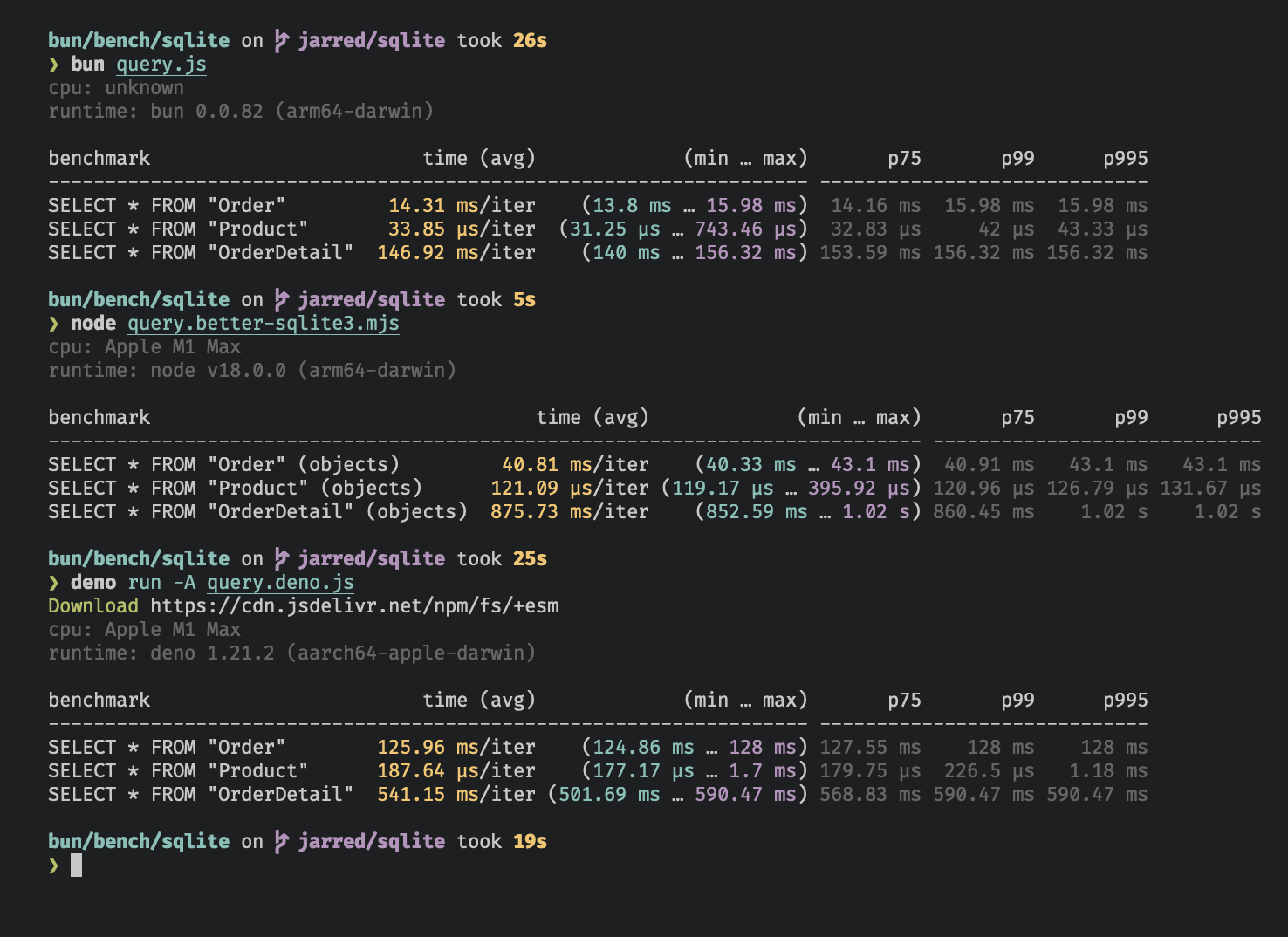
Database#
To open or create a SQLite3 database:
import { Database } from "bun:sqlite";

const db = new Database("mydb.sqlite");
To open an in-memory database:
import { Database } from "bun:sqlite";

// all of these do the same thing
const db = new Database(":memory:");
const db = new Database();
const db = new Database("");
To open in readonly mode:
import { Database } from "bun:sqlite";
const db = new Database("mydb.sqlite", { readonly: true });
Bun creates the database file if it doesn't exist. To throw an error instead, set create: false:
import { Database } from "bun:sqlite";
const db = new Database("mydb.sqlite", { create: false });
Options that contradict each other, such as { readonly: true, create: true }, throw a TypeError.
Strict mode#
By default, bun:sqlite does not throw an error if a parameter is missing: it binds NULL.
To instead throw an error when a parameter is missing, set strict: true on the Database constructor:
import { Database } from "bun:sqlite";

const strict = new Database(":memory:", { strict: true });

// throws error because of the typo:
const query = strict.query("SELECT $message;").all({ messag: "Hello world" });

const notStrict = new Database(":memory:");
// does not throw error:
notStrict.query("SELECT $message;").all({ messag: "Hello world" });
Load via ES module import#
You can also load a database with an import attribute.
import db from "./mydb.sqlite" with { type: "sqlite" };

console.log(db.query("select * from users LIMIT 1").get());
This is equivalent to the following:
import { Database } from "bun:sqlite";
const db = new Database("./mydb.sqlite");
.close(throwOnError: boolean = false)#
To close a database connection but let statements created with .prepare() keep working until they are finalized or garbage collected, call .close(false):
const db = new Database();
// ... do stuff
db.close(false);
The Database owns statements created with .query() and finalizes them immediately either way. Bun releases the underlying connection (and the database file handle) once the last outstanding .prepare() statement is finalized.
To finalize every outstanding statement, release the connection immediately, and throw if SQLite reports an error while closing, call .close(true):
const db = new Database();
// ... do stuff
db.close(true);
Using a statement that close() finalized throws Database has closed. Two exceptions: toString() returns an empty string, and finalize() stays safe to call.
close() is safe to call multiple times but has no effect after the first. One exception: close(true) after
close(false) still finalizes any remaining .prepare() statements. If a Database is garbage collected without
being closed, Bun releases the connection once every statement created from it has also been finalized or collected.
The using statement calls close(true).
using statement#
The using statement closes the database connection when the block exits.
import { Database } from "bun:sqlite";

{
  using db = new Database("mydb.sqlite");
  using query = db.query("select 'Hello world' as message;");
  console.log(query.get());
}
{ message: "Hello world" }.serialize()#
bun:sqlite supports SQLite's built-in mechanism for serializing and deserializing databases to and from memory.
const olddb = new Database("mydb.sqlite");
const contents = olddb.serialize(); // => Uint8Array
const newdb = Database.deserialize(contents);
Internally, .serialize() calls sqlite3_serialize.
.query()#
Use the db.query() method on your Database instance to prepare a SQL query. The result is a Statement instance that is cached on the Database instance. The query is not executed.
const query = db.query(`select "Hello world" as message`);What does "cached" mean?
The caching refers to the compiled prepared statement (the SQL bytecode), not the query results. When you call db.query() with the same SQL string multiple times, Bun returns the same cached Statement object instead of recompiling the SQL. The cache holds the Database.MAX_QUERY_CACHE_SIZE (default 20) most recently used SQL strings. Evicted statements keep working, but a later db.query() with the same string compiles a new one. SQL text over 64 KB is not cached.
It is safe to reuse a cached statement with different parameter values:
const query = db.query("SELECT * FROM users WHERE id = ?");
query.get(1); // ✓ Works
query.get(2); // ✓ Also works - parameters are bound fresh each time
query.get(3); // ✓ Still works
Use .prepare() instead of .query() when you want a fresh Statement instance that isn't cached, for example if you're dynamically generating SQL and don't want to fill the cache with one-off queries.
// compile the prepared statement without caching
const query = db.prepare("SELECT * FROM foo WHERE bar = ?");
WAL mode#
SQLite supports write-ahead log mode (WAL), which dramatically improves performance, especially with many concurrent readers and a single writer. We recommend enabling WAL mode for most applications.
To enable WAL mode, run this pragma query at the beginning of your application:
db.run("PRAGMA journal_mode = WAL;");For faster commits, run PRAGMA synchronous = NORMAL. SQLite then syncs the WAL file at checkpoints instead of at every commit. A power loss can lose the last commits, but it cannot corrupt the database.
What is WAL mode?
In WAL mode, writes to the database go directly to a separate file called the "WAL file" (-wal). SQLite also creates
a shared-memory index file (-shm) for read coordination. SQLite later integrates the WAL file into the main database
file. Think of the WAL file as a buffer for pending writes. Refer to the SQLite
docs for a more detailed overview.
WAL sidecar file cleanup#
When using WAL mode with a file-based database, SQLite creates two sidecar files alongside your database: a write-ahead log (-wal) and a shared-memory index (-shm). Whether SQLite removes these files automatically after .close() depends on your platform:
- macOS: Bun uses the system-provided SQLite, which Apple builds with persistent WAL enabled. The
-waland-shmfiles persist after close. This is not a bug — it is how Apple configured the system SQLite. - Linux and Windows: Bun statically links its own SQLite build, which follows upstream defaults. SQLite typically removes the sidecar files after close when no other connections are open.
To ensure sidecar files are cleaned up on all platforms, disable WAL persistence and run a truncating checkpoint before closing:
import { Database, constants } from "bun:sqlite";

const db = new Database("mydb.sqlite");
db.run("PRAGMA journal_mode = WAL;");

// ... use the database ...

// Disable persistent WAL (needed on macOS)
db.fileControl(constants.SQLITE_FCNTL_PERSIST_WAL, 0);
// Checkpoint and truncate the WAL file
db.run("PRAGMA wal_checkpoint(TRUNCATE);");
db.close();
// Only mydb.sqlite remains — no -wal or -shm filesStatements#
A Statement is a prepared query, which means it's been parsed and compiled into an efficient binary form. It can be executed multiple times.
Create a statement with the .query method on your Database instance.
const query = db.query(`select "Hello world" as message`);Queries can contain parameters. These can be numerical (?1) or named ($param or :param or @param).
const query = db.query(`SELECT ?1, ?2;`);
const query = db.query(`SELECT $param1, $param2;`);
A Statement is one SQL statement: .query() and .prepare() compile the first statement of the string and ignore the rest. To run a string of several statements, use db.run().
You bind values to these parameters when you execute the query. You can execute a Statement with several different methods, each returning the results in a different form.
Binding values#
To bind values to a statement, pass an object to the .all(), .get(), .run(), or .values() method.
const query = db.query(`select $message;`);
query.all({ $message: "Hello world" });
You can bind using positional parameters too:
const query = db.query(`select ?1;`);
query.all("Hello world");
Names with and without the prefix#
The key of a named parameter can include the $, :, or @ prefix or leave it out.
const query = db.query(`select $message;`);

query.all({ $message: "Hello world" });
query.all({ message: "Hello world" });
If the object has both keys, the key with the prefix wins. With strict: true, the key without the prefix wins.
.all()#
Use .all() to run a query and get back the results as an array of objects.
const query = db.query(`select $message;`);
query.all({ $message: "Hello world" });
[{ $message: "Hello world" }]Internally, this calls sqlite3_reset and repeatedly calls sqlite3_step until it returns SQLITE_DONE.
.get()#
Use .get() to run a query and get back the first result as an object.
const query = db.query(`select $message;`);
query.get({ $message: "Hello world" });
{ $message: "Hello world" }Internally, this calls sqlite3_reset followed by one sqlite3_step and another sqlite3_reset: the rows after the first are not read. If the query returns no rows, the result is null.
.run()#
Use .run() to run a query and get back an object with execution metadata. This is useful for schema-modifying queries (such as CREATE TABLE) or bulk write operations.
const query = db.query(`create table foo (bar text);`);
query.run();
{
lastInsertRowid: 0,
changes: 0,
}Internally, this calls sqlite3_reset and repeatedly calls sqlite3_step until it returns SQLITE_DONE. It builds no rows.
The lastInsertRowid property is the ID of the last row inserted into the database. The changes property is the number of rows that the query inserts, updates, or deletes itself. Rows that a trigger or a foreign key action such as ON DELETE CASCADE changes do not count.
.as(Class) - Map query results to a class#
Use .as(Class) to run a query and get back the results as instances of a class. The class's methods, getters, and setters are available on each row.
class Movie {
  title: string;
  year: number;

  get isMarvel() {
    return this.title.includes("Marvel");
  }
}

const query = db.query("SELECT title, year FROM movies").as(Movie);
const movies = query.all();
const first = query.get();

console.log(movies[0].isMarvel);
console.log(first.isMarvel);
true
trueAs a performance optimization, Bun does not call the class constructor or run default initializers, and private fields are not accessible. This is more like Object.create than new: Bun assigns the class's prototype to the object, so its methods, getters, and setters work.
Bun sets the database columns as properties on the class instance.
.iterate() (@@iterator)#
Use .iterate() to run a query and incrementally return results. This is useful for large result sets that you want to process one row at a time without loading all the results into memory.
const query = db.query("SELECT * FROM foo");
for (const row of query.iterate()) {
  console.log(row);
}
You can also use the @@iterator protocol:
const query = db.query("SELECT * FROM foo");
for (const row of query) {
  console.log(row);
}
A Statement has one cursor, and its newest run owns it. If you run the same Statement again inside the loop, the call works and the loop throws at its next row. db.query() returns the same Statement for the same SQL, so use db.prepare() to run the same SQL inside the loop.
.values()#
Use values() to run a query and get back all results as an array of arrays.
const query = db.query(`select $message;`);

query.values({ $message: "Hello world" });
query.values(2);
[ [ "Hello world" ] ]
[ [ 2 ] ]Internally, this calls sqlite3_reset and repeatedly calls sqlite3_step until it returns SQLITE_DONE.
.finalize()#
Use .finalize() to destroy a Statement and free any resources associated with it. Once finalized, a Statement cannot be executed again. Typically, the garbage collector does this for you, but explicit finalization may be useful in performance-sensitive applications.
const query = db.query("SELECT title, year FROM movies");
const movies = query.all();
query.finalize();.toString()#
Calling toString() on a Statement instance prints the expanded SQL query. This is useful for debugging.
import { Database } from "bun:sqlite";

// setup
const query = db.query("SELECT $param;");

console.log(query.toString()); // => "SELECT NULL"

query.run(42);
console.log(query.toString()); // => "SELECT 42"

query.run(365);
console.log(query.toString()); // => "SELECT 365"
Internally, this calls sqlite3_expanded_sql. The parameters are expanded using the most recently bound values.
Parameters#
Queries can contain parameters. These can be numerical (?1) or named ($param or :param or @param). Bind values to these parameters when executing the query:
const query = db.query("SELECT * FROM foo WHERE bar = $bar");
const results = query.all({
  $bar: "bar",
});
[{ "bar": "bar" }]Numbered (positional) parameters work too:
const query = db.query("SELECT ?1, ?2");
const results = query.all("hello", "goodbye");
[
{
"?1": "hello",
"?2": "goodbye",
},
];Integers#
SQLite supports signed 64-bit integers, but JavaScript only supports signed 53-bit integers or arbitrary-precision integers with bigint.
bigint input is supported everywhere, but by default bun:sqlite returns integers as number types. If you need to handle integers larger than 2^53, set the safeIntegers option to true when creating a Database instance. The option also validates that bigint values passed to bun:sqlite do not exceed 64 bits.
bun:sqlite binds a number as INTEGER when Number.isSafeInteger() is true, and as REAL otherwise (also -0).
safeIntegers: true#
When safeIntegers is true, bun:sqlite returns integers as bigint types:
import { Database } from "bun:sqlite";

const db = new Database(":memory:", { safeIntegers: true });
const query = db.query(`SELECT ${BigInt(Number.MAX_SAFE_INTEGER) + 102n} as max_int`);
const result = query.get();

console.log(result.max_int);9007199254741093nWhen safeIntegers is true, bun:sqlite throws a RangeError if a bigint value in a bound parameter does not fit in a signed 64-bit integer:
import { Database } from "bun:sqlite";

const db = new Database(":memory:", { safeIntegers: true });
db.run("CREATE TABLE test (id INTEGER PRIMARY KEY, value INTEGER)");

const query = db.query("INSERT INTO test (value) VALUES ($value)");

try {
  query.run({ $value: BigInt(Number.MAX_SAFE_INTEGER) ** 2n });
} catch (e) {
  console.log(e.message);
}
BigInt value '81129638414606663681390495662081' is out of rangesafeIntegers: false (default)#
When safeIntegers is false, bun:sqlite returns integers as number types and rounds integers beyond 53 bits to the nearest representable number:
import { Database } from "bun:sqlite";

const db = new Database(":memory:", { safeIntegers: false });
const query = db.query(`SELECT ${BigInt(Number.MAX_SAFE_INTEGER) + 102n} as max_int`);
const result = query.get();
console.log(result.max_int);9007199254741092A bigint parameter that does not fit in a signed 64-bit integer keeps its low 64 bits. For example, 2n ** 64n - 1n is stored as -1.
.safeIntegers()#
To change the setting for one Statement, call .safeIntegers(true) or .safeIntegers(false). It returns the statement. Without an argument it returns the current setting.
const query = db.prepare("SELECT 9007199254741093 AS max_int");
query.safeIntegers(true).get(); // => { max_int: 9007199254741093n }
query.safeIntegers(); // => true
db.query() returns the same Statement for the same SQL, so the setting stays for its next caller.
Transactions#
A transaction executes multiple queries atomically: either all of them succeed or none do. Create a transaction with the db.transaction() method:
const insertCat = db.prepare("INSERT INTO cats (name) VALUES ($name)");
const insertCats = db.transaction(cats => {
  for (const cat of cats) insertCat.run(cat);
});
No cats have been inserted yet. db.transaction() returns a new function (insertCats) that wraps the function that executes the queries.
To execute the transaction, call this function. The transaction function passes its arguments through to the wrapped function and returns the wrapped function's return value. The wrapped function also has access to the this context as defined where the transaction is executed.
const insert = db.prepare("INSERT INTO cats (name) VALUES ($name)");
const insertCats = db.transaction(cats => {
  for (const cat of cats) insert.run(cat);
  return cats.length;
});

const count = insertCats([{ $name: "Keanu" }, { $name: "Salem" }, { $name: "Crookshanks" }]);

console.log(`Inserted ${count} cats`);
The driver automatically begins a transaction when you call insertCats and commits it when the wrapped function returns. If an exception is thrown, the driver rolls back the transaction. The exception propagates as usual; the driver does not catch it.
The wrapped function must be synchronous. The driver commits when the function returns, and an async function
returns at its first await. Everything after that await runs outside the transaction, and an error thrown there
does not roll anything back. Do the awaited work first and pass the results in.
If the function returns a promise that is already rejected, as an async function does when it throws before its first await, the driver rolls back the transaction and returns the promise.
Nested transactions — You can call transaction functions from inside other transaction functions. When you do, the inner transaction becomes a savepoint.
View nested transaction example
// setup
import { Database } from "bun:sqlite";
const db = Database.open(":memory:");
db.run("CREATE TABLE expenses (id INTEGER PRIMARY KEY AUTOINCREMENT, note TEXT, dollars INTEGER);");
db.run("CREATE TABLE cats (id INTEGER PRIMARY KEY AUTOINCREMENT, name TEXT UNIQUE, age INTEGER)");
const insertExpense = db.prepare("INSERT INTO expenses (note, dollars) VALUES (?, ?)");
const insert = db.prepare("INSERT INTO cats (name, age) VALUES ($name, $age)");
const insertCats = db.transaction(cats => {
  for (const cat of cats) insert.run(cat);
});

const adopt = db.transaction(cats => {
  insertExpense.run("adoption fees", 20);
  insertCats(cats); // nested transaction
});

adopt([
  { $name: "Joey", $age: 2 },
  { $name: "Sally", $age: 4 },
  { $name: "Junior", $age: 1 },
]);
Transactions also come with deferred, immediate, and exclusive versions.
insertCats(cats); // uses "BEGIN"
insertCats.deferred(cats); // uses "BEGIN DEFERRED"
insertCats.immediate(cats); // uses "BEGIN IMMEDIATE"
insertCats.exclusive(cats); // uses "BEGIN EXCLUSIVE".loadExtension()#
To load a SQLite extension, call .loadExtension(name) on your Database instance:
import { Database } from "bun:sqlite";

const db = new Database();
db.loadExtension("myext");
macOS users By default, macOS ships with Apple's proprietary build of SQLite, which doesn't support extensions. Bun uses it, so sqlite_version() and PRAGMA compile_options report Apple's version and options there. To use extensions, install a vanilla build of SQLite.
brew install sqlite
which sqlite # get path to binary
To point bun:sqlite to the new build, call Database.setCustomSQLite(path) before creating any Database instances. (On other operating systems, SQLite is statically linked: the call does nothing and returns false.) Pass a path to the SQLite .dylib file, not the executable. With recent versions of Homebrew this is something like /opt/homebrew/Cellar/sqlite/<version>/libsqlite3.dylib.
import { Database } from "bun:sqlite";

Database.setCustomSQLite("/path/to/libsqlite.dylib");

const db = new Database();
db.loadExtension("myext");
Workers can repeat setCustomSQLite() with the exact same path. Bun rejects a different path after SQLite loads.
.fileControl(cmd: number, value?: number | TypedArray | null)#
To use the advanced sqlite3_file_control API, call .fileControl(cmd, value) on your Database instance. See WAL sidecar file cleanup for a practical example.
import { Database, constants } from "bun:sqlite";

const db = new Database("mydb.sqlite");
// Ensure WAL mode is NOT persistent
// this prevents WAL files from lingering after the database is closed
db.fileControl(constants.SQLITE_FCNTL_PERSIST_WAL, 0);
SQLite reads the input of cmd from value and writes its output there. value can be:
number: passed as a 32-bit integer. What SQLite writes back is not returned.TypedArrayorDataViewof at least 8 bytes: passed as is. Use it to read what SQLite writes back.undefinedornull: for acmdthat takes no argument, such asSQLITE_FCNTL_RESET_CACHE. Acmdthat reads its argument reads-1.
The return value is the SQLite status code: 0 is SQLITE_OK, 12 is SQLITE_NOTFOUND (the VFS does not implement cmd, or the database is in memory).
User-defined functions#
.function()#
db.function(name, fn) defines a SQL function that calls a JavaScript function. It returns the Database.
import { Database } from "bun:sqlite";

const db = new Database(":memory:");
db.function("add2", (a, b) => a + b);

db.query("SELECT add2(12, 4) AS sum").get();
{ sum: 16 }The SQL function takes as many arguments as fn has parameters (fn.length). Functions with the same name and different numbers of arguments exist side by side. A function with the same name and the same number of arguments replaces the earlier one. That includes the functions that are built into SQLite.
Pass options as the second argument:
db.function("count_args", { varargs: true }, (...args) => args.length);

db.query("SELECT count_args(1, 2, 3) AS n").get(); // { n: 3 }| Option | Default | Description |
|---|---|---|
varargs | false | The SQL function takes any number of arguments. |
deterministic | false | You promise that the same arguments give the same result. SQLite then allows the function in an index and in a generated column. |
directOnly | false | Only SQL that you pass to the Database can call the function. A view or a trigger cannot. Use it for a function with side effects when the database file comes from somebody else. |
safeIntegers | the Database's option | An INTEGER argument is a bigint instead of a number, and a bigint result outside 64 bits throws. |
Values. An argument has the type that a column of a result row has, so a BLOB is a Uint8Array. Bun stores the return value like a bound parameter, and undefined is NULL. Any other return value, such as an object or a promise, makes the query throw a TypeError.
Errors. What the function throws ends the query. The call that ran the query throws the same value.
db.function("fail", () => {
  throw new RangeError("not today");
});

db.query("SELECT fail()").get(); // throws RangeError: not today
No queries inside a function. While the function runs, SQLite is in the middle of a statement. Every other use of the same Database and of its statements throws TypeError: This database connection is busy executing a query. A second Database works.
.aggregate()#
db.aggregate(name, options) defines an aggregate function such as sum(). Bun calls step for each row of a group with the accumulator and the arguments. What step returns is the new accumulator.
db.run("CREATE TABLE expenses (category TEXT, dollars INTEGER)");
db.aggregate("add_all", {
  start: 0,
  step: (total, value) => total + value,
});

db.run("INSERT INTO expenses VALUES ('rent', 80), ('food', 7), ('food', 5)");
db.query("SELECT category, add_all(dollars) AS total FROM expenses GROUP BY category").all();
[ { category: "food", total: 12 }, { category: "rent", total: 80 } ]| Option | Description |
|---|---|
start | The accumulator that each group starts with. Defaults to null. Bun calls a function once for each group. Use one for an array or an object, so that groups do not share it. |
step | Required. Called with the accumulator and the arguments. When it returns undefined, the accumulator stays. |
result | Makes the result from the accumulator. Without it, the accumulator is the result. |
inverse | Undoes step for a row that leaves the window. It makes the function usable as a window function. |
.aggregate() also takes the four options of .function(). The SQL function takes as many arguments as step has parameters after the accumulator.
db.aggregate("list", {
  start: () => [],
  step: (items, value) => {
    items.push(value);
  },
  inverse: items => {
    items.shift();
  },
  result: items => items.join("+"),
});

db.query("SELECT list(dollars) OVER (ROWS 1 PRECEDING) AS pair FROM expenses").values();
[ [ "80" ], [ "80+7" ], [ "7+5" ] ]For a window function, Bun calls result once for each row. result must leave the accumulator as it is.
Update hooks#
Set db.onInsert, db.onUpdate or db.onDelete to a function. SQLite calls it for each row that a statement of this Database inserts, updates or deletes.
import { Database } from "bun:sqlite";

const db = new Database(":memory:");
db.run("CREATE TABLE cats (id INTEGER PRIMARY KEY, name TEXT)");
db.onInsert = (db, tableName, rowid) => {
  console.log(`inserted ${tableName} ${rowid}`);
};

db.run("INSERT INTO cats (name) VALUES ('Salem'), ('Keanu')");
inserted cats 1
inserted cats 2The arguments are:
database: theDatabase. It is alsothis.tableName: the table of the row.rowid: the rowid of the row, which is also the value of anINTEGER PRIMARY KEYcolumn. After an update that changes the rowid, it is the new one. It is abigintif theDatabasehassafeIntegers: true.schemaName:"main","temp", or the name of an attached database.
To remove a hook, set it to null.
The three properties are one sqlite3_update_hook. Its rules apply:
- SQLite calls the hook while the statement runs, before the transaction commits. A change that you roll back later has been reported.
- The hook cannot use its
Database. Every call on theDatabaseand on its statements throwsTypeError: This database connection is busy executing a query. To read the new row, wait until the statement has ended, for example withqueueMicrotask(). - The hook cannot stop the statement. Bun reports what it throws as an uncaught exception, and the statement goes on.
- SQLite does not report changes to a
WITHOUT ROWIDtable, a row thatINSERT OR REPLACEremoves, and changes by another connection or process. ADELETEwithoutWHEREon a table without triggers empties the table in one step, and SQLite does not report its rows. - For a virtual table such as FTS5, SQLite reports the rows of the tables that store its data (
docs_content,docs_data), not the rows of the virtual table.
Reference#
class Database {
  constructor(
    filename: string,
    options?:
      | number
      | {
          readonly?: boolean;
          create?: boolean;
          readwrite?: boolean;
          safeIntegers?: boolean;
          strict?: boolean;
        },
  );

  query<ReturnType, ParamsType>(sql: string): Statement<ReturnType, ParamsType>;
  prepare<ReturnType, ParamsType>(sql: string, params?: ParamsType): Statement<ReturnType, ParamsType>;
  run(sql: string, params?: SQLQueryBindings): { lastInsertRowid: number | bigint; changes: number };
  exec = this.run;
  clearQueryCache(): void;

  transaction(insideTransaction: (...args: any) => void): CallableFunction & {
    deferred: (...args: any) => void;
    immediate: (...args: any) => void;
    exclusive: (...args: any) => void;
  };

  function(name: string, fn: (...args: any[]) => SQLFunctionResult): this;
  function(name: string, options: FunctionOptions, fn: (...args: any[]) => SQLFunctionResult): this;
  aggregate<T>(
    name: string,
    options: FunctionOptions & {
      start?: T | (() => T);
      step: (accumulator: T, ...args: any[]) => T | void;
      inverse?: (accumulator: T, ...args: any[]) => T | void;
      result?: (accumulator: T) => SQLFunctionResult;
    },
  ): this;

  onInsert: UpdateHook | null;
  onUpdate: UpdateHook | null;
  onDelete: UpdateHook | null;

  readonly inTransaction: boolean;
  readonly filename: string;

  serialize(name?: string): Buffer;
  static deserialize(
    serialized: TypedArray | ArrayBufferLike,
    options?: boolean | { readonly?: boolean; strict?: boolean; safeIntegers?: boolean },
  ): Database;

  loadExtension(extension: string, entryPoint?: string): void;
  static setCustomSQLite(path: string): boolean;
  fileControl(op: number, arg?: ArrayBufferView | number | null): number;
  fileControl(zDbName: string, op: number, arg?: ArrayBufferView | number | null): number;

  close(throwOnError?: boolean): void;
}

class Statement<ReturnType, ParamsType> {
  all(...params: ParamsType[]): ReturnType[];
  get(...params: ParamsType[]): ReturnType | null;
  run(...params: ParamsType[]): {
    lastInsertRowid: number | bigint;
    changes: number;
  };
  values(...params: ParamsType[]): unknown[][];
  raw(...params: ParamsType[]): (Uint8Array | null)[][];
  iterate(...params: ParamsType[]): IterableIterator<ReturnType>;
  [Symbol.iterator](): IterableIterator<ReturnType>;

  safeIntegers(enabled: boolean): this; // return integers as bigint
  safeIntegers(): boolean;

  finalize(): void; // destroy statement and clean up resources
  toString(): string; // serialize to SQL

  columnNames: string[]; // the column names of the result set
  columnTypes: string[]; // types based on actual values in first row (runs the statement; read-only statements only)
  declaredTypes: (string | null)[]; // types from CREATE TABLE schema
  paramsCount: number; // the number of parameters expected by the statement
  reader: boolean; // whether the statement returns rows
  readonly: boolean; // whether the statement makes no direct change to the database
  isFinalized: boolean;
  native: any; // the native object representing the statement

  as<T>(Class: new (...args: any[]) => T): Statement<T, ParamsType>;
}

type SQLQueryBindings =
  | string
  | bigint
  | TypedArray
  | ArrayBufferLike
  | number
  | boolean
  | null
  | Record<string, string | bigint | TypedArray | ArrayBufferLike | number | boolean | null>;

type SQLFunctionResult = string | bigint | TypedArray | ArrayBufferLike | number | boolean | null | undefined | void;

type FunctionOptions = {
  varargs?: boolean;
  deterministic?: boolean;
  directOnly?: boolean;
  safeIntegers?: boolean;
};

type UpdateHook = (
  this: Database,
  database: Database,
  tableName: string,
  rowid: number | bigint,
  schemaName: string,
) => void;A library that accepts a database from several runtimes can tell them apart: db[Symbol.for("sqlite-type")] is "bun:sqlite" for a Database and "node:sqlite" for a DatabaseSync.
Datatypes#
| JavaScript type | SQLite type |
|---|---|
string | TEXT |
number | INTEGER or REAL |
boolean | INTEGER (1 or 0) |
Uint8Array | BLOB |
Buffer | BLOB |
ArrayBuffer | BLOB |
bigint | INTEGER |
null | NULL |